S&P affirms Jamaica with ‘BB/B’ Rating with stable outlook

/ Our Today
administrator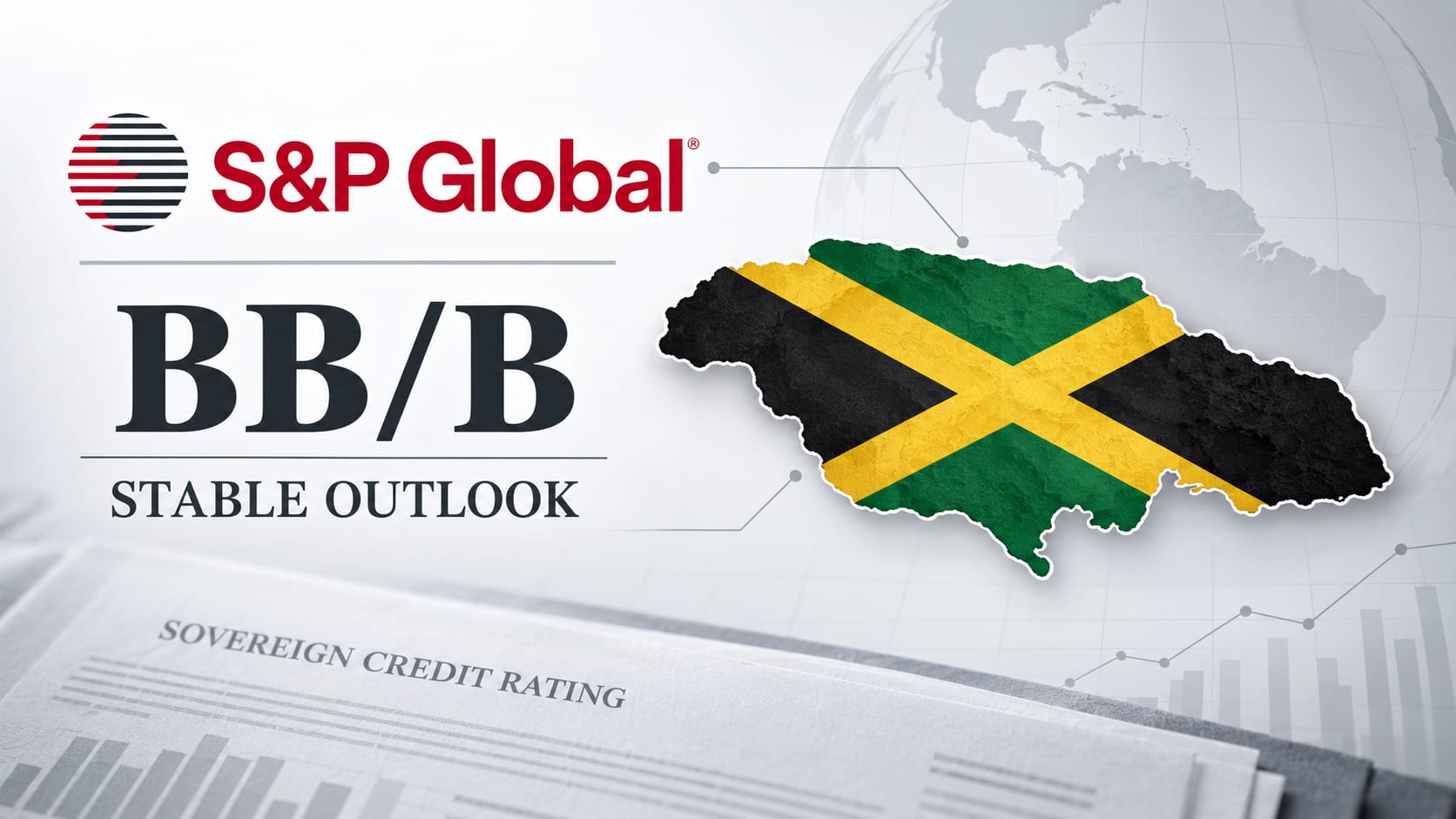
Outlook assumes government will prudently manage recovery and rebuilding
Durrant Pate/Contributor
International credit ratings agency, S&P Global has affirmed its ‘BB’ long-term and ‘B’ short-term foreign and local currency sovereign credit ratings on Jamaica.
S&P’s transfer and convertibility assessment remains ‘BB+ ‘, with its outlook remaining stable for Jamaica, expecting the incumbent administration will adhere to fiscal consolidation despite larger fiscal deficits in the near term to fund rebuilding post Hurricane Melissa. It acknowledges that the fiscal position will temporarily weaken, as spending needs increase in response to Melissa, a Category 5 hurricane that struck on October 28 last year, as the strongest to directly hit Jamaica.
The assessment is that Jamaica’s debt burden will rise before continuing its long-term trajectory of decline. In addition, the economy will contract in 2026 and then rebound

Rationale for credit rating
Real Gross Domestic Product (GDP) is set to contract 1.1% in 2026 following the significant damage caused by the Melissa, which led to major infrastructure damage (especially in the southern and western part of the island), together with the destruction of important assets in the main sectors of the economy (particularly agriculture and tourism).
The first half of 2026 recorded 20% fewer tourist passengers compared with the same period in 2025. The agricultural sector has also been damaged by both drought conditions from El Niño and the lingering effects of the hurricane.
The economic contraction caused by Hurricane Melissa is the latest of a series of external shocks that have hit the Jamaican economy. These have led to anaemic average growth over the past few decades and these events will continue to hamper growth.
It has been assessed that the impact of the contraction will lead to GDP per capita of about US$8,600 in 2026. S&P reports that Jamaica’s 10-year weighted-average growth will be 1.3%, which remains below that of sovereigns in the same GDP category.
Also, the country’s creditworthiness is supported by the strong commitment to sustainable public finances across political parties and many economic sectors, enshrined in the debt target outlined in its fiscal responsibility law.
“This commitment follows a record of adherence to large government primary surpluses and reducing debt. Jamaica is the only one of the 141 sovereigns rated by S&P Global Ratings that has achieved an annual primary fiscal surplus above 3% of GDP for the past 10 years notwithstanding significant external shocks like the pandemic and major hurricanes,” the rating agency declares in its latest assessment.

Downside and upside scenarios
In its downside scenario, S&P says, “we could lower our ratings on Jamaica during the next 12 months if we believe changing fiscal policy and a weaker commitment to fiscal sustainability over the long term would lead to materially larger, sustained deficits over the forecast horizon that we do not expect to improve, and if we expect debt to continue to rise. We could also lower the ratings if the economy fails to recover over the long term as expected, weakening the country’s external position.”
On the upside scenario, S&P reports, “we could raise the ratings over the same period if Jamaica’s debt burden improves with a sustained and material decrease in its interest-to-revenues ratio and a quicker recovery in the government’s fiscal performance. We could also raise the ratings if the economic recovery is substantially faster and stronger than we expect, leading to higher longer-term economic growth that converges with that of peers at a similar level of economic development.
S&P observes that while the government has introduced reforms over the past decade to support diversification and growth, these factors constrain the economy by the
- High security costs (although they have recently improved);
- Perceived corruption;
- Low productivity;
- Low business competitiveness; and
- Vulnerability to external shocks, including weather-related ones.
S&P acknowledges that while the government has yet to legislate a timeline to achieve its legislatively enshrined debt-to-GDP ceiling of 60%, it believes there is strong commitment from all parts of government to resume this path following its recovery stage and return to a 60% ratio of debt to GDP by fiscal 2030.
In addition, the government has strengthened other institutions over the past several years, including solidifying the Bank of Jamaica, giving it legal independence and an official inflation-targeting mandate, and lowering violent crime.





Comments