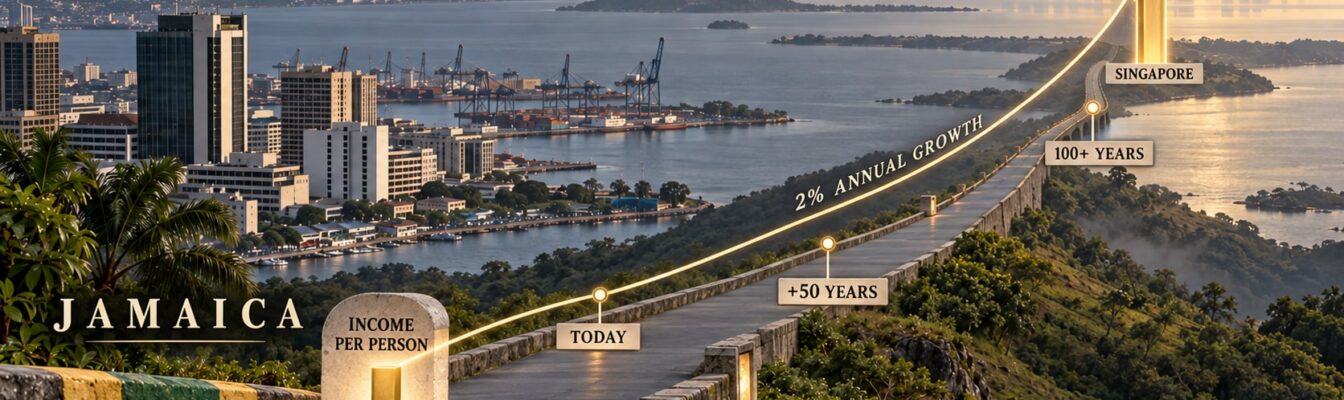
At 2 per cent a year, Jamaica would need more than a century to reach Singapore’s income level

/ Our Today
administrator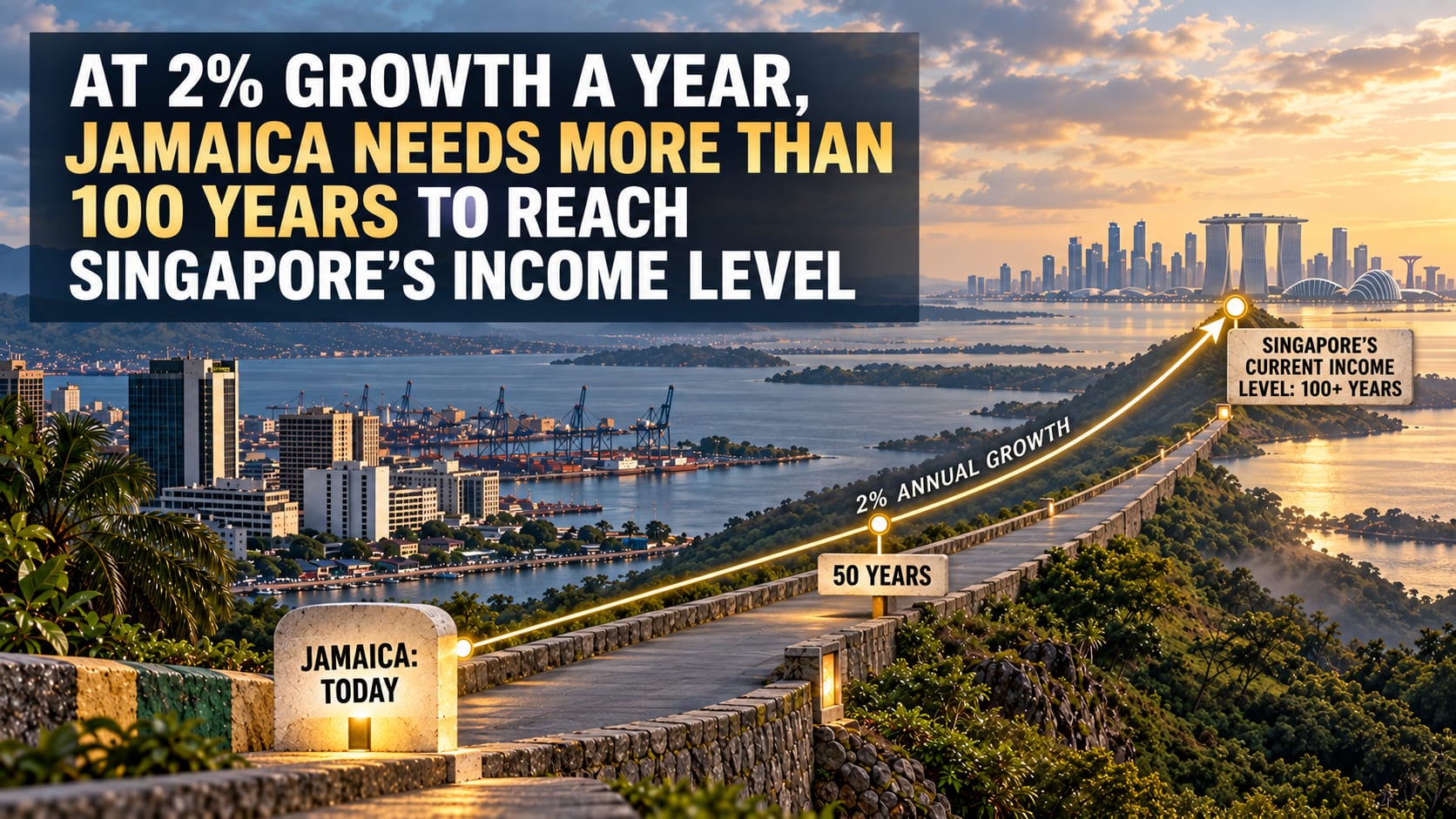
Jamaica would need real per capita growth of about 5.2 per cent a year for 50 straight years to match Singapore’s current income, according to Our Today’s calculations using World Bank data.
That is more than two and a half times the top of the Bank of Jamaica’s medium-term forecast.
The figures test a claim Prime Minister Andrew Holness has made repeatedly, most recently at the Caribbean Infrastructure Forum in Miami on September 15, that Jamaica will become the Singapore of the Caribbean. Before the September 2025 election, he framed the ambition in terms of growth and performance, saying the government would now accelerate growth after stabilising the economy.
The starting gap
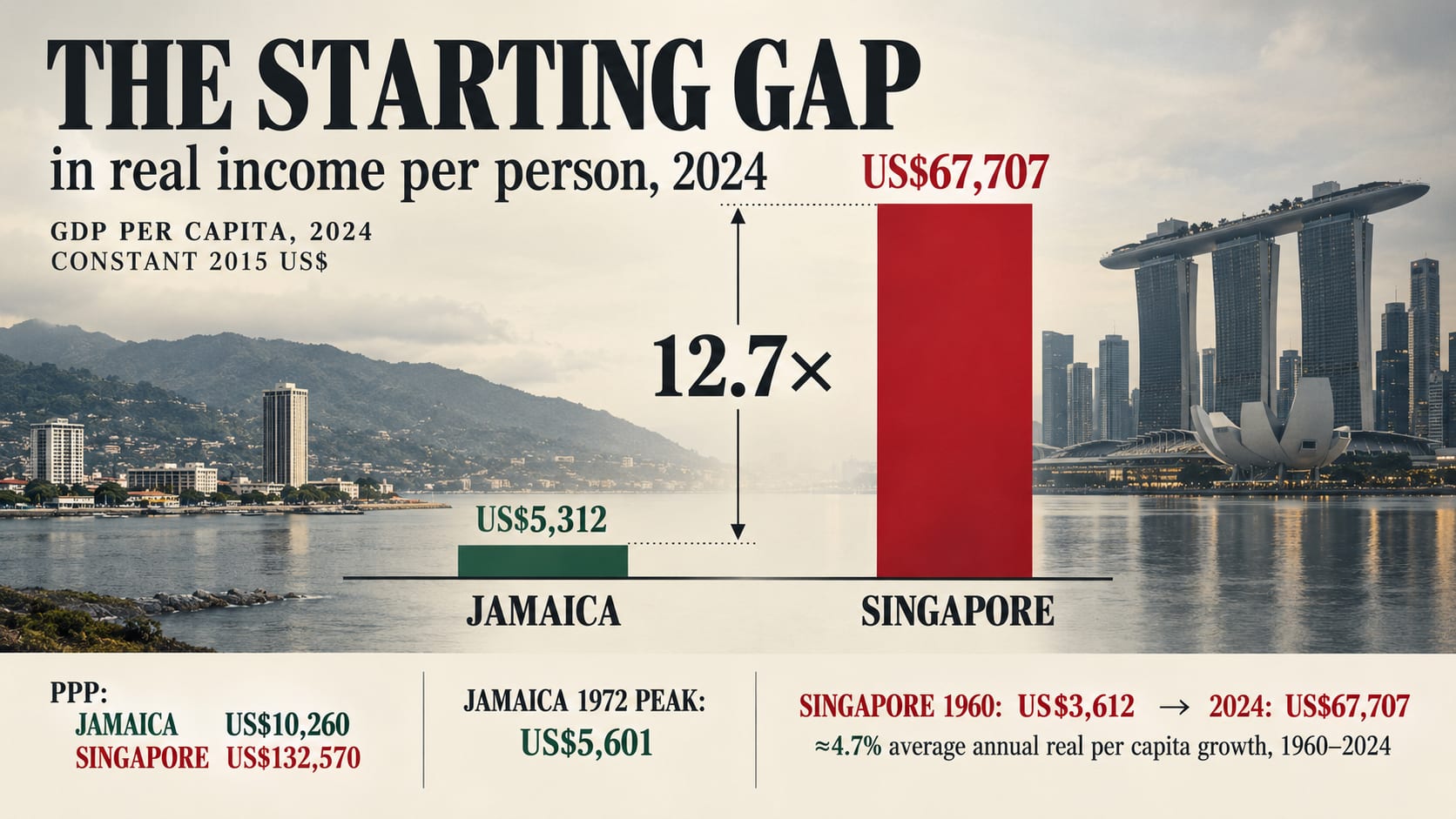
In constant 2015 US dollars, Jamaica’s GDP per capita was US$5,312 in 2024, according to World Bank data compiled by Trading Economics. Singapore’s was US$67,707, about 12.7 times higher. On a purchasing power parity basis, the ratio is similar: US$10,260 for Jamaica against US$132,570 for Singapore.
Jamaica’s 2024 figure sits below its 1972 peak of US$5,601, meaning real income per person has edged down slightly over five decades. Singapore started at US$3,612 in 1960, which works out to average real per capita growth of roughly 4.7 per cent a year over 64 years [Our Today calculation].
What the forecast implies
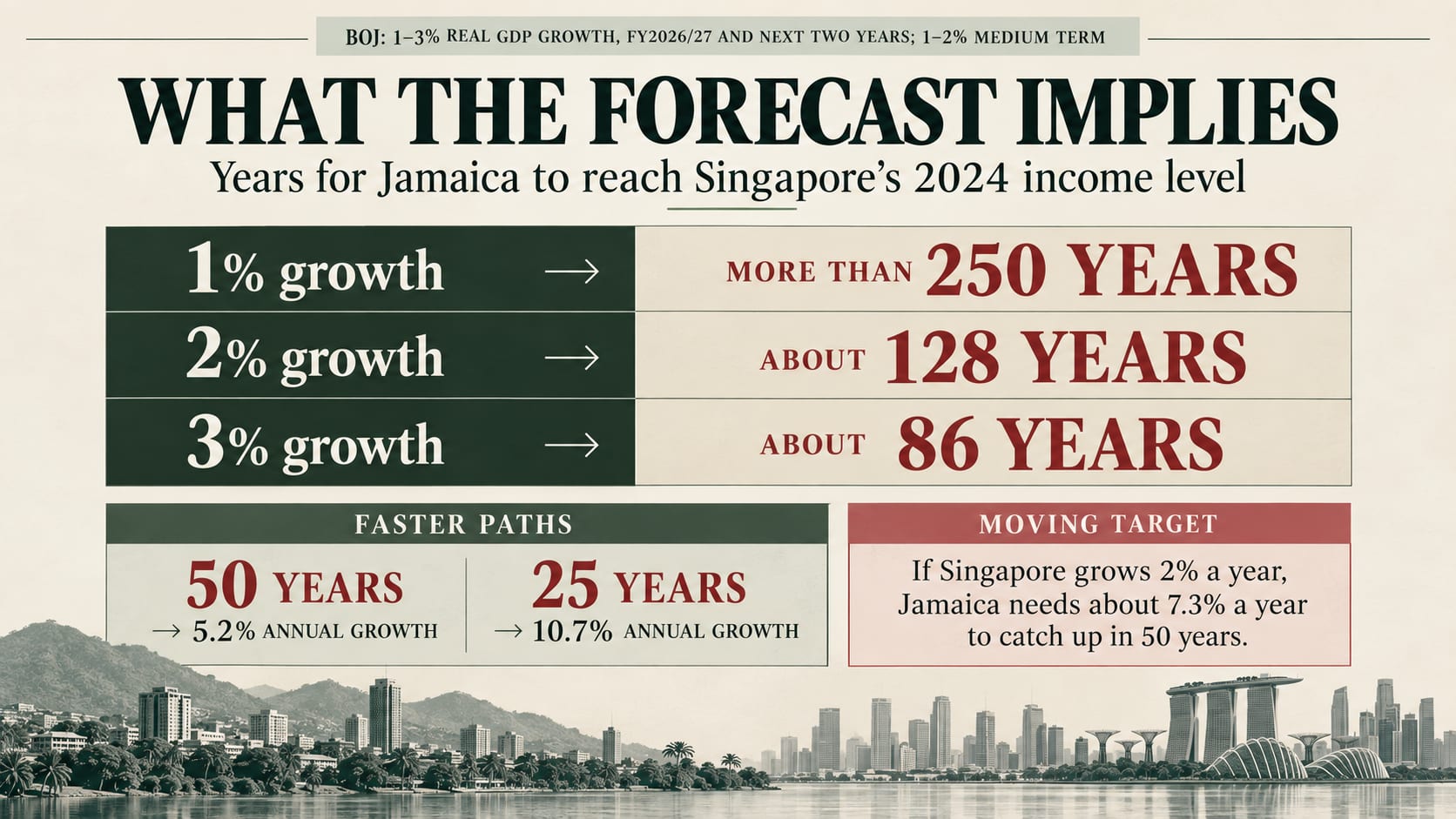
The Bank of Jamaica projects real GDP growth of 1 to 3 per cent for FY2026/27 and the following two years, then 1 to 2 per cent over the medium term. With a fertility rate of 1.4 and an ageing population, overall GDP growth translates almost directly into per capita growth.
On that basis, sustained 2 per cent growth would take about 128 years to reach Singapore’s 2024 income level. At 3 per cent, the timeline is about 86 years. At 1 per cent, it exceeds 250 years.
Faster paths require exceptional rates. Closing the gap in 50 years means 5.2 per cent a year. Doing it in 25 years means roughly 10.7 per cent a year
Singapore is also a moving target. If its per capita income grows 2 per cent a year. Jamaica would need about 7.3 per cent annually for 50 years to catch up.
Recent shocks widen the gap
These calculations use pre-hurricane 2024 data. Output fell 7.3 per cent in the last quarter of 2025 from the previous quarter after Hurricane Melissa, and the final FY2025/26 contraction is not yet settled.. Coface expects reconstruction spending to drive a return to growth in 2027.
The productivity constraint
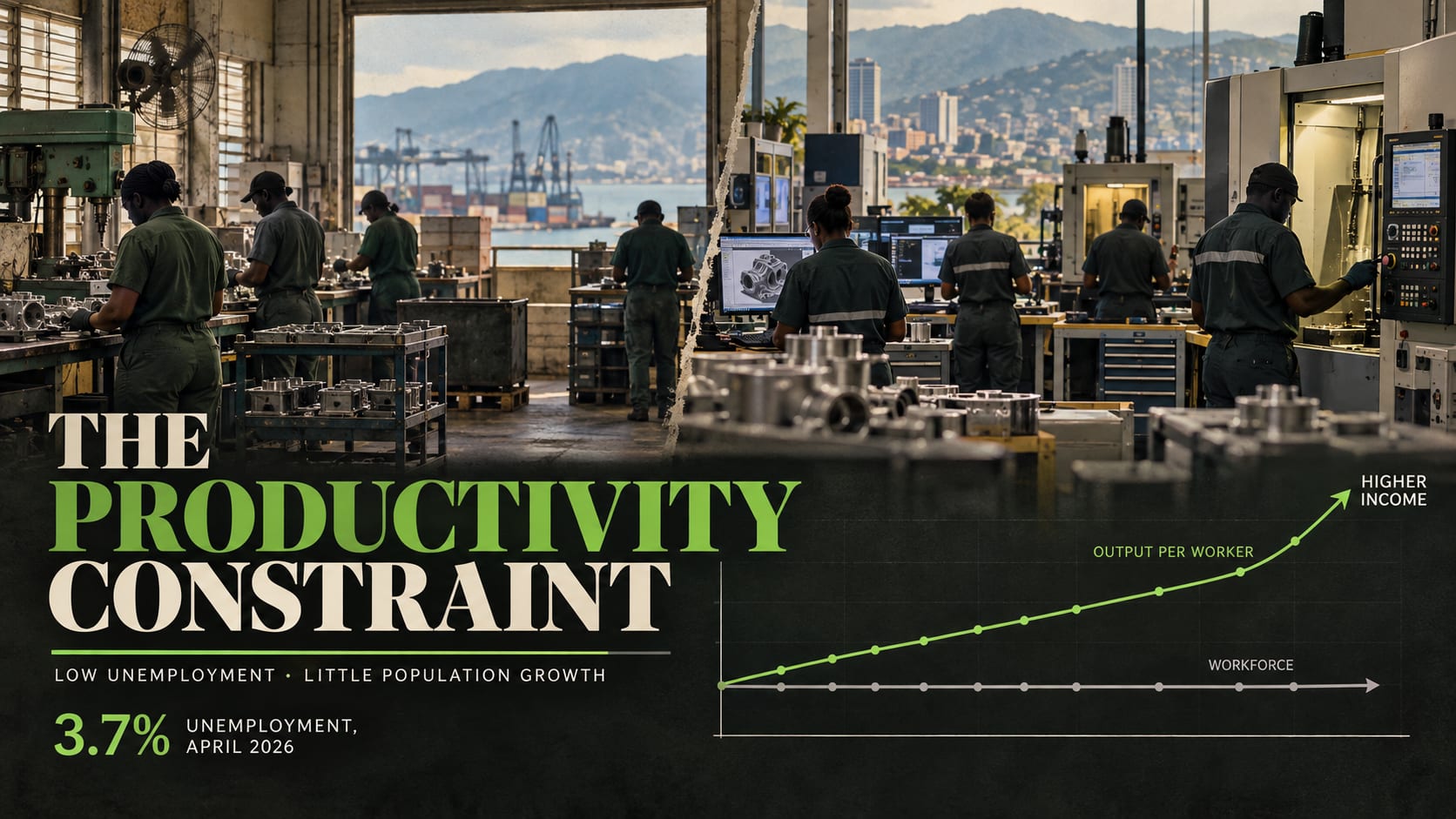
Holness has identified productivity as the central issue, noting in June that Jamaica ranks third lowest in the region and calling productivity the heart of growth. Unemployment stood at 3.7 per cent in April 2026, and with population growth near zero, there is limited room to lift output by adding workers. Sustained growth above 5 per cent would therefore depend largely on output per worker.
Jamaica has a problem with productivity, and this pertains to both the private and public sector. Too many Jamaicans are simply happy to be in a job and pick up a paycheck. Many are not concerned about the place where they work generating more revenue, or that if they all work harder, there will be greater rewards. It is a mindset that has to change if Jamaica is to come anywhere close to Singapore.
Last year, speaking at the Amber Group’s 10th Anniversary Gala, Prime Minister Andrew Holness identified Jamaica’s productivity problem.
At the AC Hotel in Kingston, he said: “ We are very proud to say we have 3.3 per cent unemployment, but that is just the base that solves step one of the problem. Step two is the increase of productivity and the level of tasks and undertakings that our people perform. That’s how we move from employment to empowerment, upskilling to higher-level jobs and higher pay.
“If our economy is to grow, the services that we provide must either expand or improve in quantity and sophistication. That is why productivity and skills development are not optional; they are fundamental to building a modern competitive Jamaica.
“For decades we have hidden from the issue of productivity. If we are to thrive as a country that cannot rely on natural resources, we must build a labour force capable of performance, more complex, higher-value work that earns higher incomes and drives innovation.”
The government has not published a target growth rate or timeline attached to the Singapore comparison






Comments