BOJ Governor admits devaluation of Jamaican dollar still too high

/ Our Today
administrator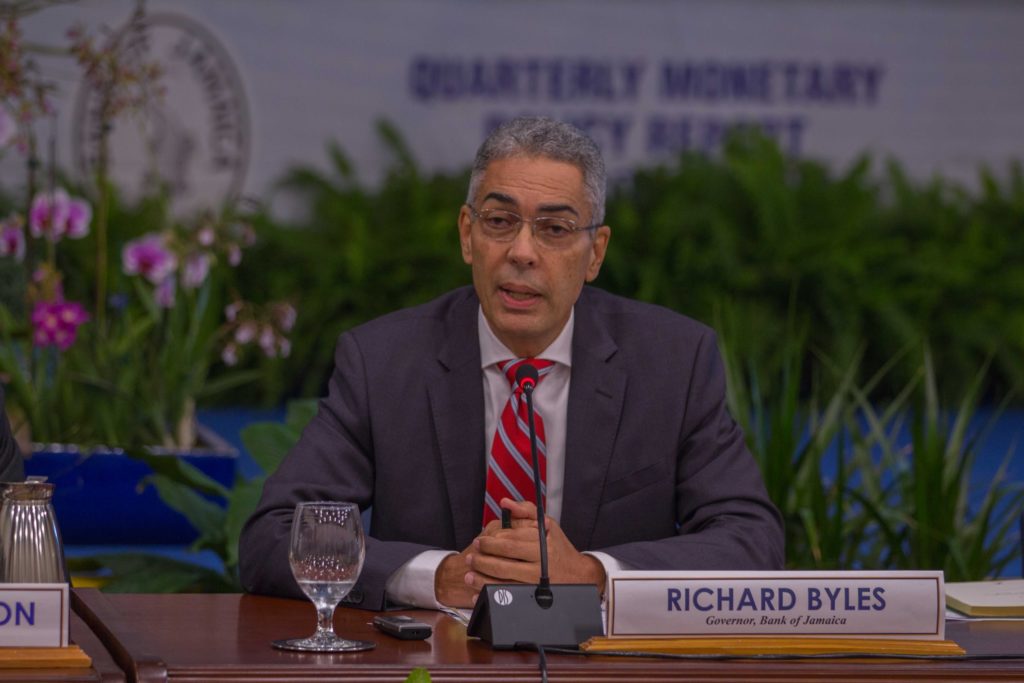
Bank of Jamaica (BOJ) Governor, Richard Byles is admitting that the pace of devaluation of the Jamaica dollar is still too high for comfort.
In relation to the foreign exchange (FX) market, Byles advised that, “notwithstanding recent movements in the exchange rate, the pace of depreciation is better than we experienced last year.”
Addressing his recent quarterly briefing last Friday, Byles reported that while the movement is still too high for comfort, it compares favourably with the 12.0 per cent depreciation that occurred over the same period of last year.
On August 16, the exchange rate was J$155.08 to US$1, representing a depreciation of 8.7 per cent for the calendar year to date. Byles pointed out that even in this period of economic uncertainty, foreign currency flows have remained strong and businesses or individuals in Jamaica who require foreign exchange have been able to access it.
For the calendar year to August 16, 2021, daily purchases of US dollars by authorised dealers and cambios averaged US$36.2 million, higher than the average of US$29.9 million recorded over the same period last year. At the same time, daily sales to end-users excluding sales to BOJ averaged US$33.2 million since the start of 2021, well above the average of US$26.6 million a year earlier.
For the calendar year to August 16, the BOJ purchased US$1.1 billion from the market via market surrenders, which pays Government of Jamaica debt servicing and facilitates some energy imports.
BOJ’s intervention in FX market
The BOJ has also continued to intervene in the market when temporary shortfalls have been identified. Total B-FXITT flash sale operations and direct sales to the energy sector for the calendar year to August 16 has amounted to US$484.0 million.
At August 16, 2021, Jamaica’s gross international reserves remain healthy, amounting to US$4.2 billion, which is the equivalent of 128 per cent of the level considered adequate. Looking forward over the next two years, the BOJ projects that the current account deficit of the balance of payments will remain at sustainable levels of about 2 to 4 per cent of Gross Domestic Product (GDP).
This reflects the earlier mentioned expectations for a recovery in tourist arrivals and spending. While supported by the favourable outlook for the current account, the BOJ’s outlook for the gross reserves also anticipates the receipt of an International Monetary Fund allocation of Special Drawing Rights by end-September 2021.
This allocation will boost the reserves by the equivalent of US$520 million (approximately). The BOJ Governor emphasised that by any standard, Jamaica’s foreign currency liquidity position will be more than sufficient to support the economy, if needed, in the foreseeable future.

Positive economy indicators
Byles reported that the outlook for the Jamaican economy is positive with the most recent real GDP data published by STATIN showing a slowing down in economic contraction. Domestic economic activity contracted by 6.7 per cent for the March 2021 quarter, compared with the contraction of 8.3 per cent in the December 2020 quarter.
This outturn represents another in a series of improvements, relative to the previous quarter. The labour market also continues on a path of improvement.
The latest data released by STATIN indicated an unemployment rate of 9.0 per cent at April 2021, down by 3.6 percentage points compared to the rate at July 2020, when the economy was experiencing the early stages of the pandemic. The BOJ Governor explained that the decline in the unemployment rate reflected a reduction of 42 300 in the number of unemployed persons as well as a growth of 42 100 in the labour force.
He concluded by indicating that real GDP growth for FY2021/22 is now likely to be higher than we earlier anticipated, given the impact of stronger than expected improvements in the economies of Jamaica’s main trading partners. The BOJ is currently projecting that real GDP growth for this fiscal year will be in the range of 7 to 10 per cent, up from the 5 to 8 per cent indicated in May 2021.




Comments