
Damion Crawford | Majoring in the Minor: From Cane Fields to Coopers Pen

/ Our Today
administrator
The almost exclusive focus on Coopers Pen as an independent occurrence unfortunately puts the nation in danger of majoring in the minor. Hidden in the political blame game, jokes, and ridicule is a more consequential question. This question is not simply whether the approximately 600 occupants of Coopers Pen possessed legal title, but instead how, almost two centuries after emancipation, approximately 700,000 Jamaicans are still considered “squatters”, and further, why the vast majority of the descendants of Afro-Jamaicans remain without legal title to land to this very day. Coopers Pen therefore represents less than 0.1 per cent of a much larger national land-access problem.
Marcus Garvey warned that “A people without the knowledge of their past history, origin and culture is like a tree without roots.” To understand how we arrived here, we therefore must understand our history.
My argument is straightforward: Afro-Jamaican landlessness is not simply the product of poverty, lawlessness or individual failure. It has historical roots in a colonial system in which control over land was used to maintain control over labour.
After emancipation, limiting access to land became central to maintaining a cheap and dependable plantation labour force. The historical record is clear that large proprietors sought to restrict Afro-Jamaicans’ access to land and to maintain a “landless proletariat” rather than an independent peasantry because of concerns that land independence would reduce the supply of plantation labour.

The laws and policies that followed therefore formed part of an oppressive architecture that denied access to land, restricted economic independence and maintained the plantation’s access to cheap labour. I beg your indulgence to briefly recount this history.
1655–1833: The Establishment of the Plantation Land System
Following the British conquest of Jamaica in 1655, large areas of land were distributed by the Crown and consolidated into the plantation economy. Enslaved Africans were excluded from ownership and the accumulation of property, as they themselves were considered property. This was the foundation upon which the post-emancipation land system was built.
1833: The Real Property Limitation Act and the Abolition of Slavery
On 24th July 1833, the British Parliament enacted the Real Property Limitation Act, concretising the extraordinary 60-year period applicable to claims involving Crown land. Just 35 days later, the same Parliament enacted the Slavery Abolition Act. The significance is striking. The 60-year period exceeded the average life expectancy of an Afro-Jamaican at the time, which was less than 40 years.
The abolition settlement also preserved the underlying imbalance in property ownership. Jamaican slave owners received more than £10 million in compensation, while the enslaved received nothing. The planters also retained ownership of their land as their productive asset. The newly freed population received freedom, but neither land nor compensation.
1838: Full Emancipation and the Free Village Movement
With full emancipation in 1838, formerly enslaved Jamaicans increasingly sought land outside the plantations. Through the Free Village Movement, land was purchased mainly by churches and subdivided so that freed Jamaicans could establish homes and farms independent of the estates. These Free Villages demonstrated that access to land meant access to real economic freedom.
1839: The Vagrancy Act
The Vagrancy Act of 1839 effectively criminalised aspects of landlessness by making persons without recognised employment or means of support vulnerable to arrest. For a person without access to land on which to live and produce, this increased dependence upon wage labour.
The Vagrancy Act therefore operated within a wider system in which restricted access to land and the regulation of labour reinforced each other.
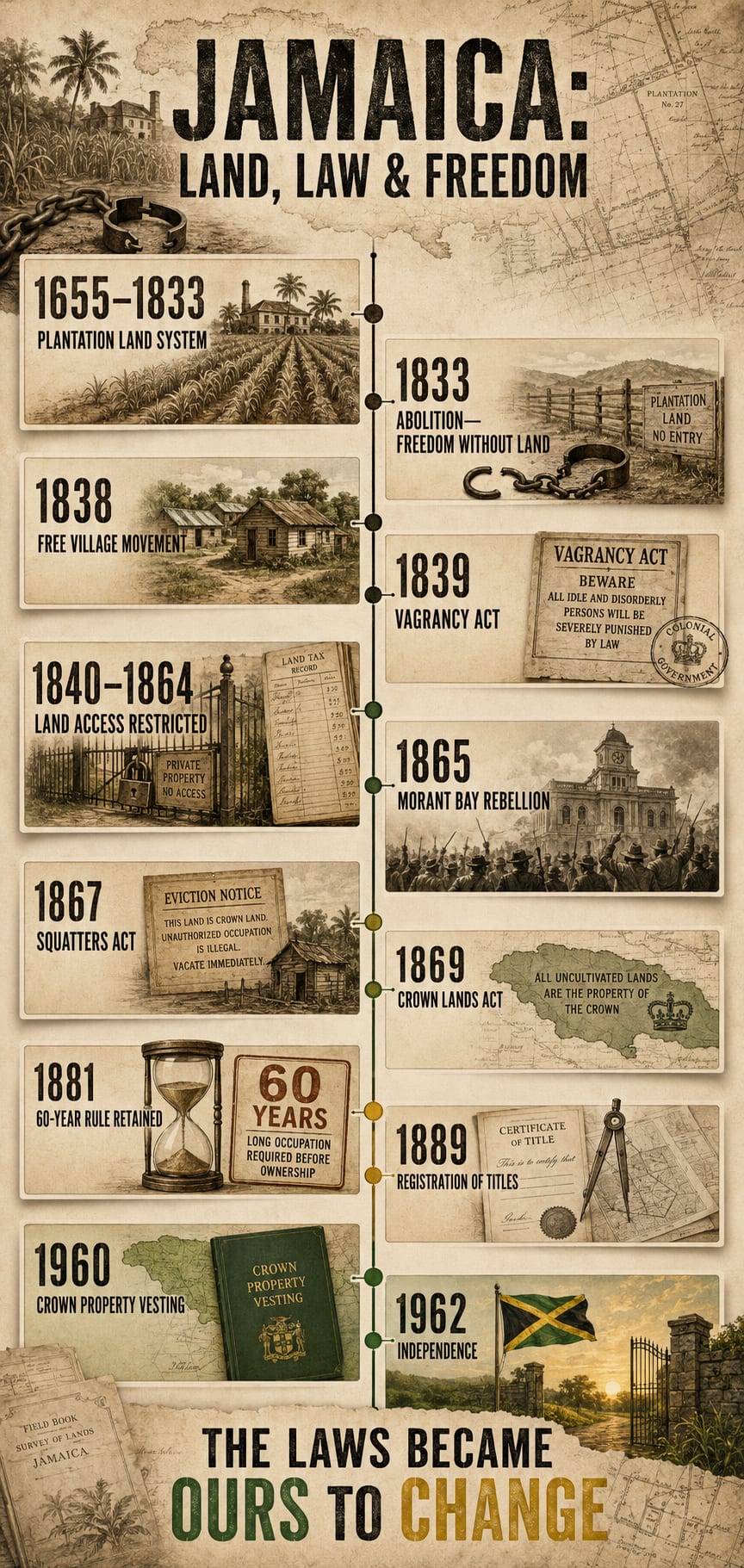
1840–1864: Continued Restrictions on Land Access to Preserve Plantation Labour
During the decades after emancipation, the plantocracy continued to resist widespread access by now freed Afro-Jamaicans to land. Large proprietors restricted sales, demanded high prices for small plots and used their political influence to restrict access to Crown lands. The taxation system also placed disproportionate burdens on small plots compared with large estates.
The intent and economic logic were clear: limiting access to land helped preserve access to cheap plantation labour. These policies were not simply about maintaining order; they were about maintaining an economic system.
1865: The Morant Bay Rebellion
By 1865, land access, poverty, taxation, political exclusion and unequal access to justice had contributed to a profound crisis. Poor Jamaicans petitioned the Crown for relief, including greater access to land. The response, remembered as the Queen’s Advice, emphasised industry and wage labour rather than substantially expanding access to land.
Central to the conditions surrounding the Morant Bay Rebellion was the inaccessibility of land for shelter, farming and economic independence.
1867: The District Courts Land Law (The Squatters Act)
Two years later came the District Courts Land Law of 1867, commonly referred to as the Squatters Act.
The law provided a more efficient legal mechanism through which persons claiming ownership could remove squatters from land. It therefore strengthened formal ownership against persons whose claims rested largely upon occupation.
The distinction between the owner and the squatter became increasingly enforceable through colonial law. That history matters today because the term “squatter” did not develop in a society where access to ownership had been equal.
1869: The Crown Lands Act
The Crown Lands Act of 1869 further formalised colonial control and administration of Crown lands. This was particularly significant because Crown land represented one of the most obvious potential sources of land for a population that had emerged from slavery largely without property.
To establish a claim against Crown land under the 60-year rule in 1869, an Afro-Jamaican would effectively have needed to demonstrate occupation extending back to 1809—despite slavery continuing until 1838.
1881: The Limitation of Actions Act
The Limitation of Actions Act of 1881 maintained the extraordinary 60-year limitation period for Crown land.
Put simply, decades of occupation were insufficient to extinguish the Crown’s claim. For a population historically excluded from widespread formal ownership, this created a formidable barrier to converting long occupation of Crown land into legal ownership. Most significantly, the 60-year Crown-land protection remains part of Jamaican law today.
1889: The Registration of Titles Act
The Registration of Titles Act of 1889 established the formal registered-title system. Registration provided certainty and security, but entering the system required surveys, documentation, legal processes and money. Those unable to meet these requirements often remained dependent upon family arrangements, informal occupation and undocumented inheritance.
The consequence remains familiar today: a family can occupy land for generations without possessing the legal title necessary to transform that land fully into an economic asset. Less than 40 per cent of occupied land is titled.
1960: The Crown Property (Vesting) Act
The Crown Property (Vesting) Act of 1960 established the Commissioner of Lands and provided for the vesting and administration of Crown property.
1962: Jamaican Independence
Independence did not automatically redistribute land or repeal the inherited land laws. Instead, it changed who possessed the power to do so. The Parliament became ours. The Government became ours. The public lands became ours to administer. And the inherited laws became ours to change. For generations, Afro-Jamaicans lived under laws they had little meaningful power to make or amend. Independence transferred that responsibility to us.
History therefore explains what we inherited. It cannot indefinitely excuse what we choose to preserve. I therefore beseech my colleagues, some of whom may be encountering parts of this history for the first time: let us not perpetuate the oppression through continued inaccessibility to landownership.
If we are serious about reparatory justice, let us make access to Crown land the starting point—a start entirely within our control.






Comments