

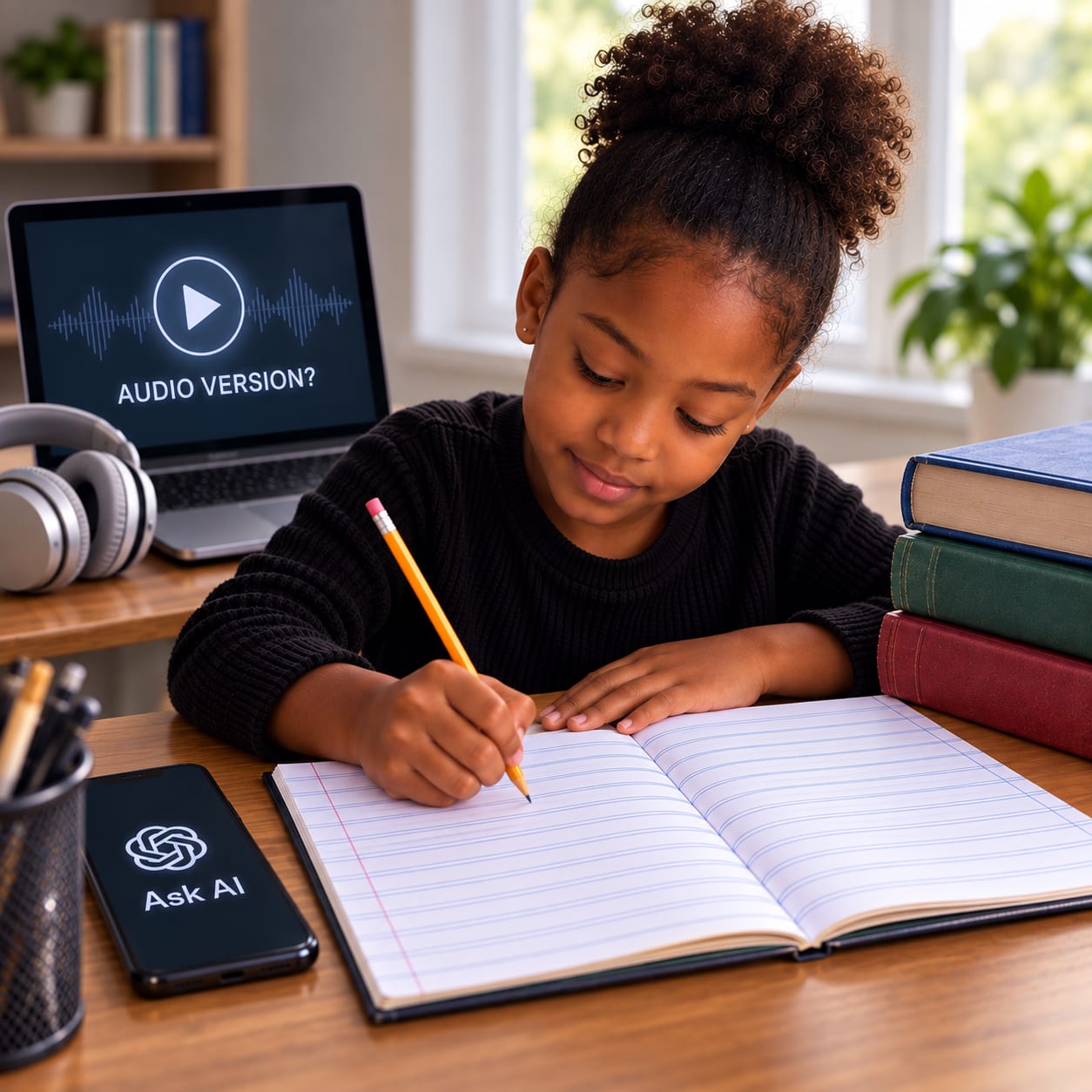
My advocacy for the double-lined book continues.
Can you imagine that after I wrote last week about the importance of making your own notes, so that the brain, memory systems and other cognitive processes could actually be engaged, someone dared to ask me if I had an audio version of the article so they could listen and share it?
Whilst I clearly appreciated the ease with which this critical piece of my work could be shared, I also felt slightly defeated. The article took about three minutes to read. Three minutes of reading aloud or quietly, processing the words and constructing meaning, had just been replaced by being read to. Another opportunity to exercise attention, reading fluency and comprehension was about to disappear again, all in the name of convenience.
This is precisely what concerns me about some of our conversations around technology and education. After the first article, another reader offered a fair critique: “technology may eventually render penmanship redundant.” I am certainly not suggesting that children’s handwriting needs to resemble artwork or that we should measure intelligence by perfect cursive. My concern is that I am seeing too many ten and eleven-year-olds writing at a level we would once have associated with much younger children. Some have not mastered an efficient pencil grip, basic letter formation or sufficient writing fluency. Their writing pace is slower than a turtle taking a Sunday stroll.

The issue is bigger than penmanship. And maybe, technology may replace what handwriting produces without necessarily replacing what learning to write produces in the brain. Writing by hand requires fine motor control, visual motor integration, spatial processing, attention, working memory and the retrieval and formation of learned symbols. Research with young children has found that handwriting experience can activate neural circuitry associated with reading and letter processing differently from simply typing or tracing. The hand may therefore be doing much more than producing marks on a page because it is participating in learning.
For this reason and more, some skills need to be automatic. When a child has sufficiently mastered letter formation, less cognitive effort has to be devoted to physically producing each letter. Working memory can then be used for spelling, sentence construction, organising ideas and thinking about what comes next. A ten-year-old who is still concentrating intensely on how to form individual letters is using cognitive resources that should increasingly be available for higher-order processes, even with a startling ability to articulate him or herself orally. This is not about beautiful handwriting; this is about functional mastery.

Interestingly, some highly digitised education systems are reconsidering how quickly traditional learning practices were pushed aside. Sweden, for example, has deliberately increased investment in printed textbooks and reduced screen-based learning for younger children, with its government emphasising stronger foundations in reading, writing and arithmetic. This is not a rejection of technology. It is recognition that introducing technology and abandoning foundational learning practices are not the same thing.
There is also a question we rarely ask. What about children around the world who do not have constant access to tablets, artificial intelligence and high-speed internet, yet learn, reason, remember, solve problems and function exceptionally well? Technology access is not a proxy for intelligence. In fact, having immediate access to information tells us very little about whether someone can understand, retain, evaluate or use it. Cognitive development still requires engagement, practice and, sometimes, effort.
Then there is the simplest argument of all. What happens when everything goes down? What happens when the battery dies, the network disappears, the “clouds” burst or even a hurricane takes out electricity. What happens when you are trapped somewhere and need to leave a written message, record an address, copy a code or communicate information that could help someone find you? Suddenly, holding a pen and writing something another human being can read does not feel quite so outdated.
I am not asking schools to choose between a pencil and artificial intelligence. Children should learn technology, and they should learn to use AI intelligently and ethically. But we should be careful about outsourcing basic cognitive and functional skills before those skills have had an opportunity to develop. So yes, bring on the technology. Just bring back ways to ensure writing skills are mastered. Because before we decide that a skill is redundant, perhaps we should first understand what learning that skill was doing to the brain.
Dr. Olivia Rose is a performance and sports psychologist at UWI, Mona






Comments