
Haitians awake to uncertainty after presidential assassination

/ Our Today
administrator
PORT-AU-PRINCE (Reuters)
Haitians awoke to uncertainty on Thursday (July 8), awaiting the outcome of a gunbattle between police and a hit squad that assassinated President Jovenel Moise, while politicians argued over who should assume the leadership of the violence-wracked country.
Moise, 53, was shot dead early on Wednesday at his home by a commando of trained killers, pitching the poorest country in the Americas deeper into chaos amid deep political divisions, hunger and widespread gang violence.
Haiti’s police and army managed to track down and encircle the presumed assassins, who included foreign mercenaries, and were engaged in a fierce battle with them late on Wednesday night, officials said.
They had so far killed four suspects, apprehended two and freed three police officers taken hostage.
“The police are still in combat with these assailants,” Police General Director Leon Charles said in televised comments late on Wednesday, as gunshots rang through the capital.
“I can picture a scenario under which there are issues regarding to whom the armed forces and national police are loyal, in the case there are rival claims to being placeholder president of the country.”
Ryan Berg, an analyst with the Center for Strategic & International Studies
The sprawling capital on the shores of the Caribbean appeared calm on Thursday morning as police prowled the streets in the Pelerin neighbourhood where a standoff with the remaining gunmen continued, a Reuters witness said.
Moise’s death has generated confusion now about who is the legitimate leader of the country of 11 million people, which shares the island of Hispaniola with the Dominican Republic.
That does not bode well in a nation that has struggled to achieve stability since the fall of the Duvalier dynastic dictatorship in 1986, grappling with a series of coups and foreign interventions.
“I can picture a scenario under which there are issues regarding to whom the armed forces and national police are loyal, in the case there are rival claims to being placeholder president of the country,” said Ryan Berg, an analyst with the Center for Strategic & International Studies (CSIS).
The 1987 constitution stipulates the head of the supreme court should take over. Meanwhile, amendments that are not unanimously recognised stipulate it be the prime minister, or, in the last year of a president’s mandate – like in the case of Moise – the parliament should elect a president.
Adding further complications: the head of the supreme court died last month due to COVID-19 amid a surge in infections in one of the few countries worldwide to have yet to start a vaccination campaign.
There is no sitting parliament as Haiti failed to hold legislative elections in late 2019 amid political unrest.
And Moise had just this week appointed a new prime minister, Ariel Henry, to take over from interim prime minister Claude Joseph, although he had yet to be sworn in when the president was killed.
QUESTIONS OVER WHO SHOULD LEAD
Joseph appeared on Wednesday to take charge of the situation, running the government response to the assassination, appealing to foreign governments for support and declaring a state of emergency.
Henry, however, told Haitian newspaper Le Nouvelliste that he did not consider Joseph the legitimate prime minister anymore and he should revert to the role of foreign minister.

“I think we need to speak. Claude was supposed to stay in the government I was going to have,” Henry was quoted as saying.
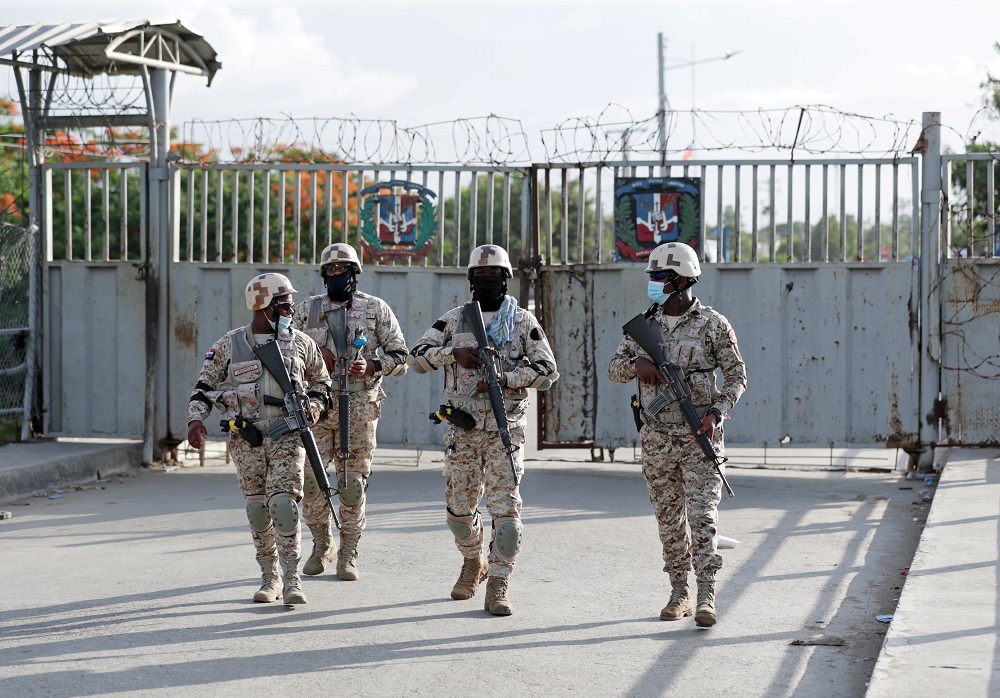
The Dominican Republic said on Wednesday it was closing its border with Haiti and bolstering security amid fears of a breakdown in order in the country.
The United Nations Security Council was due to hold a closed-door meeting on the situation in Haiti on Thursday.
A UN peacekeeping mission – meant to restore order after a rebellion toppled then-President Jean-Bertrand Aristide in 2004 – ended in 2019 with the country still in disarray.


Comments