
Immaculate Conception High are JPS Foundation’s debate competition finals champs

/ Our Today
administrator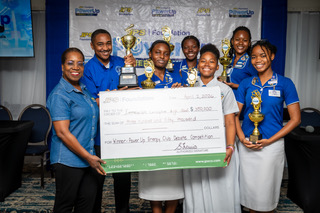
D’Janae Jonas could not hold back the tears.
They came rolling down her cheeks in spontaneous glee and relief.
After weeks of hard-fought matches, her Immaculate Conception High School team, for which she had served as captain, snagged the first-place honours in the JPS Foundation Power Up Energy Club Debate Competition finals.
The tear-jerker moment came after Jonas had fully registered the judges’ announcement that Immaculate had triumphed over St. Hilda’s Diocesan High.
When asked to share the feeling behind the tears, the 18-year-old upper sixth form student reflected: “It was for a variety of reasons – with the main one being that I was so overwhelmed with gratitude for my team who stuck it out until the end.”
Schoolmates La’Tavier Burton and Kirabo Musaazi were Jonas’ support system, delivering convincing case defences at the lectern individually, and as a collective.
Launched in 2024 as a partnership with the Jamaica Association for Debating and Empowerment (JADE), this year’s JPS Foundation Power Up Energy Club Debate Competition kicked off in late January and ran for a six-week stretch with 16 high school team entrants from across the island.
The finals — which came after three knockout rounds of competition — took place at the Jamaica Pegasus Hotel’s 17th-floor Talk of The Town space on April 2.
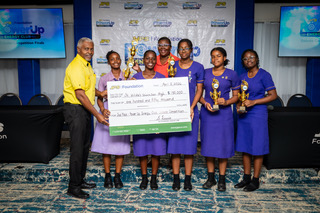
Immaculate secured $350,00 in prize winnings to be evenly split among its debaters, while St. Hilda’s bagged $150,000 and third-place Knox College walked away with $60,000.
For the oratorical playoffs for the top prize, the Kingston-based Immaculate opposed the motion, ‘This House would prioritise changing how energy is used over adopting newer sources of energy’ against the young women from St. Hilda’s High located in Brown’s Town, St. Ann. Detailing the preparatory process on the road to success, Jonas revealed that each of the four rounds began with a shared document for brainstorming and research.
“We followed up with in-depth meetings to discuss ideas, explore possible stances and finalise the arguments we intended to present. In these sessions, I assigned points to each speaker to guide speech preparation. We engaged in continuous practice and refinement of our speeches while also anticipating our opponents’ arguments and developing effective counterpoints,” explained Jonas, who has ambitions to become either a renewable energy engineer or a cybersecurity specialist.
Meanwhile, Immaculate’s coach and Power Up Energy Club Facilitator, Leevan Smith, expressed confidence his girls would emerge victorious ahead of the big day.
“We had a strong team with three top-class debaters. However, we did not take St. Hilda’s lightly as we recognised they were also a formidable team,” remarked Smith who has taught physics as well as electrical and electronic engineering at the Constant Spring Road all-girls secondary school for the last 15 years.
The educator noted that it was Immaculate’s second go at the Power Up Energy Club contest, having made it to the quarter-finals round last year.
The strategic line, according to Smith, that was pursued towards improving their standing this time around, emphasised a fact-based approach. “We carefully selected solid evidence and well-supported arguments to minimise opportunities for our opponents to challenge or dismantle our case. This focus on credibility strengthened our position throughout the competition.”
The coach said his team also demonstrated adaptability on the day of the finals by incorporating insights into renewable energy from JPS Vice President – Generation (Regulated Assets), Sameer Simms, who made a special presentation to the debate competition audience before the match. “We included his comments into our arguments and this reflected our ability to think critically in real time and adjust our strategies and build on new information.”
Smith’s opinion was in sync with the final decision arrived at by Germaine Barrett, founder and executive director at JADE and his supporting judging panel in making the call for first place.
“Immaculate came out winners over St. Hilda’s on account of the fact that they proved more compellingly that investments in new renewable sources of energy would materially impact improvements in the environment and in the cost of energy overall which have many subsidiary effects,” Barrett noted.
Based on the two spectrums of arguments that were presented, Barrett said one of the more important points that Immaculate highlighted as an indicator of a developed society, is its energy use.
“As Jamaica advances on a track towards becoming a developed nation state,” Barrett posited, “it is inevitable that its energy consumption is going to increase, which implies therefore that the thrust in their [Immaculate] mind of St. Hilda’s to effectively reduce the consumption of energy as they contend in engaging in social reengineering as well as adapting more efficient appliances and devices that consume energy, would not be as efficient at meeting the end goal of reducing the impact of climate change and reduce Jamaica’s general energy bill.”

Developing confidence and leadership skills
Barrett is pleased with the evolution of the Power Up Energy Club Debate Competition in its three-year existence. The twinned cornerstones in debating, content and style, have seen tweaks.
“Last year at the end of the competition, we reflected on what transpired and identified that in the area of content, the concern was that a lot of the argumentation was very technical and difficult to digest by the average citizen,” he explained.
To this end, JADE hosted training sessions before this year’s debate contest got underway to assist students “improve the content of the presentation to ensure that the listening audience really appreciates what is being said, and we think to a large extent we achieved that.”
Barrett said a public speaking expert was retained to assist debaters in oratory style and pacing. A problem area flagged last year was a majority of speeches had been delivered in a rapid fashion.
For Denika Dixon, team captain of St. HIlda’s, the runner-up position “is something I am very proud of.”
“While we aimed for first, the experience reflects our hard work, growth and dedication as a team,” relayed the 18-year-old upper sixth former. “It was a strong performance and I see it as both an achievement and motivation to improve even further.”
As one-fifth of the debating team that included Yori Pingue, Jaymia Edwards, Toria-lee Martin and Whitney Francis, Dixon said her oversight involved intense research, practising rebuttals and refining delivery.
“I focused on keeping morale high, ensuring everyone stayed motivated and creating an environment where each member felt prepared.”
With a view to pursue a law degree at the tertiary level soon, Dixon learnt a lot about herself being part of the debating team.
“I developed stronger confidence, leadership skills and the ability to think quickly under pressure,” the young adult shared of the advantages gained.
Much like Dixon, St. Hilda’s debating coach Shanakay Huie had anticipated a win for the all-girls school team; particularly as the school had led all competitors in amassed points in the previous three debating rounds.
“We started out saying we are going to give it our best, but after our first match in the first round, we defeated Herbert Morrison who were the first winners of the competition in 2024,” Huie recounted. “The girls said we have this, we have a chance.”
Huie, who read for a molecular biology degree at the University of the West Indies, Mona campus, has taught science subjects at St. Hilda’s for the past six years.
And though the final results did not come with St. Hilda’s being in pole position, Huie said her girls learnt the true value of competitive spirit. “All of the teams were powerhouses. They all did very well. One of the things I would say to my girls before matches is that we are not going to underestimate any team and we have to be mindful of that humility.”
With the debate competition’s third staging now wrapped, JPS Foundation Head Sophia Lewis was in an upbeat mood in her assessment of the objectives met. There remained a high level of interest and engagement across the network of Power Up Energy Clubs on the island.
“We were especially pleased with the participation from our rural schools, especially those in the west. Despite being impacted by hurricane Melissa, they were still very much engaged in the competition,” Lewis shared.
The Foundation’s leading woman was also gratified with the ongoing partnership with JADE. She credited the oversight organisation for “continuing its excellence at providing a strong framework for the competition, starting out from training to the execution of the different matches.”
What delighted Lewis the most though was being able to satisfy the Foundation’s three main focus areas of climate resilience, community empowerment and Science, Technology, Engineering and Mathematics (STEM) education.
“We want to ensure that we go deep with what we do. We want to ensure that there is improvement in knowledge levels, engagement among the schools, and also engagement within the JPS team to provide mentorship to our students,” she remarked.




Comments