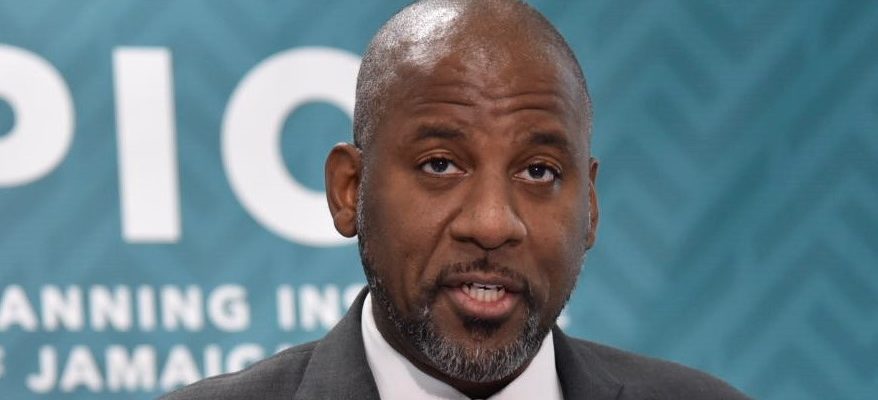
PIOJ cites new growth phase for Jamaica, plots strategies to boost productivity

/ Our Today
administrator
Durrant Pate/Contributor
The Planning Institute of Jamaica (PIOJ) is seeing a new growth phase for Jamaica, which it says has returned to pre-COVID levels of output in fiscal year 2022/23.
Critical to capitalising on this new phase and generating higher levels of growth in the short to medium term the PIOJ says is increased productivity, noting that productivity levels in Jamaica have been underperforming relative to other countries for the last 40 years. Using data from the World Bank, the PIOJ gave a comparison to countries with productivity levels close to that of Jamaica in 1980.
These countries were Republic of Korea, Malaysia, Dominican Republic, Peru, Paraguay and Saint Lucia. In examining the evolution of productivity up to 2018, the data revealed a divergence in the evolution of labour productivity for the seven countries.
By 2018, labour productivity for the Republic of Korea, Malaysia and Saint Lucia were approximately 5.0 times, 2.5 times and 1.9 times the size of Jamaica, respectively, albeit it being at similar levels in 1980.
Addressing Jamaica’s productivity gaps
According to the PIOJ, “This historical look on labour productivity growth between Jamaica and its comparators from 1980 to 2018, identified issues that Jamaica needs to address to close the productivity gaps. These include addressing gaps in:
- Innovation: Research & Development and collaboration between stakeholders in embracing disruptive ideas
- Education: the adoption of digital skills among the active population; and training of staff
- Efficiency: Pay and productivity alignment; domestic credit; and labour mobility
- Infrastructure: road, sea and air connectivity; as well as electricity and water supply quality/reliability 5. Institutions: capability of social services; active labour market policies, etc.
Addressing the institute’s quarterly news briefing last week, Director General Dr Wayne Henry advised that it will continue to consult and work with its partners in relevant ministries, departments and agencies (MDAs) to determine the most appropriate mix of strategies to stimulate higher levels of productivity.
Short-term economic outlook

Henry reported that the prospects in the short to medium term are positive based on a number of factors such as continued growth in the economies of Jamaica’s main trading partners, which augurs well for increased external demand, higher demand stemming from increased employment levels and increased economic activities, as firms continue to invest to meet higher domestic and external demand, particularly within the hotels & restaurants and manufacturing industries.
He indicated that the hotels & restaurants industry is expected to continue to record growth. Preliminary data on airport arrivals for January 2024 indicate an increase of 2.3 per cent relative to January 2023. However, the downside risks to this positive outlook include plant down-time, due to relatively aged equipment in major industries, adverse weather conditions and weaker than projected growth in the economies of Jamaica’s main trading partners.
According to the PIOJ boss, “This may temper the external demand for Jamaica’s goods and services. Within this context, economic growth is anticipated for the remainder of fiscal year 2023/24. For the January to March 2024 quarter, growth is projected to be within the range of 1.5 per cent to 2.5 per cent resulting in a fiscal year growth (that is April 2023 to March 2024) in the range of 1.5 per cent to 2.5 per cent.





Comments