
Several listed entities hold significant cross-sector investments, market analysis finds

/ Our Today
administrator
Durrant Pate/Contributor
Several locally listed companies are holding significant cross-sector investments, blurring traditional sector boundaries and potentially complicating how investors assess diversification, an analysis by NCB Capital Markets has revealed.
The analysis shows that among the 96 listed companies, one in every three holds stakes in at least one other publicly listed firm. Even more significantly, nine of these companies have exposure to at least one additional sector, contributing more than 10.0 per cent of their earnings.
Unsurprisingly, financial services (FS) and conglomerates were the most connected sectors, where conglomerates, for instance, span multiple sectors including FS, energy industrials and materials (EIM) real estate, manufacturing and distribution (M&D) and tourism. Also, FS companies hold significant interests in M&D, entertainment, real estate, EIM, health/tech and tourism.

Cross-sector investments
For their latest financial years, earnings for the 96 companies totalled J$132.27 billion with J$36.08 billion (27.3 per cent) generated by firms holding significant cross-sector investments. The analysis delves deeper to show how impactful cross-sector linkages are, as approximately J$24.16 billion (67.0 per cent) of the J$36.08 billion stemmed from companies’ top five crossholdings alone.
This level of concentration means that a significant portion of some companies’ profits and valuations partly rely on the performance of other listed businesses in other sectors. On one hand, cross-sector exposure can be an advantage, enabling a single investment to offer access to multiple sectors and thus spreading risk more broadly across the economic spectrum.
Case in point is the conglomerate GraceKennedy, which offers substantial exposure to both food M&D and FS (including insurance, money services and banking) through wholly owned private subsidiaries but also benefits from its majority stake in publicly listed Key Insurance.
Another conglomerate, Jamaica Producers Group offers exposure to the EIM sector through its 42.0 per cent stake in Kingston Wharves, while also indirectly participating in FS and real estate via its 34.6 per cent stake in fellow conglomerate Pan Jamaica Group, which itself, owns significant stakes in financial giants such as Sagicor Group Jamaica (30.2 per cent) and JMMB Group Limited (2.7 per cent).

Cross-sector reliance
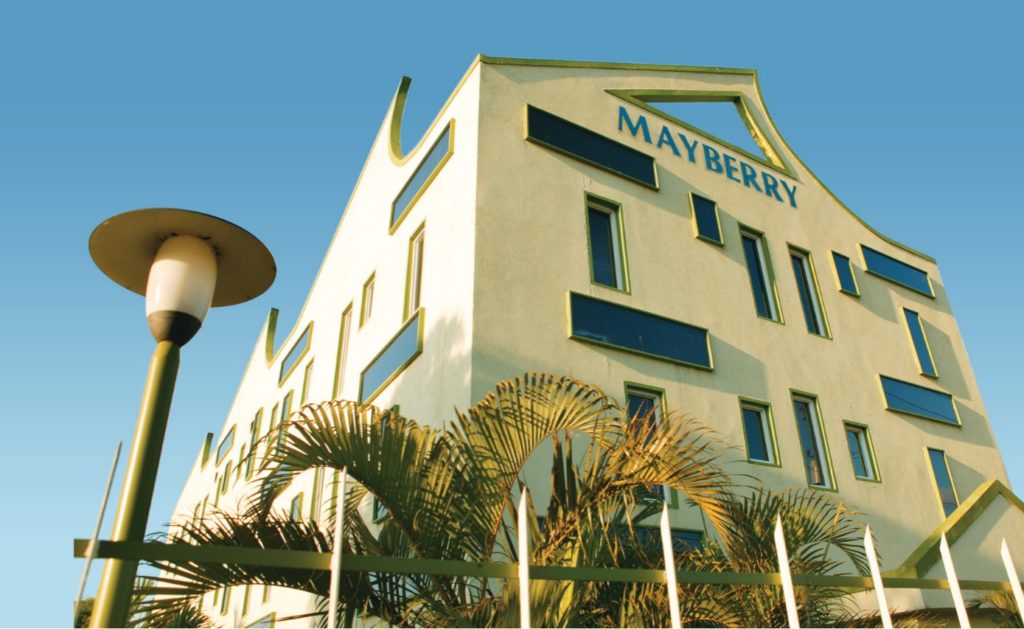
Similarly, main market FS companies often have cross-sector investments such as NCB Financial Group, which owns a 61.8 per cent stake in Guardian Holdings Limited, providing considerable exposure to the insurance subsector. Likewise, Mayberry Group Limited demonstrates cross-sector reliance through its 50.4 per cent ownership of Mayberry Jamaican Equities, which in turn has direct holdings in Supreme Ventures (18.7 per cent), Wigton Windfarm (10.2 per cent) and a 20.2 per cent stake in Blue Power Limited.
SVL provides a slice of Jamaica’s entertainment and gaming market, as Wigton offers exposure to the EIM sector, while Blue Power connects it to the M&D segment. Mayberry further broadens its exposure to M&D companies such as Jamaica Broilers and Lasco Manufacturing. Even companies like Jamaican Teas, traditionally grounded in M&D, have embraced cross-sector investments.
Jamaica Teas owns a 28.0 per cent stake in QWI Investments – a financial services firm whose investment portfolio stretches across financial services, M&D, tourism and more.
Conversely, while cross-sector exposure can be an inherent advantage when seeking diversification, it can also create complications for investors.
The research cited the example of this in the second quarter of 2025 when Jamaica Teas posted a J$74.5 million net loss, despite revenue growth led by its M&D segment. Jamaica Teas’ earnings drop came because QWI reported a $160 million loss, mostly from unrealised capital losses tied to the company’s investments, including Dolphin Cove and Access Financial Services.
Similar performance drags may also stem from exposure to companies in related subsectors, such as JMMB Group’s J$1.47 billion net loss in the June 2024 quarter, which was partly due to its J$1.47 billion share of loss from its associate, Sagicor Financial Company.






Comments