


Suriname is ensuring that it does not fall prey to a grave flaw in Guyana’s Stabroek block production sharing agreement (PSA) with ExxonMobil by failing to put in place ringfencing provisions.
With oil company TotalEnergies announcing plans for the first Suriname oil development at Block 58, Suriname has made sure to put ringfencing provisions in its petroleum agreement with the oil major. These provisions are critical in preventing revenue losses for Suriname, and ensure that the government gets a higher share of upfront dollars.
Ringfencing, in the context of oil and gas, refers to isolating the finances of a specific project such that costs incurred in one project cannot be offset against revenues from another. This ensures that each project’s profitability is separately accounted for.
Differences in Suriname and Guyana PSA
However, ringfencing is not the only difference between the two countries’ main oil contracts. A comparison between TotalEnergies’ Block 58 and ExxonMobil’s Stabroek block highlights the distinct inferiority and unfairness of the Exxon deal, as reported by Guyana’s Kaieteur News.
TotalEnergies’ project offers a 6.25 per cent royalty rate and a 36 per cent income tax. It also allows for cost recovery up to 80 per cent of quarterly production, with unrecovered cost oil balances carried forward on a project-by-project basis.
Additionally, Suriname’s state oil company, Staatsolie, has an option of 20 per cent participation. In stark contrast, ExxonMobil’s Stabroek block projects come with a mere 2.0 per cent royalty and an essentially zero tax regime since Guyana shoulders the companies’ taxes from its profit oil share, in addition to there being no option for state participation.
It is being reported that Staatsolie’s potential 20 per cent participation in Block 58 could translate into a windfall for the Surinamese state. Based on the model production sharing contract, the state could reap between US$16 billion and US$26 billion over two decades, contingent on oil prices.
Indirect revenues, stemming from local content – the provision of local goods and services – further underscore the benefits. The recent drilling of five wells in Block 58 saw all operations undertaken within Suriname, injecting approximately US$90 million into the economy. TotalEnergies’ project is expected to be a huge boost for local content in Suriname.
Suriname’s approach emphasising better fiscal terms
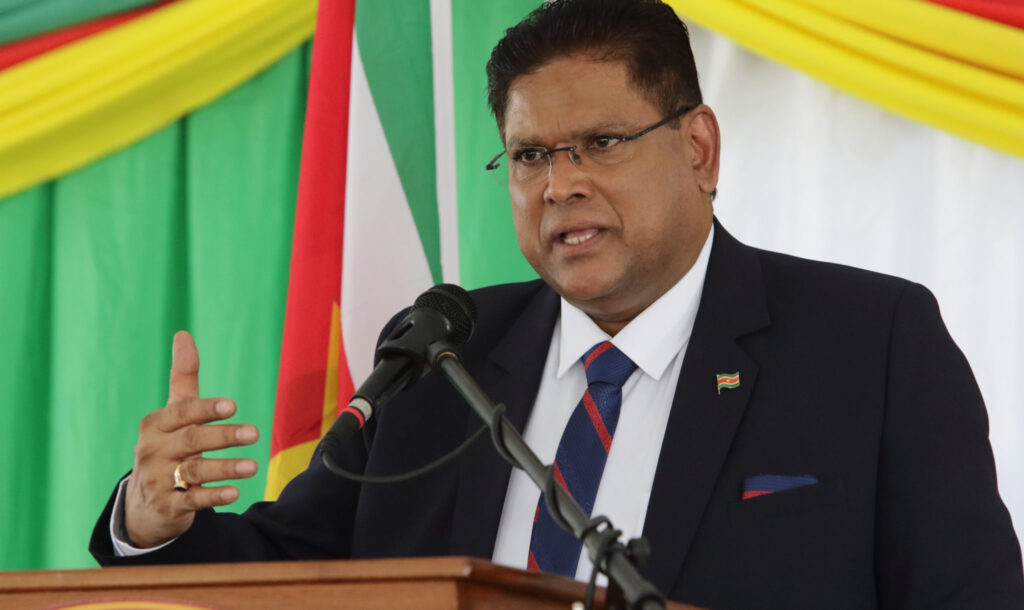
Surinamese President Chandrikapersad Santokhi views the project as a beacon of economic hope, promising that his administration “will make sure that future income from the offshore oil and gas will be spent wisely. Those incomes will contribute to the prosperity and stability fund, and will be a means to diversify our economy by developing sustainable sectors such as agriculture and tourism”.
Suriname’s approach, emphasising ringfencing and better fiscal terms, indicates that the government is keen on maximizing the benefits of its oil and gas sector for its people and economy. In contrast, the government of Guyana has said it will not renegotiate the Stabroek PSA to include ringfencing and better terms.
The deepwater oil development offshore Suriname is the beginning of the country’s arrival on the global energy stage. TotalEnergies, along with its partner APA Corporation, plans to invest US$9 billion in the Block 58 development, targeting the Sapakara South and Krabdagu fields, which boast nearly 700 million barrels combined.




Comments