The Bahamas’ $3.5 billion tourism pipeline splits almost evenly between cruise and hotels, numbers show

/ Our Today
administrator
The widely cited US$3.5 billion figure attached to The Bahamas’ tourism investment boom sounds like one number.
It is actually two roughly equal ones, and which side wins will decide whether the country’s stopover recovery has staying power.
According to the Inter-American Development Bank’s Caribbean Economics Quarterly, published in August, the pipeline breaks down into about $1.5 billion in cruise infrastructure concentrated in Grand Bahama, a $200 million Royal Beach Club development on Paradise Island, and more than $1.3 billion in luxury resort projects spread across Eleuthera, the Exumas, and Abaco. Add the resort and beach club figures together and hotel-related investment totals roughly $1.5 billion as well, putting the two categories close to parity in dollar terms.

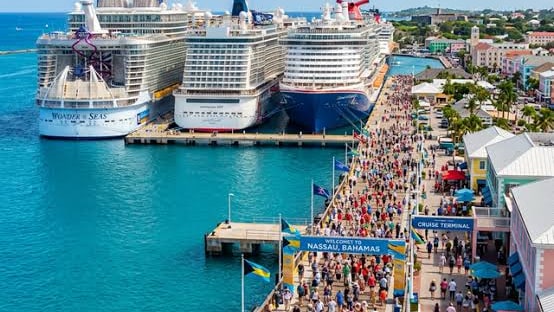
The Grand Bahama cruise buildout is the more concentrated piece. MSC has committed roughly $450 million to a new Freeport cruise port, and Carnival’s nearby project runs to about $600 million, according to reporting on the island’s redevelopment. Those two projects alone account for the bulk of the $1.5 billion cruise figure. The strategy behind them is explicit: officials want Freeport to function as a regional hub for trade, tourism, and logistics, not simply a cruise stop, and the island has drawn more than $3.5 billion in investment and commitments since 2021 on that broader thesis.
The hotel side of the ledger looks different, and geographically wider. Caribbean Journal’s Bahamas Resort Pipeline report, also published in August, found that the centre of gravity in luxury hotel development has shifted toward the Exuma Cays, where Rosewood, Aman, and Bulgari are each building. Nassau still holds the single largest committed investment in the country, and Baha Mar broke ground in February on a fourth resort now valued above $700 million. Grand Bahama itself is getting hotel capacity too: a 550-room Hilton anchoring a $700 million redevelopment of the former Grand Lucayan, the largest single hotel project in the national pipeline.
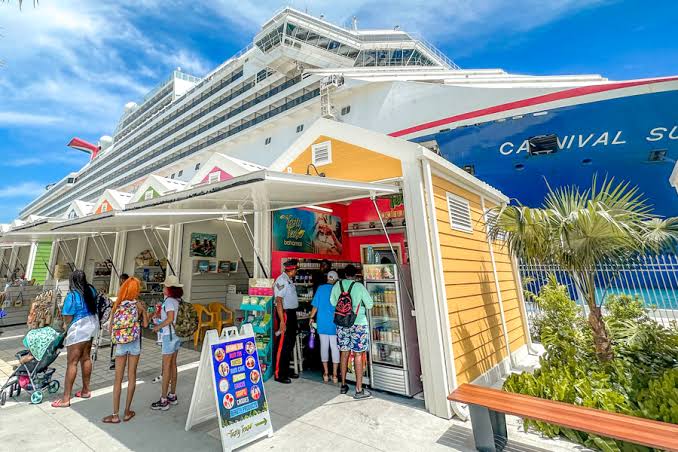
One detail in the Caribbean Journal report cuts to the heart of the composition question. Cruise line private island destinations were excluded from its resort pipeline entirely, on the grounds that they represent real committed capital but add no stopover accommodation inventory. That distinction is the whole debate in miniature: dollars invested in tourism are not the same as dollars invested in the kind of capacity, hotel rooms, that produces higher-value overnight visitors.
Read that way, the pipeline is not simply feeding more cruise passengers into a system already handling 85 per cent cruise arrivals. New hotel rooms are coming in Nassau, Exuma, and now Grand Bahama as well, the same island absorbing the bulk of the cruise buildout. Sandals will be launching an impressive Beaches resort in Exuma. If the Hilton and Baha Mar projects deliver rooms on schedule, Grand Bahama could see cruise throughput and stopover capacity expand together rather than one crowding out the other.
The risk sits in timing and geography. Luxury resort construction in the Exumas and Abaco takes years and depends on continued foreign direct investment, projected by the IDB at $209 million in 2026, rising to an average of $339 million annually from 2028 to 2030. Cruise port construction tends to move faster. If the Grand Bahama cruise terminals open before Nassau and Exuma hotel rooms come online, headline arrival numbers could climb again on cruise volume alone, reviving the same imbalance the pipeline was meant to correct.



Comments