
The Bank of Jamaica is playing its part to spur growth. Why aren’t others?

Al Edwards / Our Today
administrator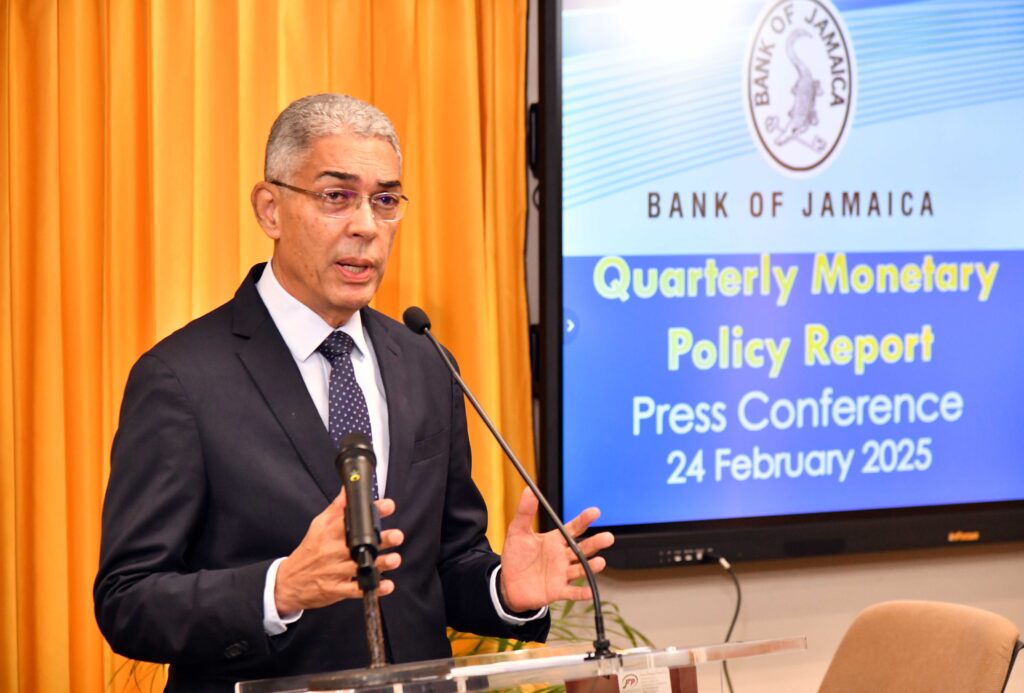
Earlier this month, the Bank of Jamaica (BOJ) made the decision to reduce the policy rate by 25 basis points from 6.00 per cent to 5.75 per cent per annum.
In the face of a contracting local economy, headline inflation climbing to 5.3 per cent, uncertainty brought on by President Trump’s tariff regime, the Federal Reserve deciding not to reduce its rate, it still decided to ease the pressure and again give a signal to commercial banks.
The BOJ’s stance is somewhat less cautious and serves more as a spur than that of the Federal Reserve in the US.
The Federal Reserve is of the view that tariff increases would lead to price hikes and higher inflation. The Federal Reserve Open Market Committee has decided to keep rates steady during this uncertain time while both trade and fiscal policy vacillate.
Part of the minutes from the Federal Reserve Open Market Committee reads: “Participants agreed that uncertainty about the economic outlook had increased further, making it appropriate to take a cautious approach until the net economic effects of the array of changes to government policies become clearer.

“Participants noted that the Committee might face difficult tradeoffs if inflation proves to be more persistent while the outlooks for growth and employment weaken.”
In response to this cautious approach, the Federal Housing Finance Agency Director, William Pulte is calling for Federal Reserve Chair Jerome Powell to slash interest rates immediately.
Pulte wrote: “Jay Powell needs to lower interest rates—enough is enough. President Trump has crushed Biden’s inflation and there is no reason not to lower rates. The housing market would be in much better shape if Chairman Powell does this. “
Given the less-than-salubrious picture of both the local and global economy, the BOJ was brave and should be commended here. It didn’t take a belt-and-braces approach, which usually is the case with bankers.
Yet the commercial banks blithely ignore the Central Bank, some asserting they will not budge unless the Asset Tax is removed.
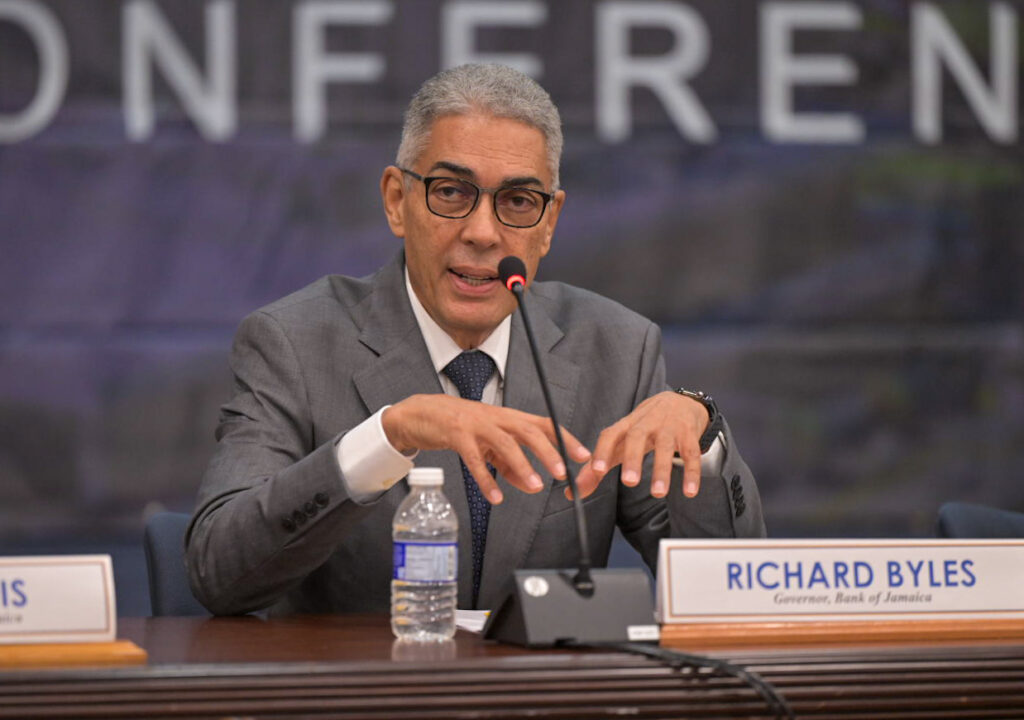
The Governor of the BOJ Richard Byles, noted: “When you look at the total financial market, the commercial banks have approximately half and non-banks have the other half. Non-banks have been very responsive to rates going up and rates coming down. What the banking community needs to look out for is if the non-banking community starts to lend to their customers. It is a risk they run if they remain stubborn and insensitive to rates coming down.”
Governor Byles went on to add that the banking transmission system is not as efficient as the BOJ would like it to be. He observed that, ”when the rates were going up, the commercial banks were very slow to act, and we had to jawbone them to get the rates to go up. Now that the rates are coming down, they are very slow to make the adjustments, and we are going to be jawboning them to bring it down.
“We don’t want that to be the case going forward, and so we are doing what we set out to do, laying the foundation in the medium term to get that system to be more efficient.”
So, should there be more commercial banks in Jamaica, thus making it more competitive and giving customers greater choice?
Governor Byles explained at the Quarterly Monetary Policy Report Press Conference at the Jamaica Conference Centre.
“We have eleven Deposit Taking Institutions ( DTIs), and in the last fifteen years, we have added maybe five to make it eleven. The Central Bank has allowed several new financial institutions, but that has not shifted the competitiveness in any significant way. Sixty per cent of all deposits are with two banks and that has not changed.
“In the banking business, he who controls deposits, controls the loans. If your deposits are more expensive than somebody else’s, you can’t be competitive in how you lend. So it’s not a matter of letting in more financial institutions, it’s a matter of giving consumers the freedom to move from one institution to another. One of the hurdles in doing that is the Know Your Customer (KYC) requirement.
“The way we are going to address that is to have a centralised digital database of KYC information, which will belong to each individual bank customer. It will not belong to the bank; it will belong to the customer, who can, in turn, take that to any bank that he or she wants. So if I am with Bank A and I don’t like their deposit rate, I can take it and walk to Bank C and open an account without too much trouble. In that way, it creates a lot more fluidity of customers from one bank to another bank. In the same way, with loans, if a customer is not happy with the rate, a customer can port their business to another bank. As I said, it takes a little doing to get done. The data is very personal to you, the customer. That means we have to be careful about how that data is accessed, stored and moved from one place to another. It will take us about a year or more, but that is coming.”






Comments