
PNP calls on government to articulate a National Industrial Strategy as structural trade decline deepens

/ Our Today
administrator
The People’s National Party (PNP) is calling on the Government to urgently articulate a clear, coherent industrial strategy, warning that the latest merchandise trade data from the Statistical Institute of Jamaica (STATIN) confirm a deepening structural decline in Jamaica’s visible trade performance and a continuing fall-off in export earnings that current policy is failing to arrest.
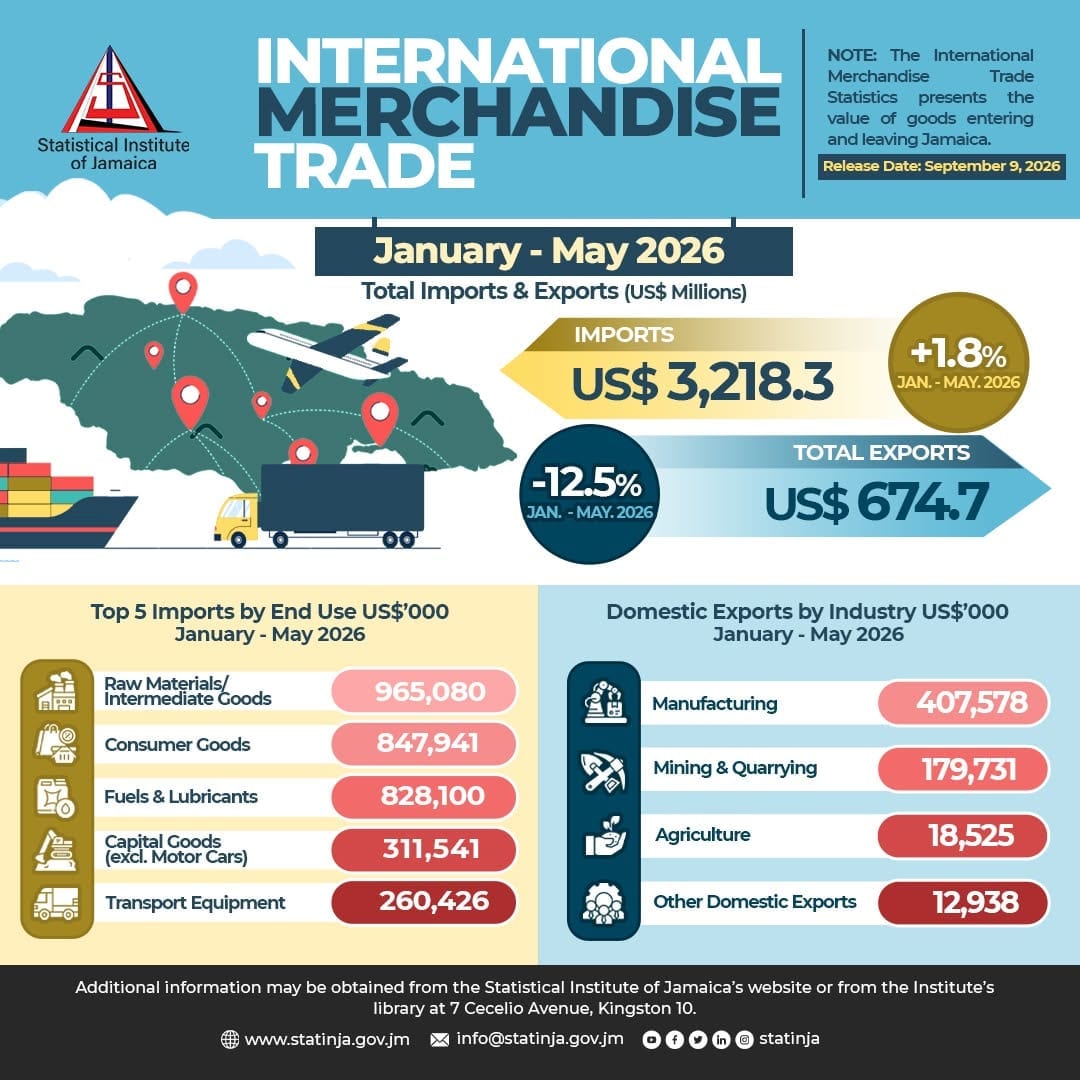
STATIN’s most recent International Trade Merchandise Bulletin, covering January to May 2026, shows total export earnings of US$674.7 million, a 12.5 per cent decline from the US$770.9 million earned over the same five months of 2025. Over the same period, Jamaica’s import bill rose 1.8 per cent to roughly US$3.2 billion, driven by higher spending on raw materials and intermediate goods, capital goods, and transport equipment, meaning the country is now spending close to five times what it earns from exports. This follows a full-year 2025 outturn in which total exports fell 13.4 per cent to US$1,652.2 million, while imports rose 3.2 per cent to US$7,523.7 million, pushing Jamaica’s export-to-import coverage ratio down to 22.0 per cent, from 26.2 per cent in 2024. In plain terms, for every US$1.00 Jamaica now spends on imports, it earns barely 20 to 22 cents from exports.
“These are not one-off numbers. They are the latest data points in a multi-year trend of structural decline in our visible trade account,” said Opposition Spokesperson on Industry, Trade and Global Logistics, Anthony Hylton. “The fall-off is broad-based, and it precedes and stands apart from the disruption caused by Hurricane Melissa. We cannot allow the understandable and hoped-for temporary decline in tourism earnings during post-Melissa recovery to obscure a separate and more entrenched problem: Jamaica is steadily losing ground in merchandise trade, and government has yet to articulate a vision for reversing it.”
Mr Hylton noted that the Government has, in parallel, continued to promote Jamaica’s ambitions as a logistics and transhipment hub for the region, pointing to port expansion, highway and airport works, and the broader logistics infrastructure agenda. The PNP supports continued investment in that infrastructure, but warns that infrastructure alone is not a strategy.
“A logistics hub without a production base to feed it is just a very expensive parking lot for other countries’ goods,” Mr Hylton said. “Logistics infrastructure and industrial policy have to be developed as two halves of the same strategy. If we build the ports, the roads and the digital trade platforms, but leave manufacturing, agro-processing and agriculture without a coherent plan to attract capital, upgrade productivity and connect to regional and global value chains, we will have built a hub with nothing of our own moving through it.”

The PNP is calling on the Government to, without further delay:
- Publish a national industrial policy setting out priority sectors, targets and the fiscal, financing and regulatory measures needed to lift local production and export diversification, beyond the current reliance on a narrow band of traditional exports;
- Align logistics and industrial planning so that port, road and special economic zone (SEZ) investments are explicitly designed around the needs of targeted productive sectors, rather than treated as a stand-alone infrastructure agenda;
- Mobilise local and foreign investment into the productive sectors through a targeted, time-bound incentive framework, rather than the current ad hoc approach to investment promotion;
- Fully exploit existing trade agreements, including CARICOM/CSME and Jamaica’s bilateral and regional FTAs, to open new export markets and supply chain linkages for Jamaican producers; and
- Report to Parliament and the public on a defined timeline for the above, so that the current period of macroeconomic stability is used as a platform for productive transformation, not simply preserved as an end in itself.

“Jamaica has, over recent years, achieved a hard-won measure of macroeconomic stability. That is a real and important achievement, and it must be protected,” Mr Hylton said. “But stability is a foundation, not a destination. If we allow the continuing decline in merchandise trade to go unaddressed, alongside the post-Melissa recovery in tourism, we risk squandering this period of hopeful possibility, a moment that should be used to regenerate growth and build lasting national prosperity, not merely to hold the line.”
The PNP is urging the Government to treat the latest STATIN figures as a call to action and to bring a clear industrial and trade strategy to Parliament as a priority, in tandem with, and not subordinate to, the post-Melissa reconstruction effort.




Comments