Ambraee Houslin | Business credit is contracting in real terms, just as Jamaica needs it most

/ Our Today
administrator
The Bank of Jamaica’s headline credit number looks stable. Underneath it, the banking system has quietly changed its mind about who it wants to lend to.
Buried in the Bank of Jamaica’s summary of decisions for August is a figure that deserved more attention than it received. Private sector credit growth was described as relatively stable in the June 2026 quarter at 7.4 per cent, against 7.9 per cent a year earlier. Stable is the wrong word for what sits underneath it. Business credit growth fell to 6.5 per cent from 10.0 per cent in the June 2025 quarter. Lending to individuals went the other way, accelerating to 7.9 per cent from 6.9 per cent.
The aggregate held because the two halves moved in opposite directions. That is not a stable credit market. It is a credit market reallocating.
The shift is not one quarter of noise. Annual growth in business lending averaged 8.7 per cent in 2025 against 10.9 per cent in 2024. In the December 2025 quarter, business lending grew 7.5 per cent and lending to individuals 8.3 per cent. By January 2026 the business figure was 6.2 per cent. By the March 2026 quarter it had fallen to 5.1 per cent, while lending to individuals held at 7.5 per cent. On that sequence, the June quarter’s 6.5 per cent is a modest recovery off the floor rather than a fresh deterioration, and it would be misleading to present it otherwise. But the two-year direction is unambiguous, and the crossover is what matters. Jamaican banks used to grow their corporate books faster than their consumer books. They now do the opposite, and have done so for close to a year.

Set the nominal figures against prices and the picture sharpens considerably. Headline inflation was 7.5 per cent at July 2026, up from 6.7 per cent in June and 3.3 per cent a year earlier. Core inflation was 5.2 per cent. Business credit growing at 6.5 per cent nominal against headline inflation of 7.5 per cent is a corporate loan book that is shrinking in real terms. Household credit at 7.9 per cent is, at best, flat. The banking system is not tightening across the board. It is tightening selectively, and firms are on the wrong side of the selection.
The obvious explanation, that money has simply become expensive, does not survive contact with the data. The policy rate has been held at 5.50 per cent through every decision this year, and against headline inflation of 7.5 per cent the real policy rate is negative. Whatever is rationing corporate credit in Jamaica at present, it is not the price of money.
Two better explanations are available, and both are probably operating.
The first is demand. In the April 2026 survey of businesses’ inflation expectations, respondents raised their twelve-month-ahead expectation to 7.1 per cent from 6.5 per cent, and raised their expectations of exchange rate depreciation alongside it. Firms facing volatile input costs and an uncertain output price defer discretionary capital expenditure, and deferred capex does not generate loan applications. There is also a mechanical post-disaster effect worth conceding: insurance recoveries and grant funding substitute for borrowing in the first year after a catastrophe, which flatters the argument that firms simply need less debt right now. That effect is real, and it will fade.
The second is supply, and this is the one that should worry us. Hurricane Melissa not only damaged output. It damaged the collateral. The Planning Institute of Jamaica put total damage and losses at US$12.2 billion, equivalent to 56.7 per cent of 2024 gross domestic product, of which physical damage alone was assessed at US$8.8 billion. Some 156,000 homes were damaged and 24,000 written off entirely. The six most affected parishes were Westmoreland, St Elizabeth, St James, St Ann, Trelawny and Manchester, which is to say the tourism and agricultural belt. A lender re-underwriting exposure across that geography is marking down security values, extending assumed recovery timelines, and adding risk premia to sectors whose cash flows are still being rebuilt. None of that appears in the policy rate. All of it appears in the credit committee.
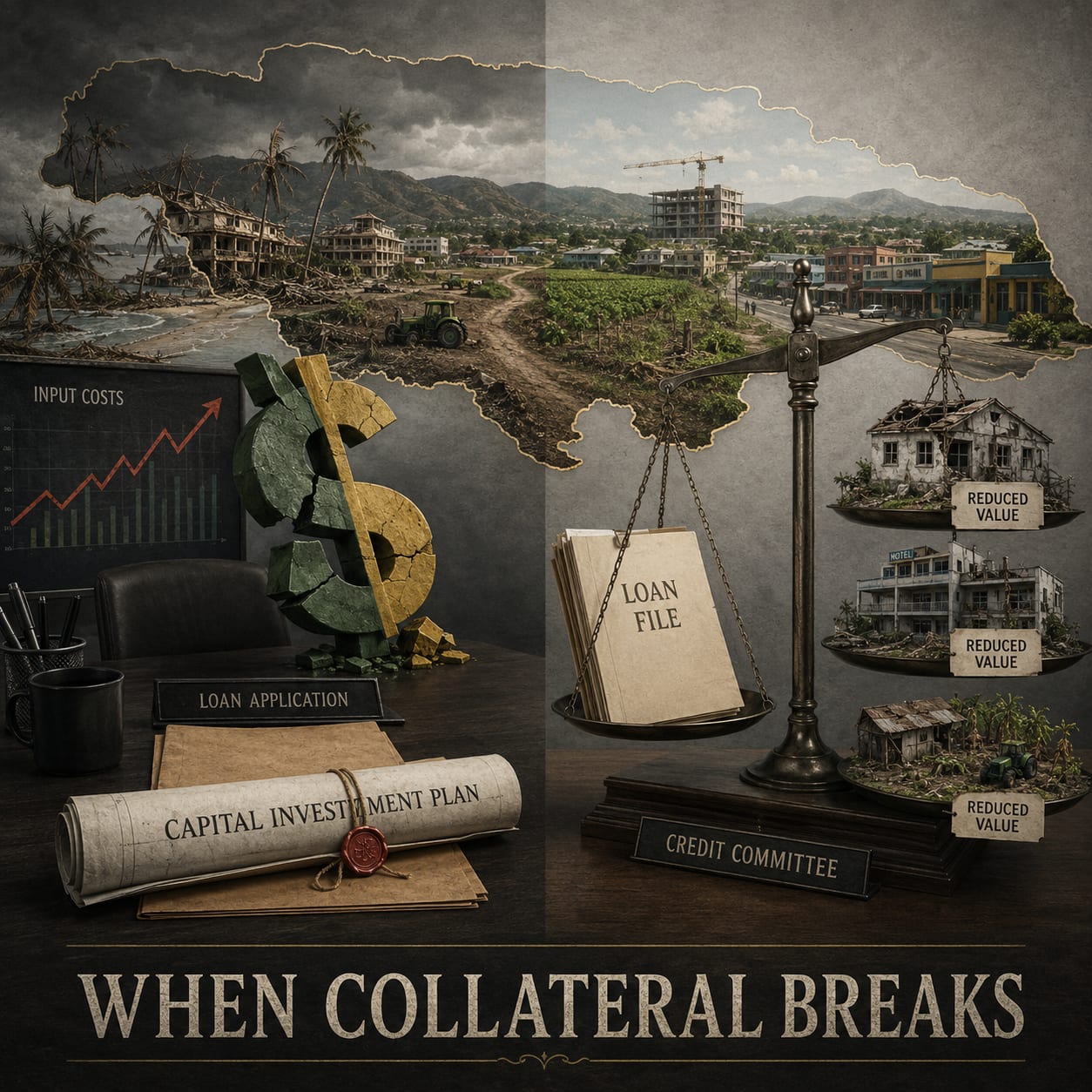
Layered on top is a constraint this column has raised before. Where title is unregistered or unclear, and it remains so across a substantial share of Jamaican land, collateral cannot be perfected at all. After a disaster that binds harder, not less, because the borrower’s fallback security, the undamaged asset, is scarcer than it was.
Now put the two sides of the ledger together. Jamaica has secured up to US$6.7 billion in international support over three years for reconstruction, including up to US$3.6 billion in government financing, and has pushed its fiscal targets back by two years to accommodate the rebuild. That is a credible response, and it covers public infrastructure and a meaningful share of the social recovery. What it does not cover is the private capital stock. Hotels, distributors, agro-processors, small manufacturers and the thousands of firms that constitute the productive base of the affected parishes have to fund their own replacement capital expenditure. The single largest domestic pool of capital available to them is currently growing its exposure to them more slowly than prices are rising.
There is a monetary policy point in this that the September decision will almost certainly not address. The Monetary Policy Committee is holding at 5.50 per cent because inflation is above the four to six per cent target range and it judges the cause to be largely temporary and administrative: the second phase of route taxi and hackney carriage fare increases, and the pass-through of higher international commodity prices into electricity rates. Governor Brian Langrin made that case explicitly in his first policy statement. The hold is defensible. But it is worth noticing that the credit channel is already transmitting restriction, and transmitting it asymmetrically. Firms are being rationed. Households are not. Any future tightening would land on a corporate credit market that has already tightened on its own, for structural reasons a policy rate cannot reach.
If the banks are not going to fund the private rebuild at the pace it requires, the question becomes what will. The honest answer is that Jamaica’s non-bank credit market is not yet built for the job. Corporate issuance still runs overwhelmingly through private placement, arranged by a small number of houses, priced substantially by relationship rather than against an observable curve, and held to maturity because there is no secondary market worth selling into. Receivables securitisation and the outright transfer of loan portfolios, which are standard tools elsewhere in the hemisphere for moving credit risk off constrained bank balance sheets, remain rare here.
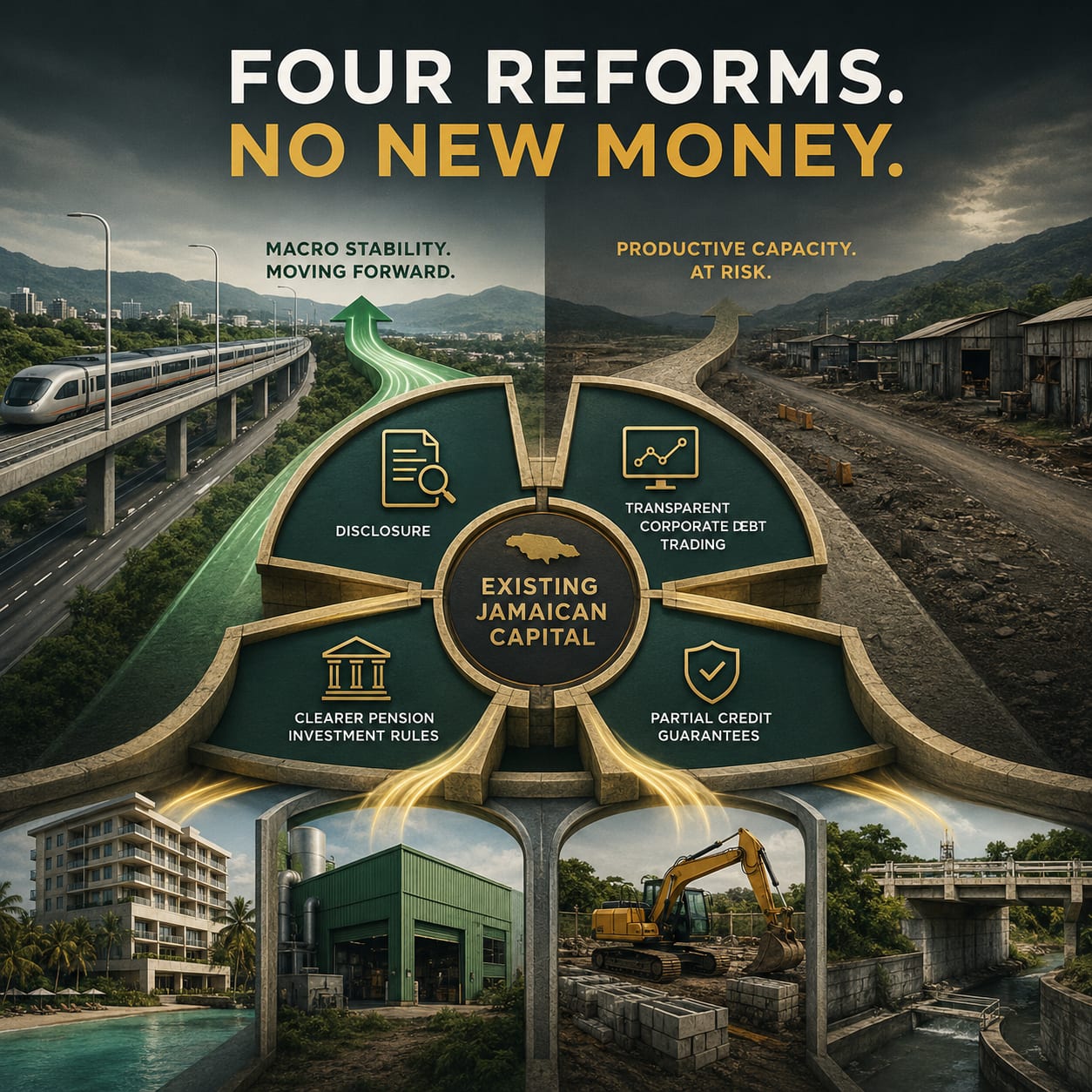
Four things would change that, none of them requiring new money.
Standardised disclosure for private placements would let pension funds and asset managers price corporate paper against something other than the arranger’s reputation. A listed segment for corporate debt with genuine post-trade transparency would, over time, produce a corporate curve, and a curve is the precondition for everything else. Clearer treatment of private credit and structured exposures in pension investment guidelines would stop long-dated local savings defaulting into government paper and equities. And partial credit guarantees from the multilaterals, structured deliberately to crowd local capital in rather than substitute for it, would stretch the concessional envelope considerably further. A guarantee that allows a Jamaican pension fund to hold a hotel refurbishment exposure it could not otherwise underwrite does more for the rebuild than the same dollar lent directly.
None of this is fast, and none of it will show up in a quarterly release. The risk of not doing it is a two-speed recovery: public infrastructure rebuilt on concessional external money, private productive capacity rebuilt out of retained earnings and insurance proceeds, which is to say rebuilt slowly, while household credit continues to finance the consumption that sits on top of a capital base nobody is replacing at pace.
Jamaica spent fifteen difficult years buying the macroeconomic credibility it now holds. Gross international reserves stand at US$6.7 billion, some 144.3 per cent of the adequacy measure. The currency held through a category five hurricane and a global commodity shock. That credibility was expensive, and it is worth defending. It would be a poor outcome to discover, three years into the reconstruction, that what it purchased was a stable economy with a smaller productive base.
Ambraee Houslin is a private equity strategist with a strong background in economics and statistics. He has extensive experience in investment banking, corporate finance, and investment research across Jamaica and the Caribbean region. His core expertise includes mergers and acquisitions, capital structuring, and executing complex transactions that drive growth and value creation. Ambraee has led and supported deals spanning strategic acquisitions, private credit facilities, and post-transaction integration strategies for high-impact sectors.






Comments