China aims to join ranks of global auto powerhouses by 2030

/ Our Today
administrator
China aims to join the ranks of the world’s automotive powerhouses by 2030, with stronger advantages across the entire industrial chain of intelligent connected new energy vehicles (NEVs), according to a five-year industry development plan released Friday.
The plan identifies intelligent connected NEVs as a key direction for transforming the auto industry, as China steps up efforts to upgrade its industrial sector and build a modern industrial system.
The plan, jointly released by nine government departments including the Ministry of Industry and Information Technology, sets targets for NEVs to account for 70 per cent of new passenger vehicle sales and 40 per cent of new commercial vehicle sales in the domestic market by 2030.

Vehicles equipped with autonomous driving functions are expected to see large-scale application by 2030, while highly automated driving is expected on expressways, urban express roads and some urban roads.
China has ranked first globally in automobile production and sales for 17 consecutive years. Last year, both auto output and sales exceeded 34 million units. NEV output and sales each topped 16 million units, maintaining the top position globally for the 11th straight year.
Latest industry data showed that NEVs further consolidated their dominant position in China’s auto market in August, with sales accounting for a record 60.6 per cent of monthly new car sales, according to the China Association of Automobile Manufacturers.
The plan calls for further advances in key technologies, setting targets for average passenger vehicle fuel consumption at 3.3 litres per 100 km and average electricity consumption of pure electric passenger vehicles at around 11.5 kilowatt-hours per 100 km by 2030.
The plan also calls for continued optimisation of the industry’s structure and a relatively high level of digital and intelligent development, with overall labour productivity targeted to rise 15 per cent from the 2025 level.

China has established a full industrial chain system for key intelligent connected vehicle technologies, covering smart cockpits, autonomous driving, and cloud-based connectivity and control.
Intelligent driving technologies have seen wider adoption. Since the beginning of 2026, the penetration rate of new passenger cars equipped with combined driver assistance functions in China has reached 70 per cent, according to the ministry.
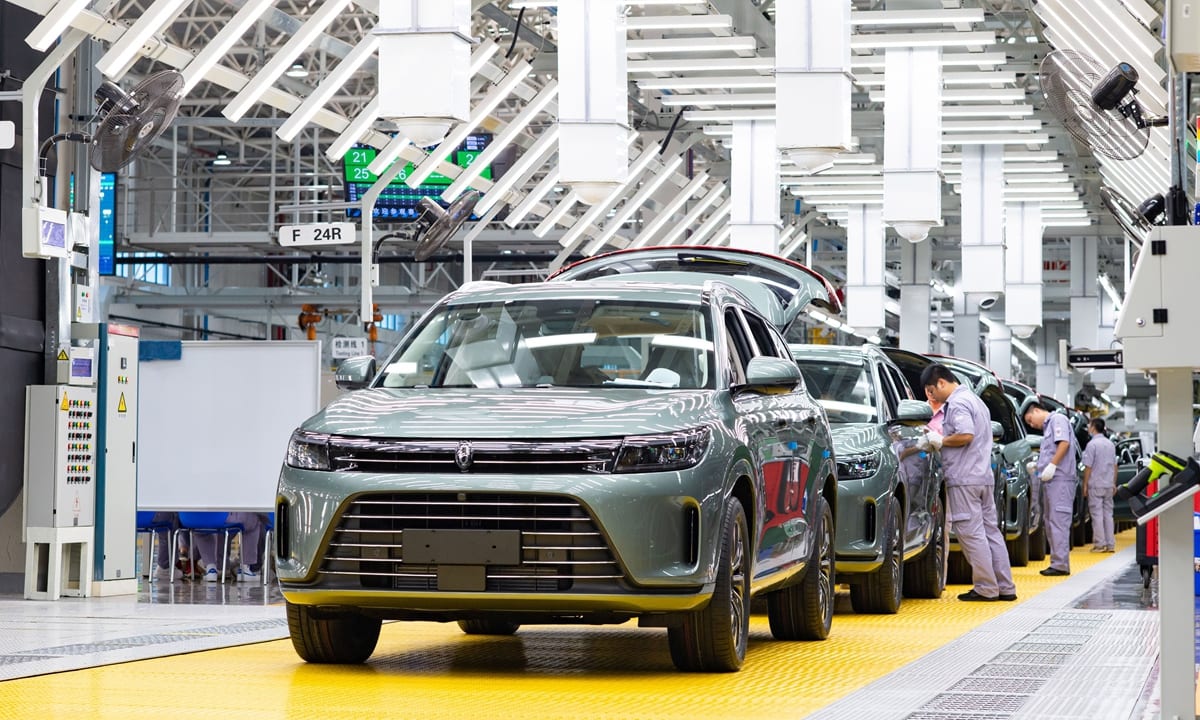
The plan also calls for further international expansion, with companies expected to strengthen global operations, Chinese auto brands to gain greater recognition, and China to have a stronger voice in shaping international standards and regulations by 2030.
China’s NEV exports continue to rise. In the first seven months of 2026, China exported 2.91 million NEVs, up 120 per cent year on year, accounting for 47.4 per cent of the country’s total vehicle exports.
China has also stepped up its participation in international rule-making for intelligent vehicles. In June, the world’s first global technical regulation on automated driving systems, jointly developed by China and several other parties, was adopted, with China leading the drafting of its core contents.
The plan also targets peak carbon emissions from the auto industry before 2030 and a faster green and low-carbon transition across the supply chain. Vehicles equipped with autonomous driving systems are expected to significantly outperform human drivers in safety.






Comments