
Dennis Miontt | In Jamaica, “Theirism Knocks Tourism Every Time”

/ Our Today
administrator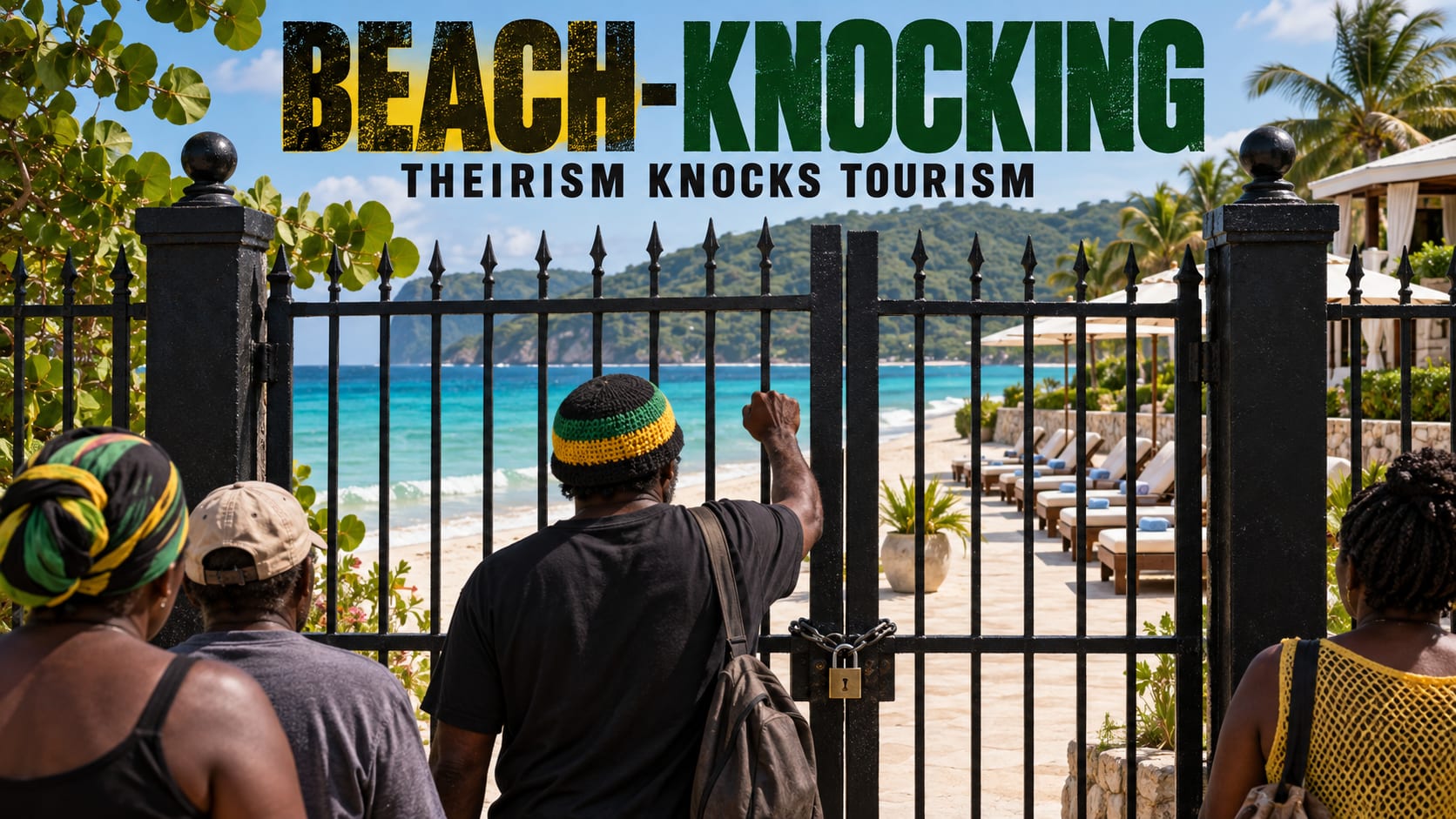
I now want to introduce a compound Jamaican word to the English language: beach-knocking.
Not sand-mining. That is merely one of the distractions.
The elephant on Jamaica’s coastline is beach enclosure—the progressive conversion of beaches that Jamaicans instinctively understand as part of their national inheritance into controlled, exclusive, and highly monetised spaces from which Jamaicans can be excluded.
Here, the true national tragedy reveals itself: in Jamaica, “Theirism knocks tourism every time.”
Notice the delicious, razor-sharp irony embedded in that single wordplay. To a British ear—or anyone steeped in Commonwealth English—”tourism” and “Theirism” sound virtually identical. Yet they are polar opposites in practice. Tourism is supposed to be an inclusive economic engine, a hospitality that welcomes the world to share in our national abundance. Theirism, on the other hand, is the cynical doctrine of total private capture. It is the quiet reallocation of our collective inheritance into the hands of them—the resort conglomerates, the exclusive developers, the offshore capital, and the gated enclaves—while we, the Jamaicans whose country supplies the asset, stand outside the perimeter fence.
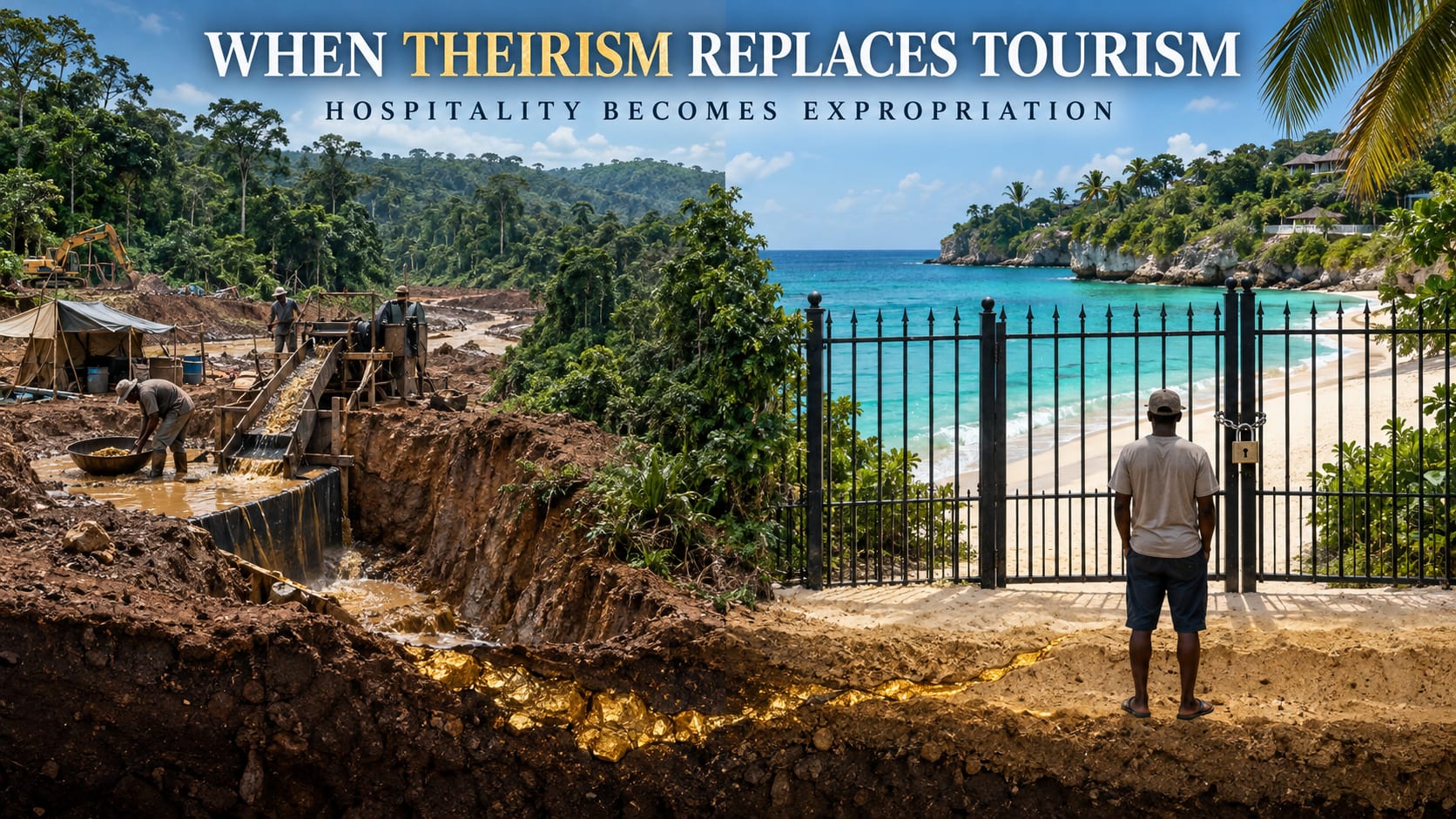
When “Theirism” replaces true tourism, hospitality turns into expropriation.
And this is where my old Guyanese experience with pork-knockers becomes relevant.
Years ago, my professional work took me into Guyana’s hinterland, where I saw at close quarters how gold and diamonds could be extracted from a nation’s interior by small operators and converted into private wealth far removed from the communities and landscapes from which that wealth originated.
The individual pork-knocker might look insignificant. The aggregate economic phenomenon was anything but.
I see an uncomfortable Caribbean parallel in Jamaica. Here the prize is not necessarily gold beneath the earth. It is the beach itself.
The breathtaking irony is that we advertise the Jamaican beach as ours—our national treasure, our tourism product, our Caribbean inheritance—while increasingly tolerating arrangements under which the Jamaican citizen can find himself standing outside the fence looking at “his” beach.
That is not a trivial contradiction. It is a question of ownership, access, economic value, and ultimately sovereignty.
Jamaica’s own environmental authority has acknowledged the problem.
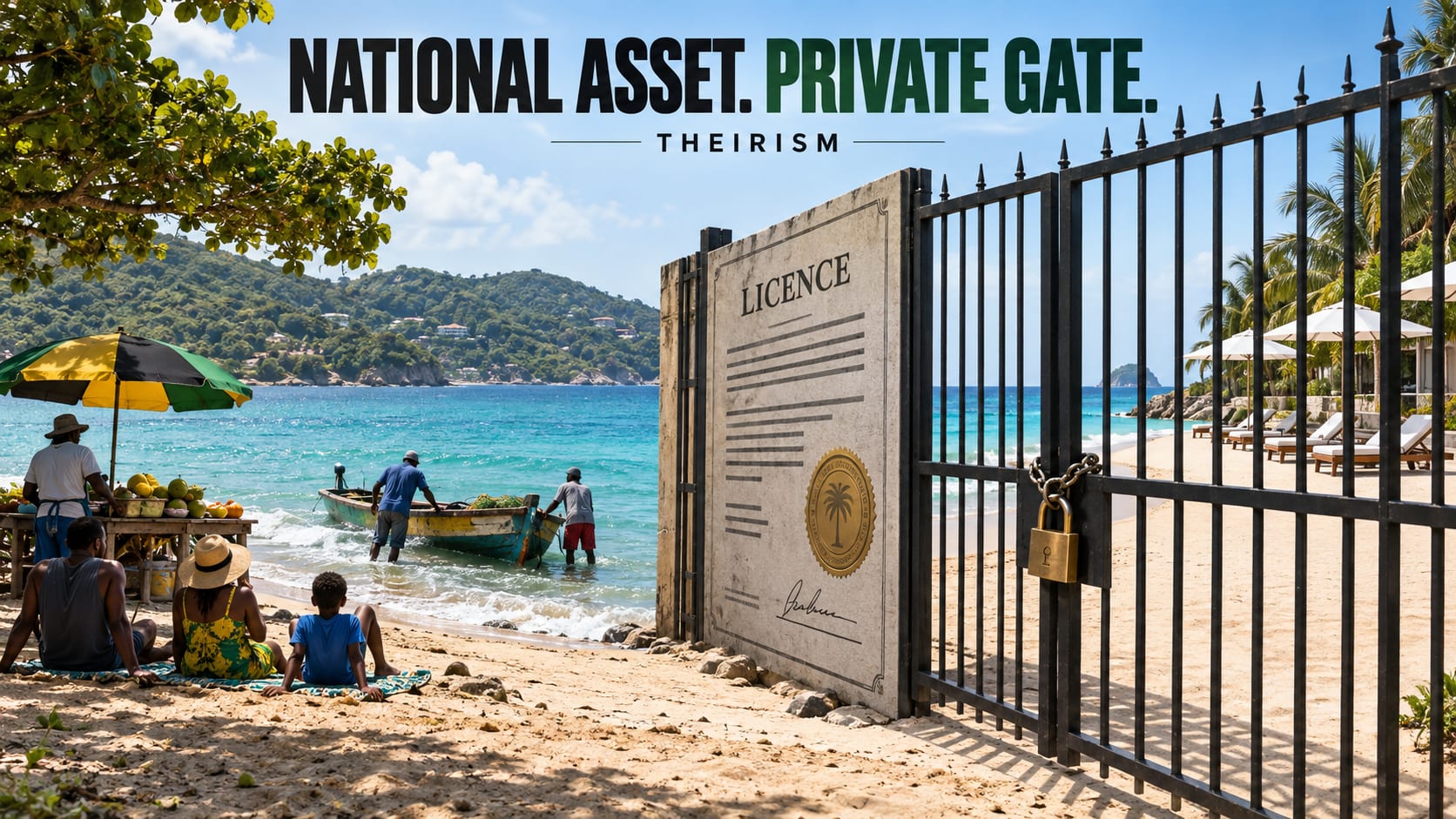
NEPA describes beaches as national assets providing public recreational space and supporting tourism, fishing, vending, and other livelihoods. It also explains that the Beach Control Act’s licensing regime exists partly to secure public access and that commercial entities developing beaches for recreational use require licences.
More revealingly, NEPA’s own policy history acknowledges that earlier management arrangements produced a system of exclusive licences that barred Jamaicans from enjoying some of the country’s finest beaches. Its stated objective has been to remove any vestige of real or implied discrimination against Jamaicans in the use and enjoyment of their national heritage.
Read that again.
The State itself has recognised the problem. And the problem is not simply that somebody stole a bag of sand. The problem is that access to an extraordinarily valuable piece of the Jamaican commons can be enclosed, controlled, and monetised under the banner of “Theirism.”
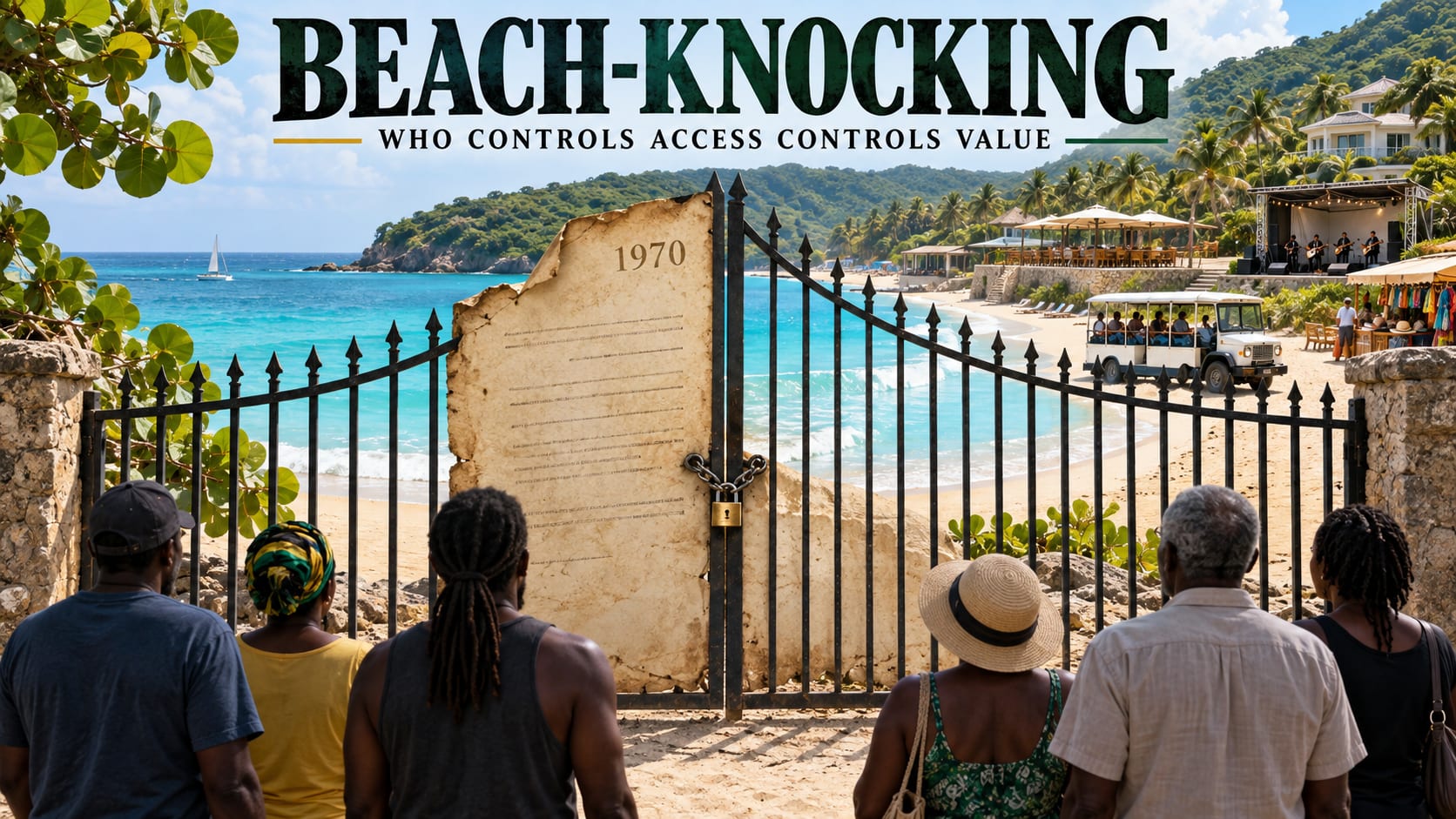
The 2025 Master Plan for Sustainable Tourism Development is even more revealing. It records that, historically, hotel beaches were licensed in a way that gave exclusive rights to the foreshore up to the mid-1970s; although exclusivity was subsequently supposed to be phased out, some licences issued before then continued to be renewed. The plan states that holders of exclusive licences could deny access altogether.
There, in official government documentation, is the elephant.
Beach exclusion is not some fevered invention of the Jamaican public. It is a documented feature of our institutional history.
And that history matters because a beach is not just a strip of sand. A magnificent beach is an economic asset. It attracts tourists. It raises the value of adjoining property. It creates opportunities for hotels, restaurants, villas, transportation operators, entertainers, vendors, and investors. It contributes to the value of entire coastal destinations.
Whoever controls access to the beach can therefore control access to a substantial stream of economic value.
That is where my use of “beach-knocking” begins.
I am not defining it as merely taking something from a beach. I am defining it as the appropriation, enclosure, control, or commercial capture of beach access in ways that convert a shared Jamaican inheritance into an increasingly exclusive economic asset.
And that makes the word “knocking” deliciously appropriate—and doubly potent.
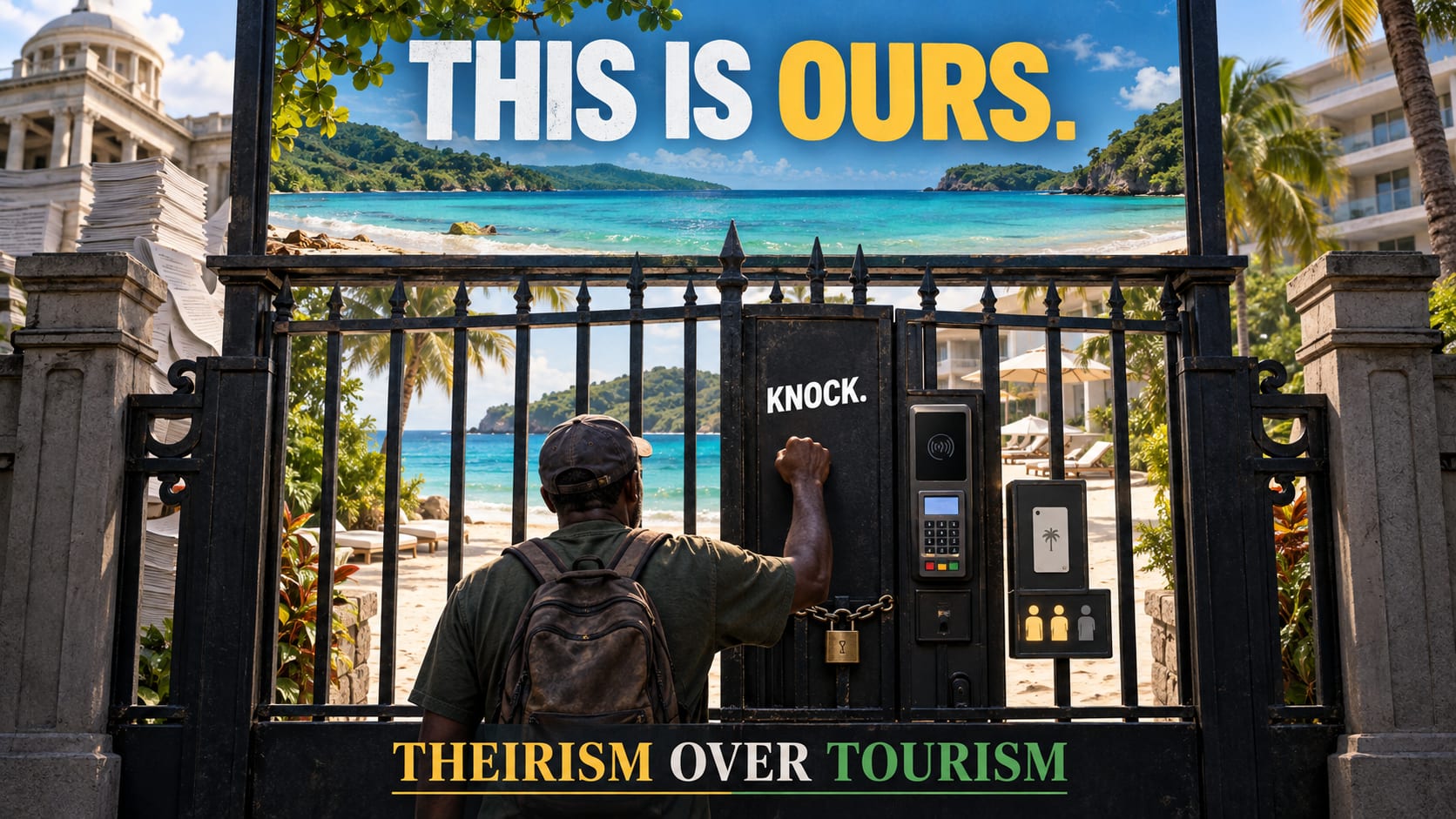
The Jamaican citizen is told: “This is Ours.”
Then comes the gate.
Knock. “Can I come in?”
There may be a price. There may be a rule. There may be an occupancy excuse. There may be a hotel policy. There may be a fence. There may be a sign explaining why the Jamaican who owns no hotel room cannot enjoy the beach beside which the hotel has been built.
Knock.
And the irony deepens.
We celebrate Jamaica’s beaches in foreign tourism advertisements as if the entire nation owns the postcard. Yet the economic machinery surrounding some of those beaches operates on the opposite principle: You may admire it as Jamaica. You may not necessarily access it as a Jamaican.
That is the ultimate victory of Theirism over Tourism.
And it is why I use the word “penetrated.” Beach-knocking has not merely appeared on the beach. It has entered the organs of the Jamaican State.
The Beach Control Act vests the foreshore and floor of the sea in the Crown and establishes a licensing regime for their use. The legislation also expressly provides for determining public needs and acquiring land for public purposes.
The governmental machinery therefore knows that there is a public interest to protect. NEPA lists among the functions associated with beach management the provision of public access, acquisition of beaches and coastal lands for public benefit, protection of existing beaches, and establishment of new ones.
So the question is not whether the State has forgotten that beaches have a public dimension. It has not.
The question is more uncomfortable: Why, despite decades of policy recognition, legislation, licensing, and official declarations, does the ordinary Jamaican still experience beach access as a contested privilege rather than an unquestioned component of citizenship? Why does Theirism continue to knock genuine, inclusive tourism out of the ring?
That question cannot be answered by blaming one hotel. Nor should it be reduced to a crude argument against tourism or private investment.
Jamaica needs tourism. Jamaica needs investment. Jamaica needs profitable hotels.
But Jamaica does not need a Theirism model in which the natural asset that makes the investment profitable becomes progressively inaccessible to the citizens whose country supplies it.
That is the distinction. The issue is not foreign versus Jamaican. It is exclusive economic capture versus public inheritance.
And there is an even deeper issue.
When an investor acquires or controls beachfront property, the value of that property is not produced by the investor alone. The sea was already there. The climate was already there. The coral reefs, where they survive, were already there. The coastline was already there. The Jamaican identity of the destination was already there.
The infrastructure, public security, roads, airports, utilities, environmental regulation, and national branding are part of the wider public ecosystem that makes the investment possible.
Yet once the beach becomes sufficiently valuable, the public can discover that its contribution to creating that value does not necessarily entitle it to enjoy the underlying asset.
That is an economic arrangement worthy of examination. It is also a democratic one.
NEPA’s earlier beach policy explicitly proposed identifying, reopening, and preserving accessways; requiring access at new coastal developments; acquiring accessways where necessary; and protecting longstanding access routes.
In 2025, the Government again publicly reaffirmed its commitment to expanding and protecting public beach access and said that a completed Beach Access Policy was before Cabinet for final review.
Excellent. Then let us measure the State by the distance between policy and reality.
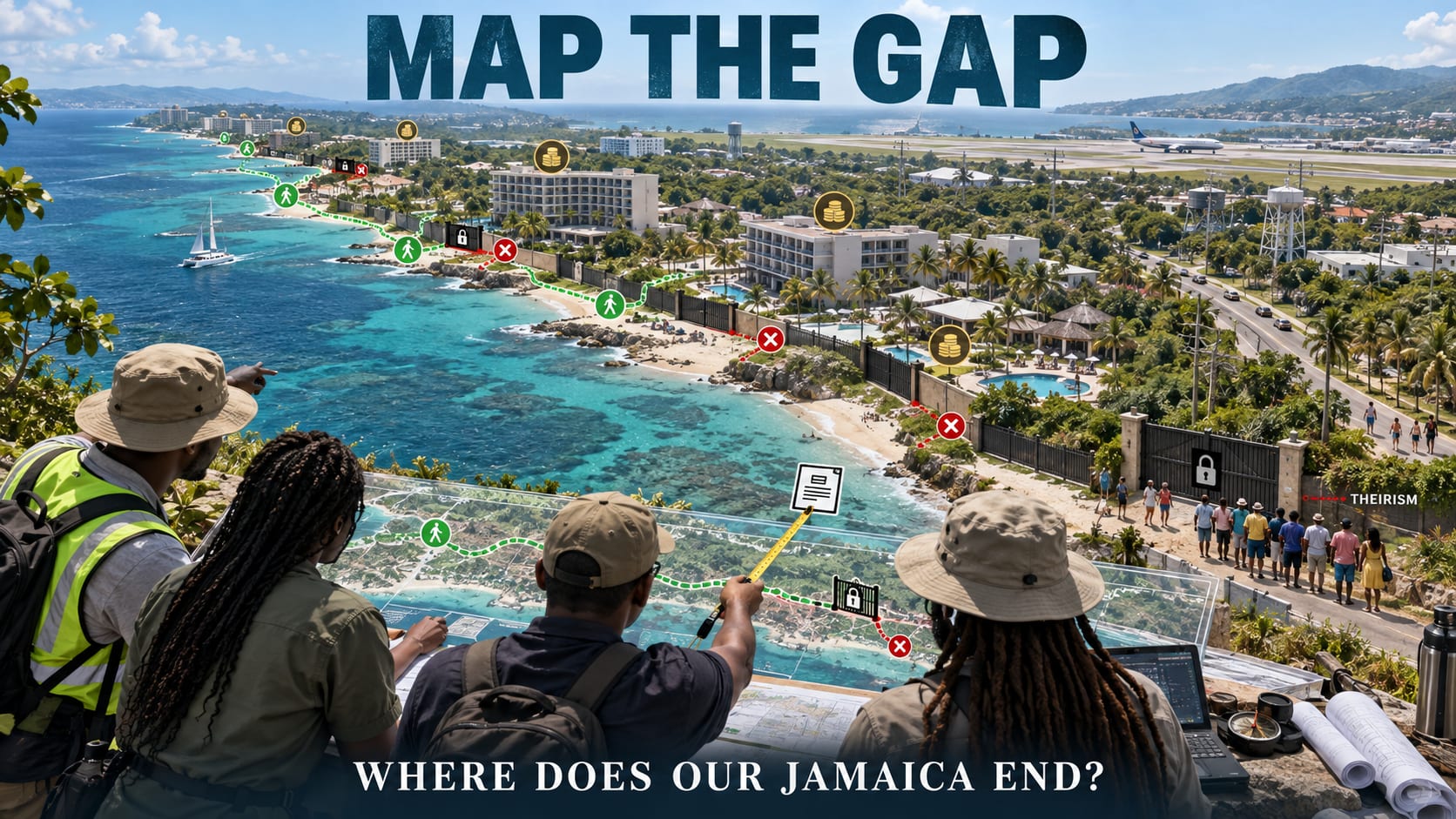
- Let us map every kilometre of coastline.
- Let us identify every public accessway.
- Let us identify every enclosure.
- Let us identify every exclusive or historically exclusive licence.
- Let us publish who holds what rights, for how long, under what authority, and at what cost.
- Let us determine how much economic value is generated by these privileged stretches of coastline.
And let us ask the most Jamaican question of all: Where does “Our Jamaica” end—and where does Theirism begin?
That is the question hidden inside beach-knocking.
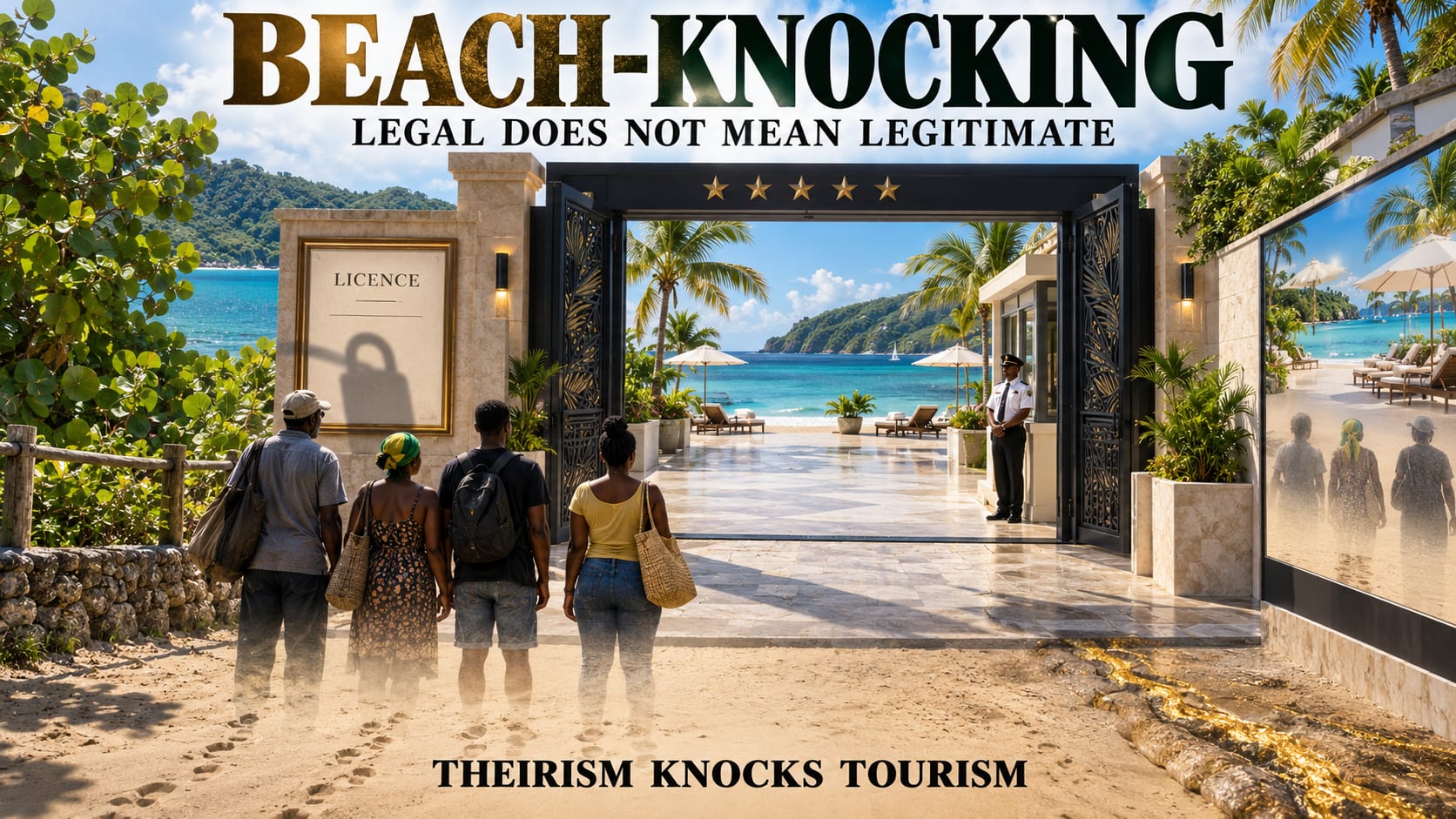
For I have come to believe that the greatest beach theft is not necessarily a truck carrying sand away at midnight. It may be something much more respectable. It may have a licence. It may have a fence. It may have a security guard. It may have a glossy brochure. It may have a foreign exchange component. It may have a five-star rating. It may even be called development.
But if the economic value of a national coastal inheritance can be captured privately while ordinary Jamaicans are progressively excluded from enjoying that inheritance, then we need to stop congratulating ourselves merely because the transaction is legal.
Legality is not the same thing as legitimacy. And a licence to use the commons should never quietly become a licence to make the commons disappear from public life.
That is why I call it beach-knocking.
The pork-knocker went into Guyana’s hinterland looking for gold. The beach-knocker does something subtler. He does not necessarily carry the beach away. He knocks Jamaica out of it.
Every single time, Theirism knocks Tourism.
And perhaps that is why the word deserves to travel. By the end of 2027, I expect beach-knocking and Theirism to be knocking on the doors of Webster’s, the Concise Oxford Dictionary and, naturally, Cassidy’s.
They should let them in. Because Jamaica already knows what they mean.
We have been hearing the knock for years. The question is whether we will finally open the door—or realise that the door has been put between us and our own sea.
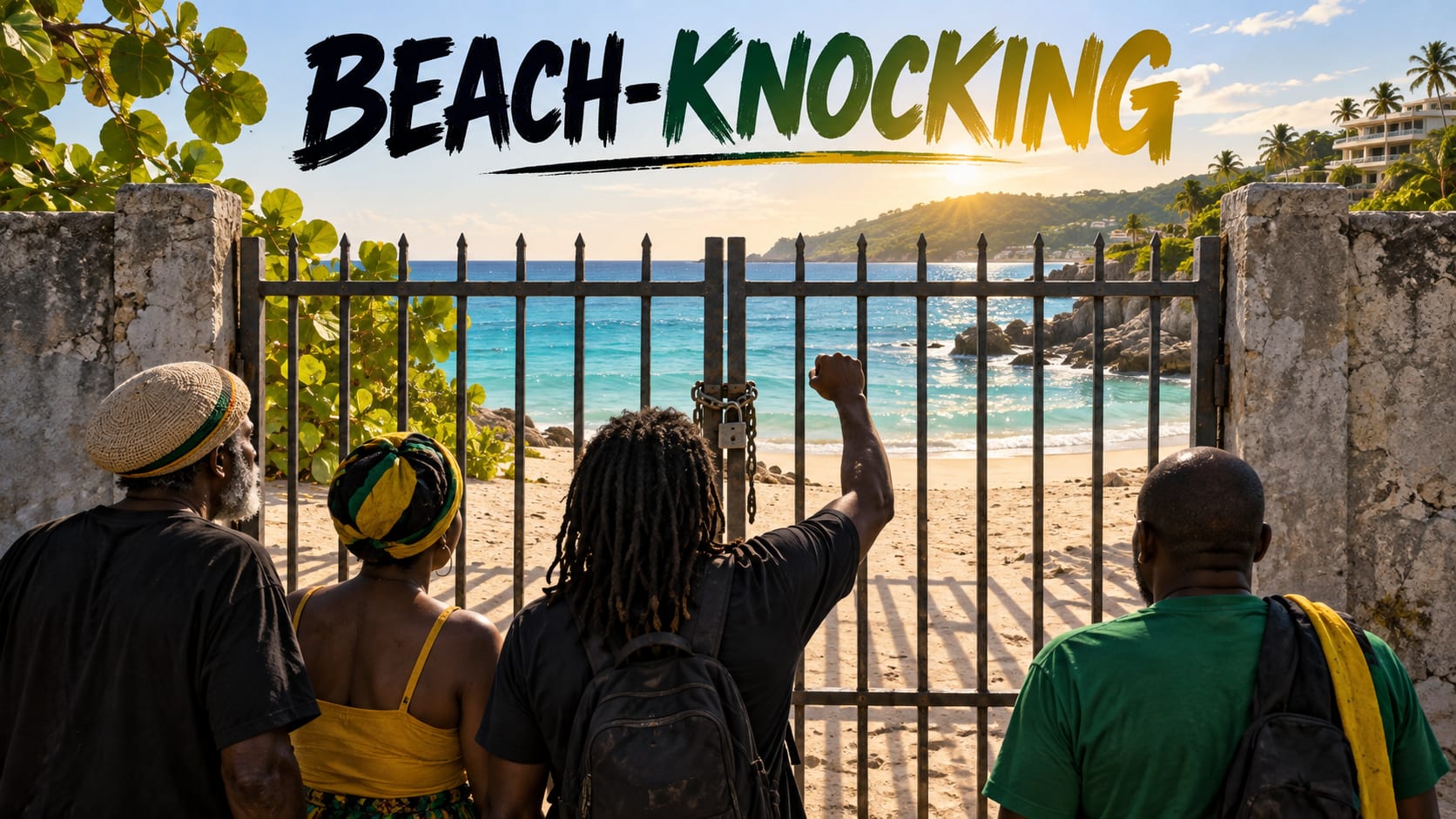
BEACH-KNOCKING
A new Caribbean song
Verse 1
This is our island, this is our sea,
Blue water calling you and me,
But down by the shoreline somebody built a wall,
“Welcome to Jamaica”—but not one and all.
Chorus
Knock, knock, knock on the beach, my brother,
Knock, knock, knock, one for another,
They say “Our Jamaica,” but the gate say “No,”
Who owns the beach where the blue waves flow?
Verse 2
Gold in the hinterland, sand by the sea,
Who takes the treasure, who gets the fee?
One takes the gold and one takes the view,
They trade it for Theirism—what remains for you?
Chorus
Knock, knock, knock on the beach, my sister,
Knock, knock, knock, don’t let them miss ya,
They say “Come to Jamaica”—then lock the door,
But the sea belongs to we forevermore.
Bridge
No fence can own the sunrise,
No gate can own the tide,
No hotel can buy the horizon,
No licence can own our pride.
Final Chorus
Knock, knock, knock—hear Jamaica knocking,
Knock, knock, knock—hear the people talking,
If the beach is ours, then let the people see,
The sea, the sand, the shore—
and the right to be free.
Outro
From Montego Bay to Portland’s shore,
From Negril’s sunset to St Thomas’ door,
Don’t knock Jamaica out of Jamaica—
Don’t let Theirism take our home.
The beach is ours.
The beach is we.






Comments