
Oneil Madden | Does a haircut produce discipline?

/ Our Today
administrator
Jamaica’s grooming debate should force us to ask what kind of discipline our schools are actually trying to cultivate.
Jamaica has become remarkably good at having national conversations about children’s hair.
Every school year, it seems, we return to the same battleground: hair length, hairstyles, “edges”, belt buckles, buttons, uniform measurements, and the ever-expanding definition of what constitutes being properly groomed.
In September 2025, the controversy reached a new level when at least 34 boys at Calabar High School were reportedly locked out over various uniform and grooming infractions, while restrictions on “edges” at St Andrew High School for Girls ignited another social-media storm.
Now, as Jamaica prepares for a revised National Student Dress and Grooming Policy, the debate has resurfaced. The education ministry has rightly clarified that students should not be locked out of school because of grooming or uniform breaches; disciplinary measures should be administered within the school.
That is an important step. But perhaps we are still asking the wrong question. The question should not simply be whether students should obey grooming rules. The more uncomfortable question is: What kind of discipline are we actually cultivating by making conformity to appearance rules such a significant measure of student discipline?
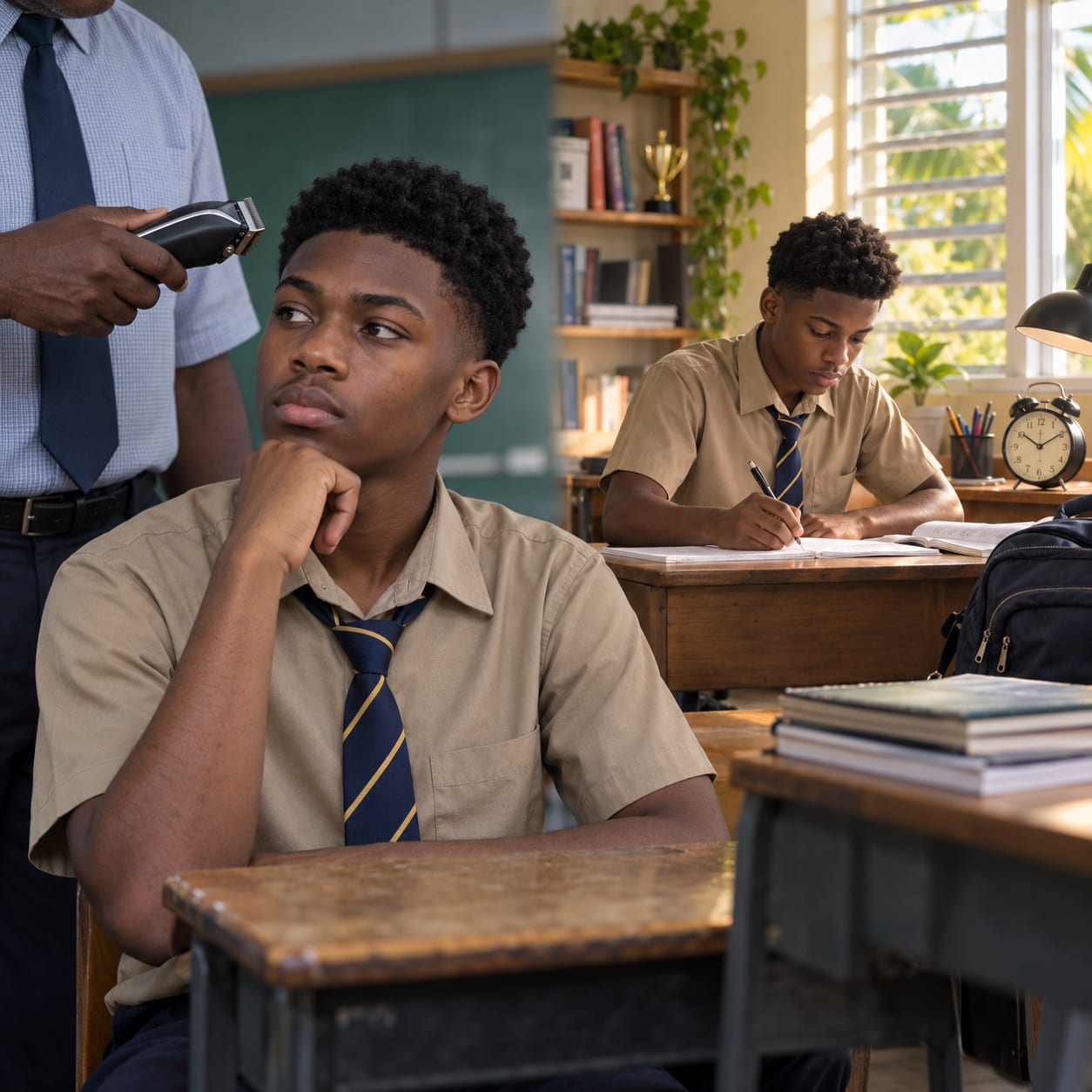
Does a haircut produce discipline?
Those who defend strict grooming policies often make a reasonable-sounding argument: Schools need rules, young people need boundaries, and learning to follow rules prepares students for adult life.
Many educators and administrators have argued that school rules are intended to teach students the principle of compliance in society.
Fair enough.
But let us follow that argument to its logical conclusion.
What evidence do we have that a student who learns to maintain a prescribed haircut becomes a more disciplined adult?
Where is the evidence that forcing a teenager to remove an “unacceptable” hairstyle develops integrity, self-control, perseverance, punctuality, empathy, honesty or responsibility?
And if the answer is simply, “It teaches them to follow rules,” then perhaps we need to distinguish between obedience and discipline.
They are not the same thing.
A person can be extraordinarily obedient in a controlled environment and yet lack the capacity for self-regulation when external authority disappears.
Conversely, a young person can question an arbitrary rule while demonstrating extraordinary discipline in studying, practising a musical instrument, playing sport, caring for a family member or pursuing a personal goal.
Discipline is not merely the capacity to obey someone else’s instructions. It is the capacity to regulate oneself in pursuit of worthwhile goals.
That distinction matters enormously.

There is an interesting experiment that Jamaica conducts every year without apparently recognising it.
Thousands of students leave secondary school. They arrive at university. And suddenly, many of the grooming rules that supposedly cultivated their discipline disappear.
Nobody at university (but perhaps at some teachers’ colleges) is measuring the length of their hair every morning. Nobody is sending them home because their hairstyle does not conform to a school-specific definition of neatness. Nobody is inspecting whether their edges are sufficiently subdued. Nobody is measuring the width of their belt buckle before allowing them into a lecture.
And yet, universities expect these same young adults to demonstrate far greater discipline.
They must attend classes without being chased; meet deadlines without their parents receiving a telephone call; read independently; manage their time; complete research; navigate competing responsibilities; respect lecturers and classmates; exercise academic integrity; and ultimately take responsibility for their own learning.
So here is the question we should ask ourselves: If the grooming regime disappears at 18, where exactly did the discipline supposedly cultivated by that regime go?
Ask university students and graduates what made them disciplined adults. I suspect very few will say: “It was because my high school insisted that my hair be cut to a particular length.”
More likely, they will point to parents, teachers, mentors, sport, church, work, personal adversity, academic expectations, consequences, responsibilities and experiences that taught them self-management.
That distinction should force us to reconsider what we mean by discipline.

Rules are not the problem. Arbitrary rules are.
To be clear, this is not an argument for schools having no rules.
Schools need rules. Students need boundaries.
Uniforms can create a sense of identity and belonging. Reasonable standards of hygiene and appearance are legitimate. Schools are communities, and communities cannot function without agreed expectations.
The issue is proportionality.
There is a profound difference between: “Come to school clean, appropriately dressed and prepared to learn.” and: “Your hair does not conform to our preferred aesthetic; therefore, your educational experience must be interrupted.”
There is an even greater problem when the definition of “proper grooming” becomes subjective. What is “neat”? What is “professional”? What is “appropriate”? And who gets to decide?
These questions become particularly important in a predominantly black society where hair can carry cultural, historical, and personal significance. Child-rights advocates have recently warned that grooming standards must not force Jamaican students to conform to Eurocentric ideas of appearance or undermine dignity, cultural identity, and freedom of expression.
This is not about telling children that anything goes. It is about asking whether the standard itself is reasonable.

Are we teaching children to think – or simply to comply?
There is a deeper educational issue here. The purpose of education is not merely to produce people who follow instructions. We want graduates who can think critically, make ethical decisions, solve problems, challenge assumptions and exercise sound judgement.
But there is a tension between teaching those capacities and treating unquestioning compliance as the highest expression of discipline.
If a student asks, “Why does the length of my hair affect my ability to learn?”, is the appropriate educational response: “Because that is the rule”? Or should it be: “Let us examine why this rule exists, what purpose it serves, whether it is reasonable, and what responsibilities accompany your freedom.”
The latter is considerably harder. It requires dialogue. It requires justification.
It requires teachers and administrators to distinguish between rules that protect the educational environment and rules that merely reproduce institutional tradition. But isn’t that precisely the kind of critical thinking we claim we want to develop?
We should also be honest about what is happening outside the school gate.
There is an irony in the intensity with which we police a student’s hair while the same child may be navigating a digital environment far more influential than the school uniform.
Jamaica’s recent national study on social-media use among minors found significant exposure to sexual content, unwanted sexual messages, violence, emotional distress and harmful online challenges. One in four caregivers surveyed reported that children under their supervision had experienced sexual exposure or grooming attempts linked to social media.
Meanwhile, concerns about student violence, substance use and social-media influence continue to occupy the national conversation.
So perhaps our hierarchy of concern deserves reconsideration. A student with two inches of hair above what a school considers acceptable can still be a disciplined, respectful, academically ambitious young person. A perfectly groomed student can still bully another child, cheat on an examination, engage in violence, disrespect authority, abuse social media or lack empathy.

Appearance is visible. Character is not.
And because appearance is visible, it is tempting for institutions to regulate it heavily. It gives us something measurable.
Character development is much harder. You cannot measure integrity with a ruler. You cannot inspect empathy at morning devotion. You cannot determine resilience by examining a student’s haircut. You cannot produce critical thinkers through compliance alone.
Perhaps we have confused order with discipline. There is nothing wrong with an orderly school. But order is not synonymous with character.
A school can have immaculate uniforms, perfectly trimmed hair and students standing silently in straight lines – and still fail to cultivate responsible citizens.
The converse is also true: A school can allow reasonable individuality while maintaining rigorous expectations for academic performance, respectful conduct, punctuality, honesty and responsibility.
Perhaps the real discipline we should be cultivating is the kind that remains when nobody is watching: The discipline to submit an assignment when nobody is checking. The discipline to tell the truth when lying would be easier. The discipline to walk away from a fight. The discipline to resist peer pressure. The discipline to use social media responsibly. The discipline to respect someone with whom you disagree. The discipline to take responsibility for one’s choices. The discipline to think before acting. That is the discipline Jamaica desperately needs.
So, what exactly is our objective? The Ministry of Education’s decision that grooming violations should not prevent students from accessing education is sensible. But the wider policy conversation gives us an opportunity to go much further.
Let us stop asking only: “How do we make students comply?” Let us ask: “What kind of adults are we trying to produce?”
If the answer is responsible, self-regulating, ethical, confident and critically thinking citizens, then our disciplinary systems must be evaluated against those outcomes.
A grooming policy should have a clear and defensible educational purpose. It should be reasonable, consistently applied, culturally sensitive, and proportionate. And when a student violates it, the response should not eclipse the fundamental purpose of schooling: education.
Jamaica does not need schools without standards. It needs schools with better standards. Standards that move beyond the superficial and visible to the difficult work of cultivating character. Because one day, the bell will ring for the final time. The student will leave the school gate. The uniform will come off. The grooming policy will no longer apply. And then what?
If we have spent twelve years teaching a child how to comply but not how to think, choose, regulate and take responsibility, can we really call that discipline?
Perhaps it is time to cut something from Jamaica’s school system. Not necessarily the student’s hair – but our attachment to the idea that conformity is the same thing as character.
Oneil Madden is a Lecturer of Academic Literacy and French PhD Candidate in Applied Linguistics, Université Clermont Auvergne, France. He can be contacted at : [email protected]





Comments