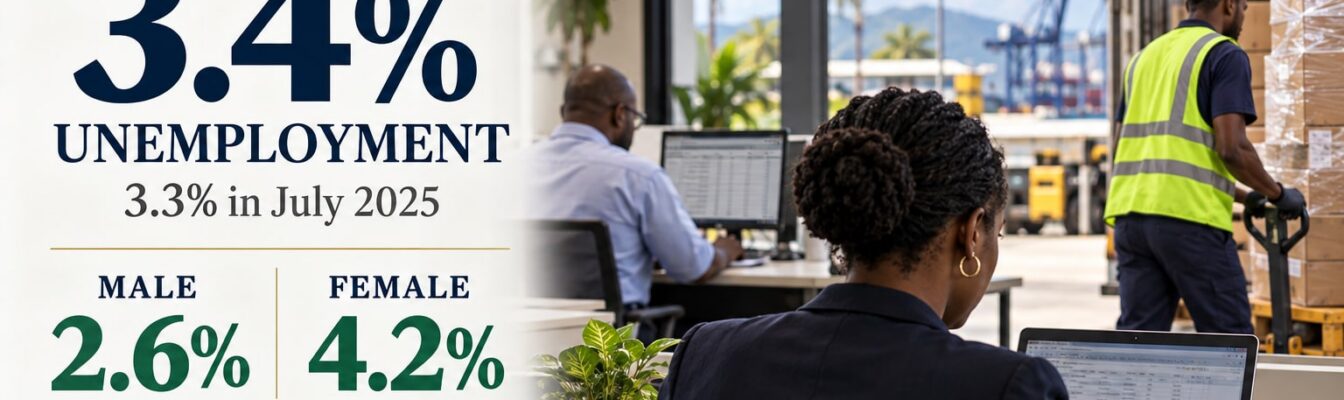
Jamaica’s unemployment relatively flat at 3.4% at July 2026

/ Our Today
administrator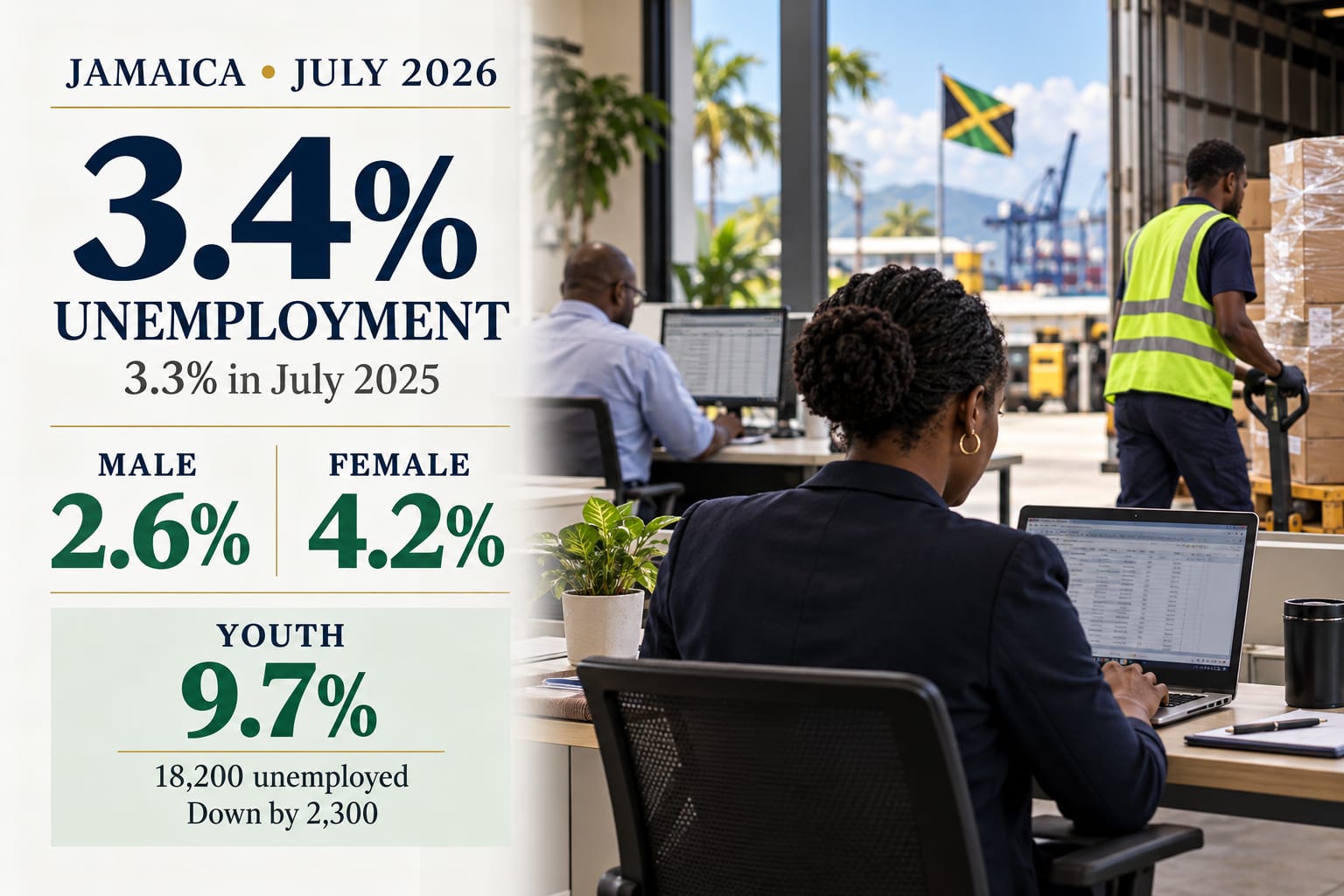
Youth unemployment down 2,300, as an additional 14,800 of them exited the labour force
Durrant Pate/Contributor
Jamaica’s latest Labour Force Survey (LFS) finding shows the unemployment rate remaining relatively unchanged at 3.4 per cent as at July 2026, compared with 3.3 per cent in July 2025.
The unemployment rate was 2.6 per cent for males and 4.2 per cent for females. Youth unemployment went down by 2,300 to 18,200, resulting in a youth unemployment rate of 9.7 per cent.
The survey, which is administered by the Statistical Institute of Jamaica (STATIN) shows Jamaica’s labour force at 1,468,500 persons, down by 21,800 compared with July 2025. The July 2026 Labour Force Survey, released yesterday, shows employment declining by 21,900 to 1,419,200, while the number of persons outside the labour force increased by 21,800 to 687,300.
The decline in labour force participation was primarily driven by the reduction in employment, as many persons moved outside the labour force. The reference week for the survey was July 5–11, 2026 with July 2026 being the first quarter since Hurricane Melissa in which the full LFS questionnaire was administered in all parishes, enabling comparisons of all standard indicators with the corresponding quarter of 2025.
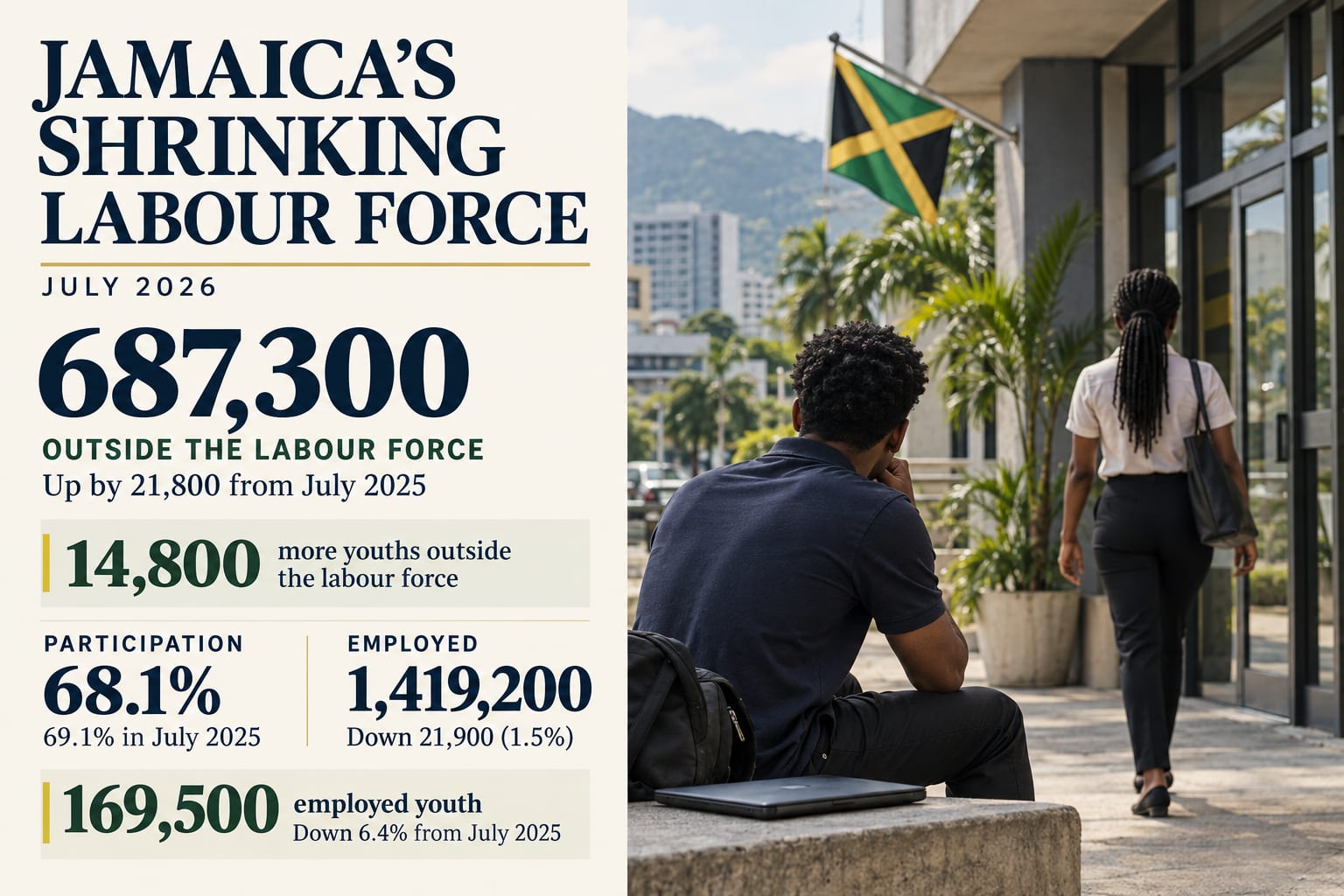
More persons outside the Labour Force
The number of persons outside the labour force was 687,300, an increase of 21,800 compared with July 2025. Males outside the labour force increased by 6,700, while females jumped by 15,100. The overall rise in the number of persons outside the labour force was largely due to an additional 14,800 youths exiting the labour force.
The overall labour force participation rate was 68.1 per cent relative to 69.1 per cent in July 2025. The labour force totalled 1,468,500, a decrease of 21,800 individuals. The male labour force fell by 6,700 to 787,700, while the female labour force declined by 15,100 to 680,800.
The number of employed persons stood at 1,419,200, down by 21,900 (1.5%) compared with July 2025. The number of employed males went down by 8,600 to 767,000, while the number of employed females decreased by 13,300 to 652,200.
There were 169,500 employed youth, a decline of 6.4 per cent compared to July 2025.
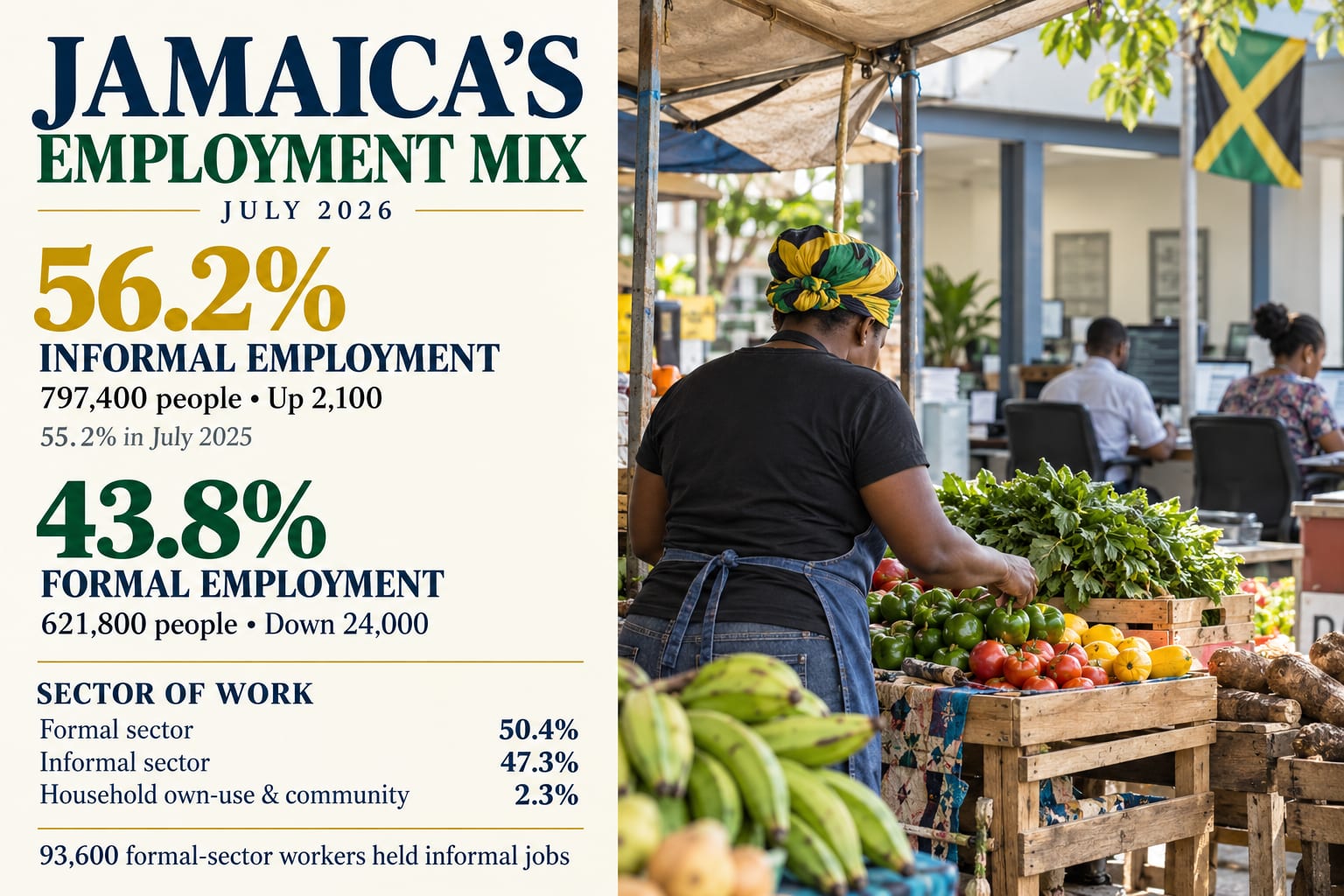
Disaggregating by sector employment
Among the employed, 50.4 per cent (715,400) were in the formal sector, 47.3 per cent (671,700) in the informal sector and 2.3 per cent (32,100) in Household Own-use and Community (HOC) activities. Compared with July 2025, 6,900 fewer persons were in the formal sector, 12,300 fewer persons were in the informal sector and employment in the HOC sector fell by 2,700.
Turning to the nature of employment, an estimated 621,800 employed persons (43.8%) were in formal employment in July 2026, representing a decrease of 24,000 compared with July 2025. Informal employment was 797,400, an increase of 2,100 persons.
Consequently, the informal employment rate was 56.2 per cent compared to 55.2 per cent in July 2025. Among employed males, 63.1 per cent were in informal employment, compared with 48.0 per cent of employed females.
Most persons employed in the formal sector (86.9%) held formal jobs; however, 93,600 persons in the formal sector were engaged in informal employment. STATIN notes that this is the first official release of estimates on formal and informal employment, and employment in the formal, informal and HOC sectors from the revised LFS.
The estimates have been produced in accordance with the latest international statistical standards for measuring informality.

Comments