
R.A. Grant | Rebuilding Jamaica’s schools requires partnership, not blame

/ Our Today
administrator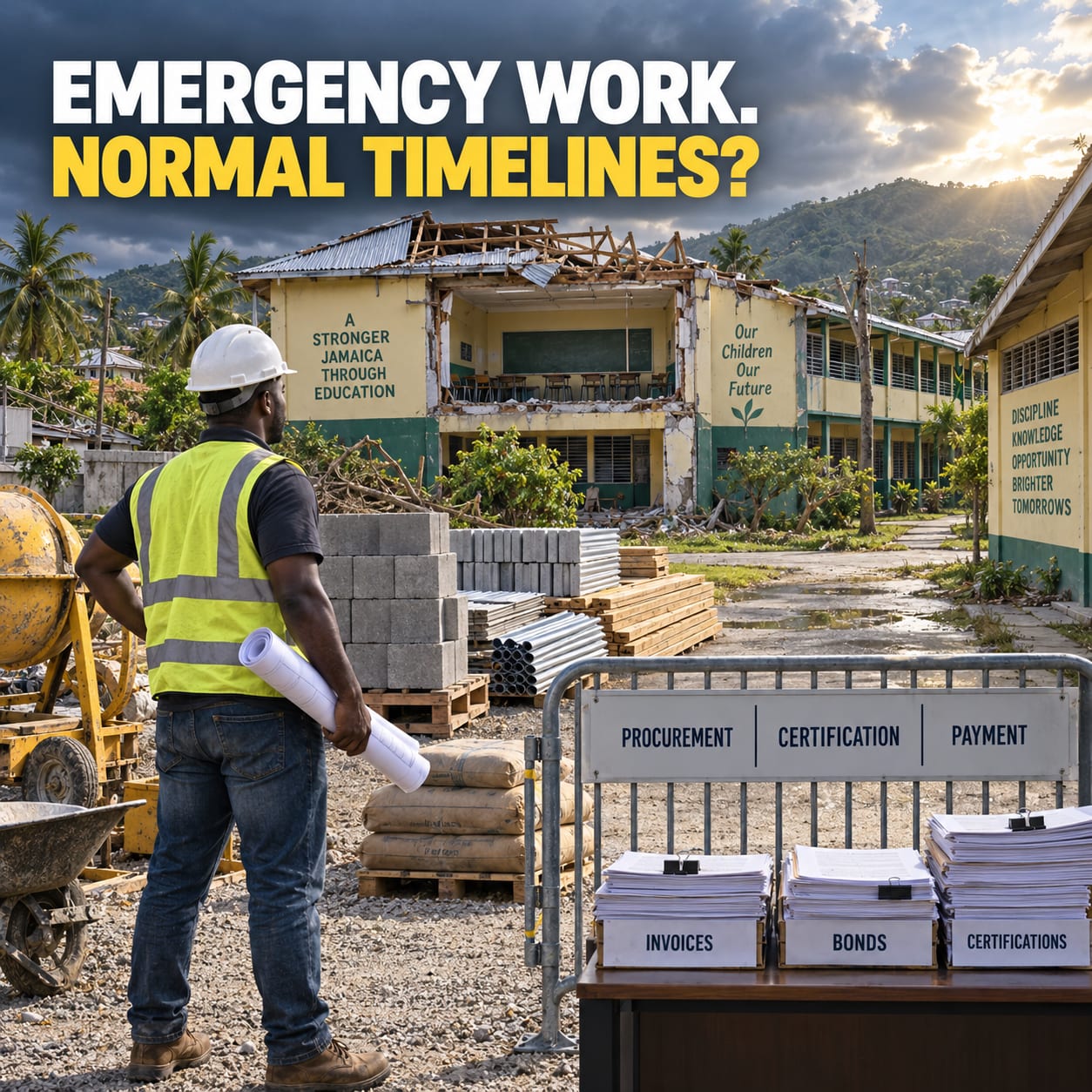
The recent pronouncements about the shortage of registered contractors available to rebuild schools damaged by Hurricane Melissa require a more balanced and honest conversation.
Before we place the blame on contractors, we must understand the realities they are facing.
There is no question that Jamaica needs to rebuild its schools quickly. Our children, teachers and communities cannot afford unnecessary delays. But emergency reconstruction cannot be managed entirely as business as usual.
Contractors are expected to mobilise labour, equipment and materials, provide bonds, pay suppliers and subcontractors, and meet extremely tight deadlines. All of this requires cash flow.
So the question is simple: How can we demand emergency results while expecting contractors to operate under normal procurement, certification and payment timelines?

Emergency Work Requires an Emergency Approach
Jamaica’s procurement framework recognises that emergencies require special consideration. We therefore need to ensure that the entire delivery system—from procurement and mobilisation to certification and payment—is capable of moving with the same urgency as the work itself.
Many contractors are willing to take risks because they believe in Jamaica and want to see our schools reopened. Some will even jeopardise their own businesses and reputations to get the job done.
But patriotism cannot be a financing mechanism.
Contractors need working capital to perform.
For established contractors with proven track records, I believe we should seriously consider a special emergency delivery model, with stronger mobilisation support and accelerated interim payments, subject to proper safeguards, securities and verification.
The current rules place limits on mobilisation, so any significant increase would require the appropriate policy and regulatory consideration. But the principle is clear: if we want contractors to mobilise quickly, the system must give them the financial capacity to do so.
We Must Also Address Payments
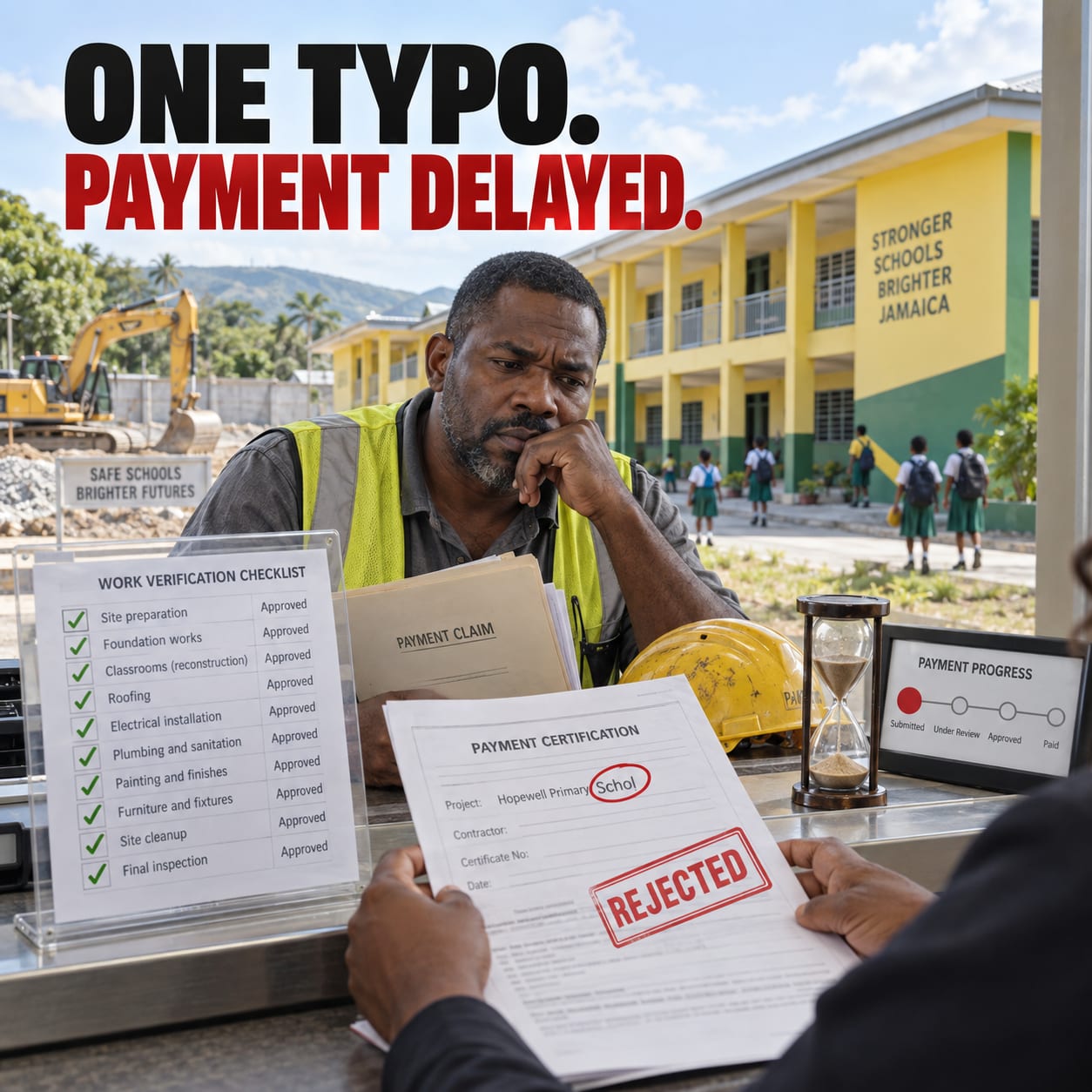
It is widely recognised within the construction industry that Government contractors can experience lengthy payment periods.
Of course, claims must be properly submitted and work properly certified. Accountability is essential.
But if a contractor is instructed to proceed urgently with additional work, the process for valuing, certifying and paying for that work must also move urgently.
I have witnessed situations where a contractor’s claim was rejected over a minor typographical error, while that same contractor was being criticised for not moving quickly enough on a variation.
Make that make sense.
We must distinguish between protecting public funds and creating unnecessary administrative obstacles.

Technical Teams Must Help Deliver
This is not an attack on the many hardworking professionals within Government. Jamaica has excellent engineers, architects, quantity surveyors and project managers.
But everyone involved must see themselves as part of the solution.
When a contractor is behind, the question should not only be, “Why are you behind?”
It should also be, “What is preventing progress, and what can we do to resolve it?”
That is what partnership means.
We must also be careful when interpreting project reports. A percentage-complete figure does not always tell the full story. Construction activities have different values and weightings, and variations, approvals, materials and payments can significantly affect progress.
Before public statements are made about a contractor’s performance, the full scope of the project should be understood.

We All Have a Responsibility
The rebuilding of Jamaica’s schools is too important for us to spend our time looking for someone to blame.
The Ministry has a responsibility.
NET has a responsibility.
Contractors have a responsibility.
Consultants and technical professionals have responsibilities.
The contractor is not the enemy. The Ministry is not the enemy. We are all supposed to be on the same side.
My recommendation is simple: before assessing a contractor publicly, examine the complete picture—scope, variations, approvals, payments, resources and the factors within and outside the contractor’s control.
Going forward, Jamaica should consider a dedicated emergency construction delivery framework with faster procurement, improved mobilisation, accelerated certification and payment, and quicker approval of emergency variations.
We do not need less accountability.
We need a system that understands the difference between an ordinary project and a national emergency.
At the end of the day, these projects are a partnership with one common goal: to get our children back into safe, functional and resilient schools.
We all win when the projects are completed successfully. Jamaica wins. Our children win.
R.A. Grant, JP, is the Founder & CEO of GARCSL Limited. He is a construction professional for the last 27 years.






Comments