
Rodger McKenzie | Criminal liability before the rules exist is just as criminal: why Jamaica’s VASP Bill must be paused (Part 1)

/ Our Today
administrator
Where the Minister is right
The Jamaica Blockchain & Cryptocurrency Association, established in 2022, does not oppose regulation.
We support Jamaica’s FATF obligations and affirm the Bill’s strongest consumer-protection provisions: quarterly audited proof of reserves, client-asset segregation, prohibitions on market manipulation, cold-storage standards, and fit-and-proper testing. These provisions are genuinely protective and we ask Parliament to retain them.
Minister Williams is also correct that Jamaicans are already buying, holding, and transferring virtual assets through platforms licensed abroad, with no local recourse when things go wrong. She is correct, and admirably candid, when she told the House: “I know I’ll be the first to say that the bill is not perfect. It is a first step.”
This paper is our contribution to ensuring that first step does not criminalise the very people it claims to protect.
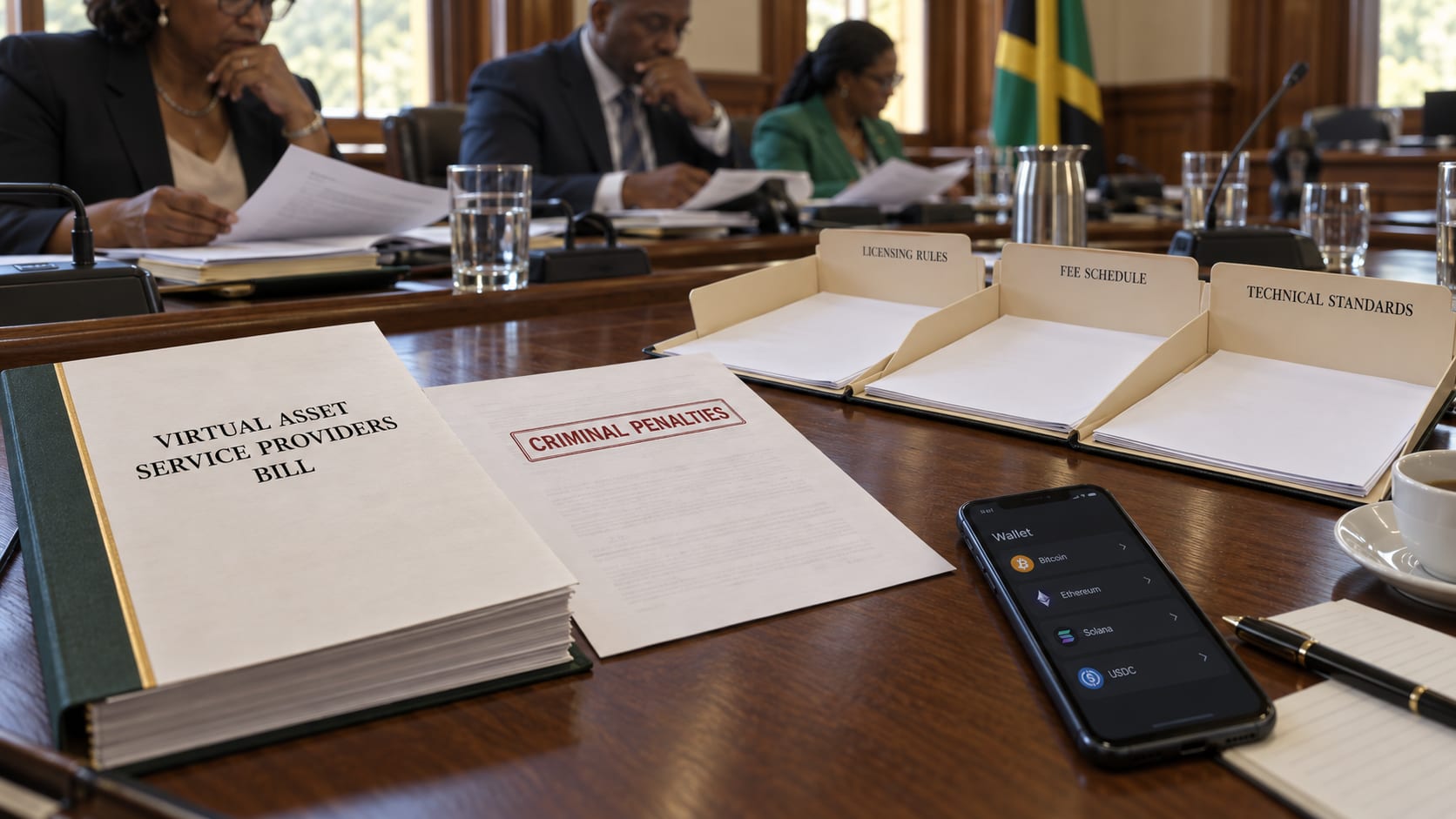
Criminal liability before the rules exist
Before addressing the Bill’s substance, the JBCA must place on public record a concern about the legislative process itself.
It has been reported, and not disputed, that the FSC has not yet finalised the rules that will sit beneath this Bill. The fee schedule has not been published. The technical compliance standards, what cold storage means in practice, what reserve audit methodology is required, and what Travel Rule infrastructure is acceptable, have not been written. The subsidiary instruments, including the AML/CFT Guidelines, Business Conduct Standards, and Licensing Requirements, remain incomplete. And yet the Bill makes operating without a licence a criminal offence.
The Minister has brought to the Parliament of Jamaica a Bill that would make it a criminal offence to fail to comply with a licensing regime whose compliance requirements have not been completed. Jamaican businesses and individuals, users and providers alike, could face criminal liability for failing to meet standards the regulator has not yet defined. Parliament is being asked to create criminal penalties without the full picture before it.
If the purpose of this Bill is genuinely to protect Jamaican consumers, there is no rational explanation for advancing criminal penalties before the rules those penalties are meant to enforce have been written. The only coherent explanation for this sequencing is speed, and the only coherent explanation for that speed, in the absence of any FATF deadline that would justify it, is that the urgency serves interests other than those of Jamaican consumers, developers, and entrepreneurs.
The JBCA formally calls on Parliament to defer final passage until the FSC publishes its complete Regulatory Impact Assessment, fee schedule, and the final text of all subsidiary instruments.

Asymmetric Burden: All of the obligations, none of the protections
The Bank of Jamaica does not recognise cryptocurrency as currency or money. The Bill nonetheless imposes on virtual asset businesses the full AML/CFT burden that governs commercial banks, the Proceeds of Crime Act, the Terrorism Prevention Act, and the UN Security Council Resolutions Implementation Act.
Banks bear these burdens as part of a regulatory bargain. In return they receive legal recognition, lender-of-last-resort access, deposit-insurance frameworks, and guaranteed access to the payments system. Under this Bill, virtual asset businesses bear all of the obligations and receive none of the protections: no statutory safe harbour, no assured banking access, no statutory right of appeal, no deposit insurance analogue, and criminal liability for rules that have not yet been written. That is not regulatory equivalence. It is asymmetric burden-sharing.

The human cost: Who this bill actually targets
This is not theoretical. A Jamaican developer who engaged the FSC directly, and built multiple platforms across crypto gaming, rewards, remittance, travel, real estate, and renewable energy finance, using token mechanics and off-ramp infrastructure that already carries KYC compliance at the point of fiat conversion, would find every one of those platforms captured by one or more of the six licence classes detailed below.
The AML compliance the Minister says this Bill exists to enforce is already happening, at the off-ramp, at the card issuer, at the voucher partner already embedded in the
Jamaican market through existing relationships with local telecoms providers. The Bill adds no AML protection that does not already exist at those touchpoints. What it adds is criminal exposure for the Jamaican developer who built locally, thought locally, and did the right thing by engaging the regulator.
The economic stakes of that criminal exposure extend far beyond the developer. Jamaica has a documented housing shortage of approximately 150,000 units. Capital is expensive. Pensioners who own property outright cannot access traditional mortgage products, cannot qualify for new loans, and cannot unlock the equity they hold without diluting their ownership or meeting bank criteria designed for a different generation.
Cryptocurrency and DeFi mechanics make it possible to offer zero per cent interest or low-interest loans secured against existing property as collateral, without equity dilution, funded by overseas DeFi liquidity where Jamaican assets are accepted, at terms no commercial bank in this country currently offers. AI-integrated construction platforms can reduce the cost of building in Jamaica by 30% to 50%.
Renewable energy financing through tokenised structures can increase solar and electric vehicle uptake at no additional cost to the consumer. Tokenised reward and markup structures allow consumers to earn between 10% and 44% on goods and services, outcomes that are only achievable through cryptocurrency, cryptoeconomics, and tokenomics, and that are structurally impossible within the traditional financial system as it currently operates in Jamaica.
None of the tokens powering these platforms are securities. None of these platforms are money laundering operations. All of them are already compliant at the point where fiat enters or exits the system. And every single one of them would be captured, classified, and potentially criminalised by this Bill as drafted, not because they are harmful, but because the Bill’s drafters did not understand, or did not consider, what is already being built here.
What the Minister has done is the legislative equivalent of a judge handing down a sentence without hearing evidence, without a jury, without counsel, and declaring it justice. The regulator has not finished writing the rules. The fee schedule does not exist.
The compliance standards are incomplete, and the criminal liability is already in the Bill.
That is not a first step toward protecting Jamaicans. That is a first step toward criminalising the very innovation that could solve problems Jamaica’s traditional financial system has failed to solve for generations.

The macroeconomic opportunity cost of regulatory prematurity
While the Minister and those who aided in drafting this Bill focused exclusively on virtual assets as a domestic compliance risk, they appear to have conducted no economic impact assessment of what Jamaica stands to gain from the same infrastructure they are rushing to criminalise.
That assessment was not produced by the FSC. It was not commissioned by the Ministry of Finance. It was identified and quantified by a single Jamaican developer, working without public resources, whose platforms would be captured and potentially criminalised by this Bill as drafted.
The global stablecoin market currently commands a liquid capitalisation exceeding US$300 billion. This is not speculative capital. It is a borderless, asset-backed liquidity pool actively seeking safe and yielding deployment. Enabling Jamaican developers to capture even one per cent of this pool would inject up to US$3 billion into the Jamaican economy.
Capturing half of one per cent would yield US$1.5 billion. To understand what those figures mean in context, consider Jamaica’s two largest foreign exchange earners: Tourism sector earnings stand at US$3.8 billion annually under normal conditions, though the sector is currently tracking at US$2.5 billion through August 2026 as it
recovers from the room-stock impacts of Hurricane Melissa, demonstrating the structural volatility of Jamaica’s dependence on this single pillar.
Remittance inflows stand at a historic high of US$3.5 to US$3.6 billion annually, yet arrive fragmented, carry significant transaction fees, and flow predominantly into consumption rather than productive national investment.
A one per cent capture of the global stablecoin market would place DeFi-sourced liquidity alongside both of these pillars simultaneously, as a third economic vector of equivalent scale, at zero cost to the Jamaican taxpayer and without drawing on the consolidated fund. A half per cent capture would exceed the current tourism recovery figure. These are not projections built on speculation. They are a function of market share arithmetic applied to a verified and publicly audited global liquidity pool.
Critically, these figures represent only the stablecoin liquidity capture opportunity. They exclude the separate and additional economic potential of real-world asset tokenisation across Jamaica’s housing, agricultural, commercial real estate, and renewable energy sectors, each of which could access DeFi financing at zero per cent or low single-digit interest rates, on terms no Jamaican commercial bank currently offers and that the traditional financial system has no structural incentive to provide. Jamaica has a documented housing shortage of approximately 150,000 units. At a true delivery cost of approximately US$90,000 per unit, inclusive of renewable energy infrastructure, the total programme value is US$13.5 billion. Phased over five years, that is US$2.7 billion per year in productive economic activity, financeable through DeFi liquidity pools where Jamaican real-world assets are accepted as collateral, without taxpayer exposure and without commercial bank intermediation.
The Minister has fast-tracked criminal legislation through Parliament before the FSC has completed its own rules, without an economic impact assessment, and without the input of the industry she is regulating. In doing so, she and those who assisted in drafting this Bill have collectively missed an economic opportunity that a single Jamaican developer, engaging this space with his own resources, identified and mapped to national GDP comparators. That is not a regulatory oversight. That is a failure of economic vision at the highest level of policy, and it is being locked into law before anyone in the drafting process has been required to account for it.
Rodger McKenzie is the Founder & President of the Jamaica Blockchain & Cryptocurrency Association, which was established in 2022. This document is an official position paper of the JBCA. It is submitted for public record and addressed to all members of the House of Parliament, the Financial Services Commission, the Bank of Jamaica, the Ministry of Finance and the Public Service, the Ministry of Economic Growth and Infrastructure Development, the Office of the Prime Minister, the Integrity Commission of Jamaica, and the Honourable Minister of Finance and the Public Service, Fayval Williams.






Comments