
Caribbean Biodiversity Fund continues to advance gender-smart environmental solutions

/ Our Today
administrator
The future of Caribbean climate resilience took a significant step forward on May 9, 2025, as representatives from eight National Conservation Trust Funds (NCTFs) gathered at the Royalton resort in Grenada for a pivotal workshop, as part of the Caribbean Biodiversity Fund’s Caribbean Organisations for a Resilient Environment (CORE) regional project.
The session brought together regional conservation leaders to advance gender-responsive approaches to ecosystem-based climate adaptation across the Caribbean.
The CBF convened the National Conservation Trust Funds to facilitate and advance gender mainstreaming knowledge and discussions among NCTFs to support the implementation of the Gender Smart Facility,” explained Nayari Diaz, CORE Project Lead and CBF Technical Officer, who facilitated the session.
The gathering marked a crucial milestone in the Caribbean Organisations for a Resilient Environment (CORE) project’s mission to mainstream inclusive gender-responsive approaches in climate action. With CAD 8 million in funding from Global Affairs Canada—acknowledged through an Address from Emma Dunkley-Elliott, First Secretary for Development at Canada’s High Commission to Jamaica—the workshop demonstrated the tangible progress being made in building regional capacity for climate resilience.
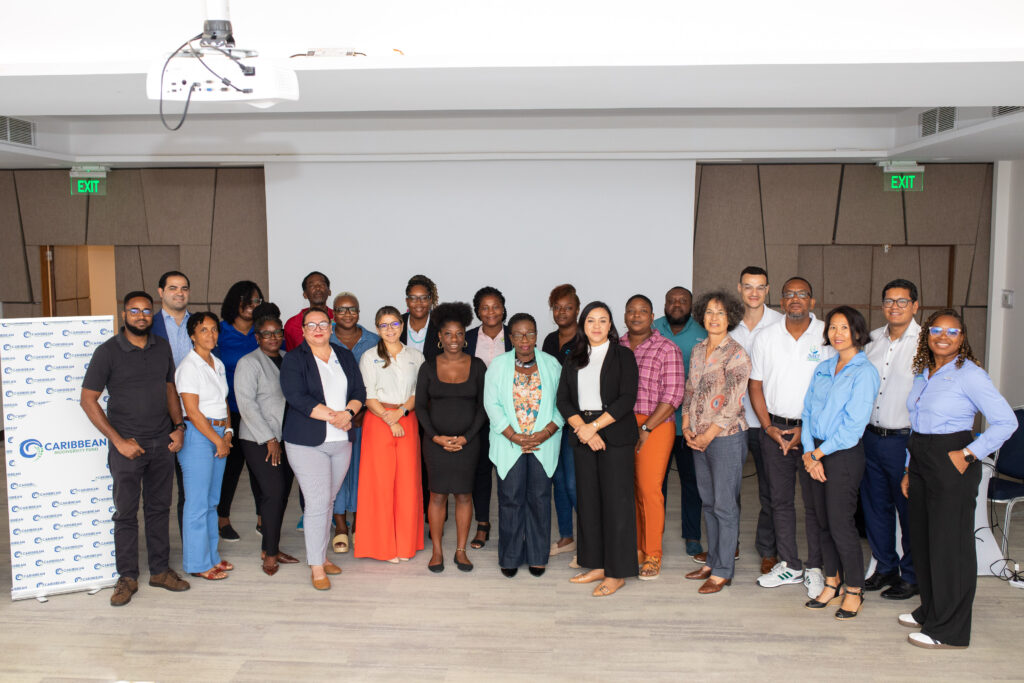
The CORE project, with its total funding of CAD 13.3 million (including $5.3 million in CBF co-financing), represents one of the most ambitious regional efforts to integrate gender-responsive approaches into environmental conservation. Participants from Belize, Dominica, Grenada, Guyana, Jamaica, St Lucia, St Vincent and the Grenadines, and Suriname engaged in intensive discussions on capacity building, technical assistance, and the implementation of the project’s innovative Gender Smart Facility.
A centrepiece of the workshop was the Gender Smart Facility (GSF) roundtable, facilitated by Cordia Chambers-Johnson, CBF’s Diversity, Equity, Inclusivity and Justice Officer. The interactive session explored four critical questions about implementing gender-responsive ecosystem-based adaptation approaches in coastal communities.
Participants shared inspiring examples of women-led conservation initiatives across the region, including sustainable farming with single mothers, women rangers in protected areas, women’s organisations practising hydroponics, river restoration led by women’s groups, and women spearheading mangrove restoration efforts. These success stories demonstrate the potential for scaling gender-responsive approaches across the Caribbean.
The GSF is already gaining traction. Three countries—Dominica, Saint Lucia, and Guyana—have begun implementing GSF activities, while work plans are being finalised for Belize, St. Vincent and the Grenadines, Grenada, Jamaica, and Suriname. The facility’s innovative approach allows up to 25 per cent of funding to be used for administrative support and capacity building, enabling NCTFs to strengthen their gender-responsive capabilities while supporting grassroots environmental and women’s rights organisations.
Participant feedback from the workshop was overwhelmingly positive, with attendees rating the session’s effectiveness, presentation quality, and delivery as excellent. Key takeaways included the importance of gender mainstreaming in environmental work, a better understanding of project implementation across NCTFs, and recognition of the CORE project’s value in advancing regional climate resilience.
The workshop’s success reflects broader momentum in the CORE project. As one participant noted, the session provided valuable insights into challenges, potential projects, and opportunities for collaboration and knowledge sharing between NCTFs.






Comments