Jamaica hikes, Trinidad holds: the rate gap regional investors now have to price

/ Our Today
administrator
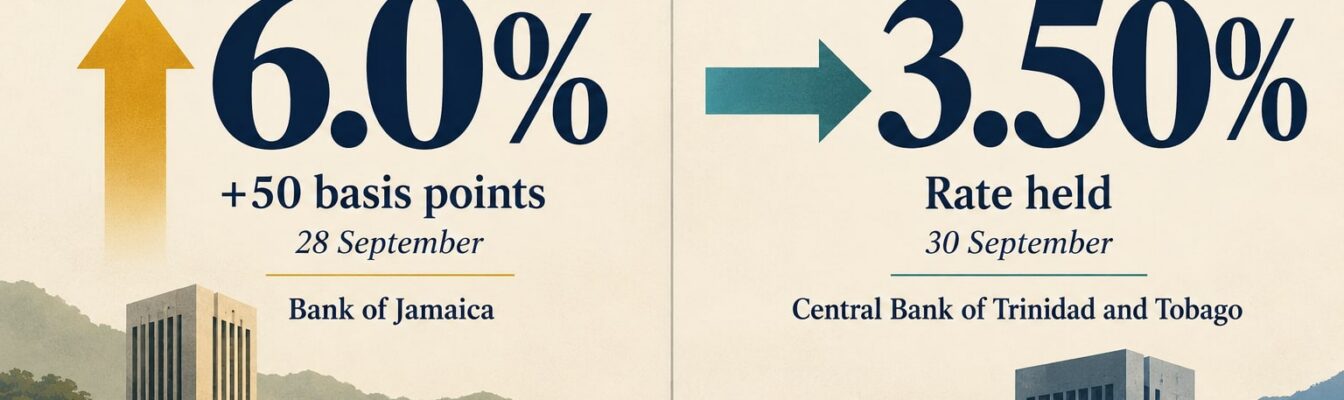
Two Caribbean central banks met within days of each other and went in opposite directions. On September 28, the Bank of Jamaica (BOJ) raised its policy rate by 50 basis points to 6.0 per cent, its first increase since November 2022. Two days later, the Central Bank of Trinidad and Tobago (CBTT) left its repo rate at 3.50 per cent.
That puts 250 basis points between the two policy rates. The nominal gap, though, tells only part of the story.
Inflation explains the split. Jamaica’s headline rate reached 7.9 per cent in August, a third straight month above the BOJ’s 4 to 6 per cent target, and the bank does not expect a return to that range until mid-2027. In Trinidad and Tobago, July headline inflation was 0.6 per cent, with core at 0.2 per cent.
Adjust for those figures and the picture flips. Jamaica’s policy rate sits roughly two points below inflation, while Trinidad’s sits nearly three points above it, based upon Our Today’s calculations. On that measure, Port of Spain is running the tighter policy, even while standing still.
For Jamaican pension funds and insurers, the hike should lift yields on new domestic fixed income. Whether those yields deliver positive real returns depends on inflation falling as projected. Economist Keenan Falconer has said further increases are possible if price pressures persist, so duration risk in Jamaican paper has not gone away.

Trinidad’s institutional investors face a different problem: plenty of local cash and few attractive places to put it. Excess liquidity in the banking system averaged $4,053.9 million in August. The three-month Treasury bill yield sits 91 basis points below the US equivalent, and Falconer noted the Fed has recently raised rates and signalled more. Every US move widens that gap unless CBTT follows.
The pull toward US dollar assets is clear. What limits it is access. Foreign exchange in Trinidad moves largely through central bank sales to authorised dealers, which totalled enough to indirectly drain $2,405.4 million from the system between June and August. Tight FX supply caps how much of the yield incentive turns into actual outflows.
Cross-listed securities sit in the middle of this. Several Jamaican financial groups trade on both the JSE and the TTSE. Higher Jamaican rates tend to weigh on equity valuations as fixed income becomes more competitive, though groups with large Jamaican loan books may see some margin benefit. Trinidad-based holders of those shares now carry more direct exposure to Jamaica’s tightening cycle than to their own central bank’s stance.
The next tests come quickly. The BOJ announces again on November 18, and the CBTT on December 23. A second Jamaican hike, or a Fed move that pushes the TT–US bill gap past 100 basis points, would sharpen these pressures before the year ends.




Comments