
Ladif | The truth sandwich distorter: When the wrapper becomes the message: The Hickey, the Range Rover and the Price of Love

/ Our Today
administrator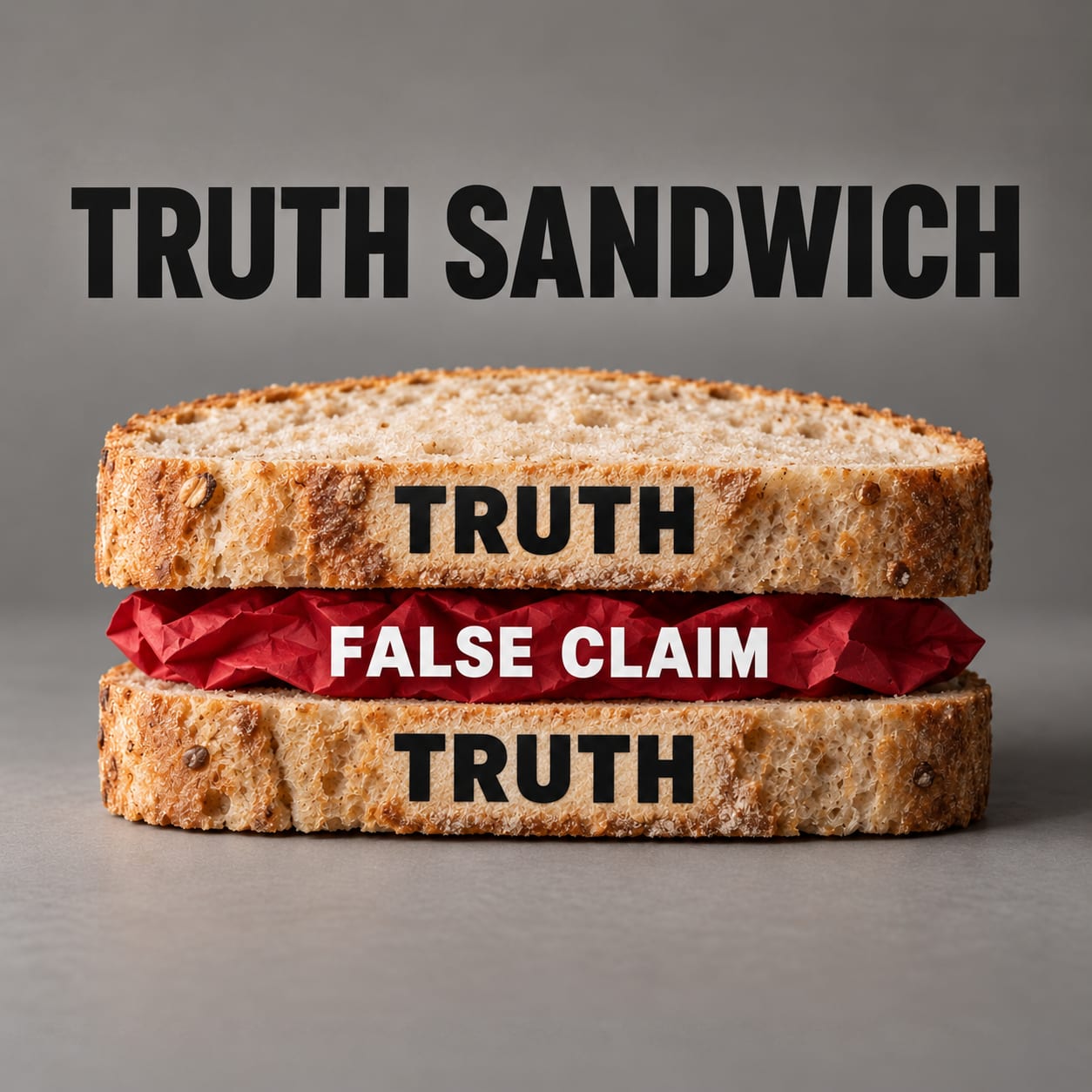
There is a rhetorical device that deserves greater attention in our increasingly influential podcast culture: the “truth sandwich.”
It is the practice of placing a questionable or false proposition between statements that are demonstrably true. The listener readily accepts the first statement, lowers their cognitive guard, and is then more likely to accept what follows simply because it arrived wrapped in something they already know to be true.
The most devastating lies are sometimes those wrapped in truth.
I was recently exposed to a segment of a popular Jamaican podcast that caused me to pause and consider this phenomenon precisely. I will leave it to readers to decide whether what followed was a truth sandwich or simply an opinion poorly constructed.
The discussion began with a proposition with which many of us could reasonably agree: it is inappropriate for a woman to arrive at work with a visible hickey on her neck.
The workplace is generally not interested in our after-hours exploits, and most of us would prefer not to be presented with the physical evidence of them while conducting business. There is a legitimate conversation to be had about professionalism, presentation and appropriate workplace conduct.
That part of the argument is sound.

But then came the filling.
The podcaster questioned why a woman should allow herself to be visibly marked by a man who had not provided her with significant financial benefits. The argument appeared to be that if the man was going to “mark his territory,” he ought to have the financial credentials to do so.
The hypothetical “broke” man was portrayed as a liability. His visible mark could potentially signal to another, wealthier man that the woman was already attached, causing the wealthier prospective partner to walk away.
The woman, therefore, was encouraged to consider the financial value of the man before allowing him to leave his mark.
And there, for me, is where the argument becomes troubling.
The issue is no longer whether a hickey belongs in the workplace. That plot is full.
The issue becomes whether a woman’s romantic choices should be measured against the financial balance sheet of the man she loves.
That is a much bigger question.

When did love require a financial statement?
A hickey does not necessarily mean a man is asserting ownership over a woman.
It could simply mean two people were caught up in a moment of intimacy. It could have been requested by the woman herself. It could be the product of affection, passion or, quite simply, poor judgment about where the evidence might eventually be visible.
None of those possibilities necessarily has anything to do with the man’s bank account.
Yes, perhaps the better advice is to exercise discretion. If you choose to engage in such intimacy, perhaps choose a location that will not become an advertising board for your private life when you arrive at work the next morning.
But should the acceptability of that intimate act depend on whether the man drives a luxury vehicle or takes public transportation?
Are we really suggesting that a man of means has a greater right to “mark his territory” than a man of modest means?
And if so, what exactly are we teaching?
The implication is unsettling: that a woman’s romantic choices should be filtered through the economic value of the man involved.

That the wealthy man is a better choice.
That the financially successful man has greater romantic currency.
That the man who has less should somehow be grateful merely to participate.
That is not a lesson about professionalism. It is a lesson about transactional relationships.
The 0.27% question
Consider, for argument’s sake, the numbers.
A rough back-of-the-envelope estimate suggests that from January through September 2026, approximately 1,850 Range Rovers and 900 Porsches were registered in Jamaica, or roughly 2,750 vehicles combined.
Of course, these vehicles are not all driven by men, and the numbers should not be interpreted as a precise measure of individual wealth. But for the sake of illustrating the argument, let us make the generous assumption that every one of these vehicles represents a man financially qualified to “mark his territory.”
Jamaica has approximately one million men aged 18 and over.
Simple arithmetic would put the proportion at roughly 0.27 per cent.
So what happens to the other 99.73 per cent?
Are they ineligible for love?
Are they merely ineligible to leave a hickey?
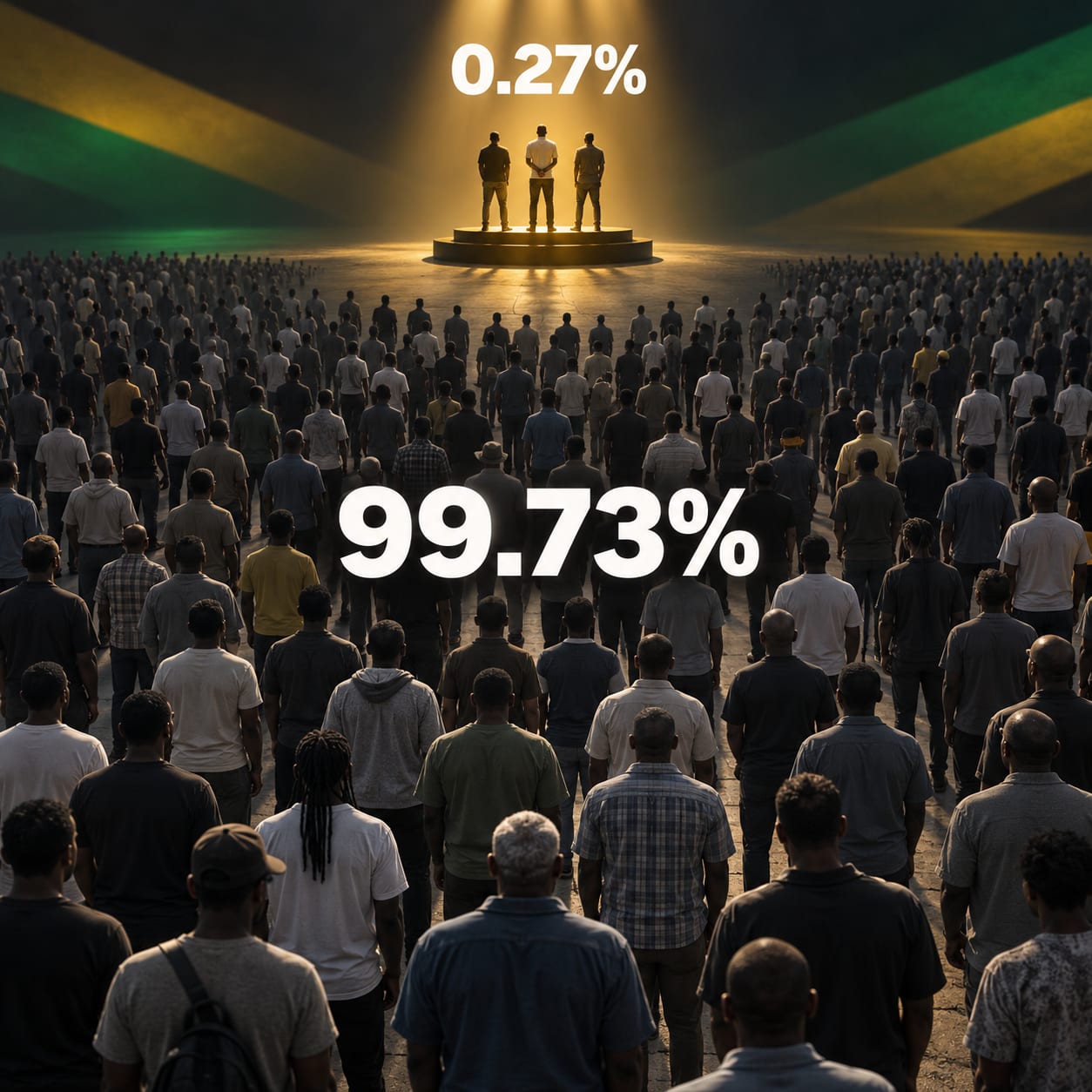
Or, more seriously, are we creating a culture in which young women are taught to evaluate romantic partners primarily by what they can provide rather than by who they are?
Money matters. Anyone who says otherwise is being deliberately naïve.
Financial stability matters in relationships. It affects housing, children, education, security and the ability to build a life together.
But there is a difference between recognising the importance of financial responsibility and teaching that a person’s romantic worth is determined by the size of his wallet.
The danger of the soapbox
The growing influence of podcasts and social media makes this conversation even more important.
The people who occupy these platforms have something increasingly valuable: attention.
And attention is influence.
When young people repeatedly hear certain ideas from people they trust, those ideas can become seeds. Those seeds eventually influence expectations, choices and behaviour.
Tell a young woman often enough that her value lies in the financial capacity of the man beside her, and eventually she may begin to measure relationships accordingly.
Teach her that love without financial gain is a poor bargain, and she may begin to dismiss a man with whom she could build a meaningful life simply because he has not yet accumulated wealth.
That does not mean young women should ignore financial responsibility. Far from it.
A woman should absolutely consider whether a potential partner is responsible, ambitious, disciplined and capable of contributing to a household.
But there is a vast difference between financial responsibility and financial entitlement.

One asks, “Can we build together?”
The other asks, “What do you have before I give you access to me?”
Those are fundamentally different philosophies of love.
Can two people still build together?
One of the casualties of our increasingly transactional society may be the idea of building together.
Is it really so outdated for two people to meet when neither has everything, fall in love, work hard and build a life together?
Is a man who is still taking the bus incapable of being a good partner?
Can a woman not love a man before he has acquired the house, the luxury vehicle and the bank balance?
Must the financial destination be reached before the journey can begin?
There is nothing wrong with wanting a financially successful partner. People have different priorities, and everyone is entitled to determine what they want from a relationship.
But when money becomes the primary measure of romantic worth, we should not be surprised when relationships begin to resemble financial transactions.

And transactions are not necessarily relationships.
The lesson we should actually teach
There is a perfectly legitimate lesson to be taught about visible hickeys.
Your private life does not belong in the workplace.
Think about how you present yourself professionally. Understand that your personal choices can have public consequences. Exercise discretion.
That is a worthwhile lesson.
But we should be careful about what we wrap around that lesson.
Because when a legitimate observation about workplace professionalism is used to introduce the idea that a woman’s romantic partner should be financially qualified to “mark his territory,” we have moved from etiquette into ideology.
And that ideology deserves examination.
The question is not whether women should want financially stable men. Of course they may.
The question is whether we want to raise a generation that believes love must first pass a financial test.
There is a danger when every human interaction is reduced to what someone can provide materially.
Money can buy comfort.
It can buy cars and houses.
It can buy experiences.
But it cannot manufacture loyalty, kindness, character, emotional availability, respect or genuine affection.
Those things still have to be earned.

Perhaps the greater lesson for our young people is not to choose between the “broke man” and the wealthy man.
Perhaps it is to choose a good man—and to determine whether the two of you have the character, ambition, compatibility and commitment to build something meaningful together.
Because true love, whatever else it may require, cannot be reduced to a financial statement.
It is measured in time, care, presence, respect and commitment.
And perhaps that is the truth we should be most careful not to distort.





Comments