
Oneil Madden | Jamaica’s teacher shortage is not a staffing problem; it is a retention crisis

/ Our Today
administrator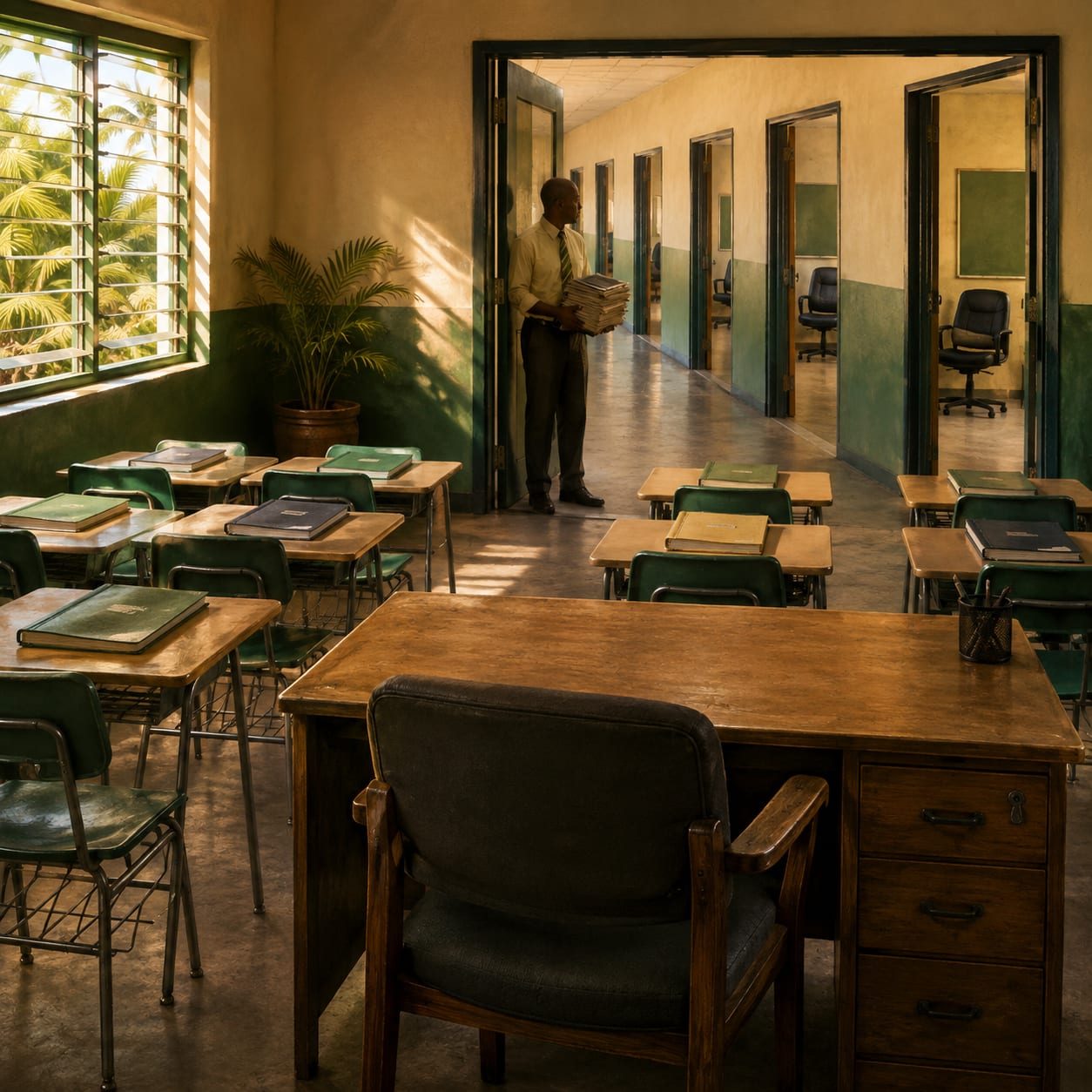
As Jamaica prepares to open another school year, we are, once again, confronted with the familiar spectacle of schools advertising teaching vacancies, principals scrambling to fill timetables, and education stakeholders expressing concern about whether every classroom will have a qualified teacher when the bell rings.
But this year, we should resist the temptation to treat the problem as a routine back-to-school inconvenience.
It is much more serious than that.
Recent reports suggest that the vacancies being advertised publicly represent only part of the problem. The president of the Jamaica Association of Principals of Secondary Schools, Anniona Jones, has described the advertised vacancies as “the tip of the iceberg”, noting that schools also recruit through social media, teachers’ groups, word of mouth and old applications. Some schools, she said, may still have several positions to fill as the academic year begins.
In the same vein, Lynton Weir, president of the Jamaica Association of Principals and Vice-Principals, warned that several schools may not have a full complement of teachers when the new school year begins.

This should concern every Jamaican – not merely teachers and parents. Because a teacher shortage eventually becomes a learning shortage.
We cannot keep treating teachers as infinitely replaceable. There is an important distinction between filling a vacancy and retaining an educator.
Jamaica can continue to recruit retired teachers, pre-trained graduates, final-year student teachers and temporary personnel. Indeed, the Ministry of Education has already identified several such measures as part of its recruitment strategy.
These measures may be necessary in an emergency. But they cannot become the permanent architecture of our education system.
If experienced teachers leave and we repeatedly fill their positions with temporary personnel, newly trained graduates or people awaiting full professional preparation, we may technically keep classrooms open. But we risk losing something much more difficult to replace: institutional knowledge, pedagogical expertise, mentorship, continuity and professional leadership.
The question therefore cannot simply be: How do we find enough teachers for September? It must be: Why are so many teachers looking for the exit in the first place?
The reasons are not mysterious. Principals have pointed to salary, working conditions, migration, opportunities elsewhere and the difficulty of recruiting teachers in certain subject areas and locations.

The Jamaica Teachers’ Association (JTA) has also been locked in difficult compensation discussions with the Government, rejecting an adjusted wage offer earlier this month.
But there is another dimension that deserves far more attention. We need to talk about what happens inside schools.
In a recent conversation with a classroom teacher, he made a point that has stayed with me. In his view, some academic leaders – including heads of departments – are part of the reason teachers become increasingly eager to leave the Jamaican classroom.
His observation should not be dismissed as merely an individual grievance. Nor should it be generalised to suggest that all school leaders are ineffective. Many principals, vice-principals and heads of department are working extraordinarily hard under difficult circumstances.
But if we are serious about retention, we must acknowledge that the quality of leadership and the quality of the workplace are inseparable.
A teacher may tolerate a difficult salary for a time if the workplace provides respect, professional autonomy, mentorship, recognition, collegiality and opportunities for growth. Conversely, even a reasonable salary can become insufficient when an educator feels micromanaged, undervalued, bullied, professionally stagnant or chronically exhausted.
We therefore need to stop imagining teacher retention as a problem that can be solved exclusively through salary negotiations.
People do not leave only jobs. They leave organisational cultures. That means the Ministry of Education and school boards need to take the quality of middle leadership seriously. Heads of department should not merely be excellent subject specialists; they must also be trained in people management, mentoring, conflict resolution, emotional intelligence, instructional leadership and staff development.
If we expect teachers to remain, we must make schools places in which professionals actually want to remain.
And then there is tertiary education. The problem does not stop at the school gate.
At the tertiary level, many lecturers are experiencing their own frustrations. Academic staff at both our major universities recently took industrial action amid unresolved compensation and promotion issues. At the University of Technology, Jamaica, academic staff have also raised concerns about a promotion ordinance that has reportedly remained suspended for several years.
These developments point to a wider problem: Jamaica is struggling to retain educators across the entire education pipeline.
And many lecturers are finding it increasingly difficult to make ends meet financially. When highly qualified academics with master’s and doctoral degrees, research responsibilities, teaching loads, administrative duties, and professional service responsibilities conclude that their compensation does not adequately reflect their expertise or cost of living, we should not be surprised when they begin considering alternatives.
The problem is particularly dangerous because tertiary educators are not simply teaching university students. They are training the teachers, nurses, engineers, pharmacists, lawyers, scientists and other professionals Jamaica needs.
If we underinvest in the people who educate those professionals, we ultimately weaken the entire labour market.
We need a national retention strategy – not another recruitment drive. Jamaica’s response must therefore move from vacancy management to workforce planning.
Here are several practical steps.
1. Establish a national education workforce observatory
Jamaica needs reliable, real-time data on how many teachers leave each year; where they go; why they leave; which subjects and regions experience the greatest shortages; how many vacancies remain unfilled; how long vacancies remain open; and how many educators move from permanent to temporary employment.
At present, even principals acknowledge that there is no sufficiently comprehensive national picture of actual vacancies because many positions are filled through informal channels.
We cannot manage what we cannot accurately measure.
2. Make retention – not recruitment – the primary performance indicator
Government should publish an annual Teacher Retention Report.
Rather than celebrating how many teachers were recruited, we should ask: How many stayed? Retention rates should be tracked by school, region, subject area, years of experience and career stage.
3. Pay strategically, not merely uniformly
Jamaica cannot ignore fiscal realities. Compensation already represents a very substantial portion of government expenditure.
But fiscal constraints do not mean that strategic compensation is impossible.
Additional incentives could target shortage subjects; rural and remote schools; high-risk communities; experienced teachers; specialist qualifications; teacher mentors; special education; science, technology, engineering, and mathematics (STEM), foreign languages; and difficult-to-fill leadership positions.
Interestingly, principals have pointed to the discontinuation of a special hazard allowance as one factor affecting recruitment in remote and high-risk locations.
A well-designed incentive system could therefore be more sustainable than simply attempting to increase every salary by the same percentage.
4. Fix the workplace, not just the payslip
Teachers need functioning classrooms, adequate resources, manageable workloads, administrative support and meaningful professional development.
They also need respect. The Ministry of Education should conduct regular, confidential teacher workplace-climate surveys. Teachers should be able to report concerns about workload, leadership, bullying, professional autonomy and organisational culture without fear of retaliation.
If the same complaints repeatedly emerge from particular institutions, those institutions should receive targeted leadership intervention.
5. Professionalise middle leadership
This deserves urgent attention.
Every head of department should receive structured preparation in instructional leadership and people leadership. Promotion should not automatically transform an excellent teacher into a competent manager.
We need to ask whether our leadership-development systems adequately prepare academic leaders to manage adults, resolve conflicts, mentor colleagues and create healthy professional cultures.
A teacher who loves teaching should not have to leave the classroom simply to escape poor leadership.
6. Create a genuine career pathway that does not force teachers out of teaching
One reason experienced educators leave may be that professional advancement is too closely associated with administrative promotion.
Jamaica should develop advanced classroom career pathways, allowing master teachers, instructional coaches, curriculum specialists, and teacher researchers to earn significantly more without necessarily becoming administrators.
The best teacher in a school should not have to become a vice-principal to be rewarded for excellence.
7. Address tertiary education as part of the same crisis
Government, universities, and unions need a sustainable framework for academic compensation and promotion.
The recent industrial action at our universities should be understood not merely as an industrial-relations dispute but as a warning about the sustainability of Jamaica’s knowledge infrastructure.
Universities need predictable compensation reviews, functioning promotion systems and career pathways that recognise teaching, research, innovation and public engagement.
8. Build a Jamaican diaspora return-and-retain programme
Jamaica has spent considerable resources training educators who subsequently become attractive recruits for other countries.
Rather than simply lamenting migration, we should develop mechanisms that make returning attractive.
These could include relocation grants; housing assistance; research grants; tax incentives; leadership opportunities; accelerated recognition of overseas experience; and flexible contracts for experienced diaspora educators.
We cannot prevent every teacher from leaving. But we can make Jamaica a more compelling place to return.
The cost of doing nothing will be much higher. There is a tendency to view education spending as an expense. It is not. Education is productive infrastructure.
A shortage of teachers affects class sizes, subject offerings, student-teacher relationships, examination preparation, and the quality of learning. It also places additional pressure on the teachers who remain, potentially accelerating the very burnout and dissatisfaction that contribute to further departures.
The consequences compound. One experienced teacher leaves. Another teacher absorbs additional classes. Workload increases. Morale falls. The second teacher begins looking overseas. Another vacancy appears. And the cycle continues.
This is why the current situation should be treated as a national workforce crisis, not a September administrative inconvenience.
Jamaica must decide what it values. There is an uncomfortable truth at the centre of this debate. We frequently say that children are our future. But children do not educate themselves.
Their future depends on the adults who stand in classrooms every day – and on the lecturers who prepare those adults for the profession.
If Jamaica wants better literacy, numeracy, science, technology, foreign-language competence and critical thinking, it must first create the conditions in which talented professionals want to teach.
The recent warnings from principals should therefore be a wake-up call. The shortage is real, the vacancies are deeper than the advertisements suggest, and migration is only one part of the story.
But the most important question is not how many teachers Jamaica can recruit for September. It is how many excellent teachers Jamaica can persuade to still be here five, ten or twenty years from now.
That is the measure that should matter.
And if we fail to answer that question, we may eventually discover that the greatest shortage in Jamaican education is not teachers. It is the willingness of talented people to remain in the profession.
Oneil Madden is a Lecturer of Academic Literacy & French
- Language Teaching & Research Centre (LTRC)
- School of Humanities & Social Sciences (SHSS)
- Faculty of Education and Liberal Studies (FELS)
- PhD Candidate in Didactics & Linguistics (French/English)
- Clermont Auvergne University, France
Oneil Madden can be contacted at: [email protected]





Comments