
Dashawn Carter | The rehabilitation of Jamaican schools: Radical optimism or forced resilience?

/ Our Today
administrator
Whilst many Jamaicans are expressing deep concerns about the seemingly slow pace of recovery in our schools and the conditions in which the teaching and learning exchange is happening in Western Jamaica, there seems to be an alternate reality for the government. On one hand, they’ve seemingly graded themselves with high marks for some aspects of the recovery process, with the Prime Minister himself declaring a “successful opening of the school year” and, on the other hand, lamenting the slow pace of the processes to rebuild and reconstruct educational institutions.
Speaking at the launch of the Jamaica Reconstruction and Resilience Oversight Committee at Jamaica House, Prime Minister Dr. Andrew Holness recently reiterated his disappointment with the pace of recovery following last year’s hurricane. He echoed the concerns of many Jamaican parents, teachers and school administrators who, as a result of the delays in renovation and reconstruction, look to the new school year with a deep sense of fear and apprehension about the ever-lingering impact of Hurricane Melissa on their students’ educational outcomes.
Notably, his comments came only days after Education Minister Dr Dana Morris Dixon assured the public that all schools across the Ministry’s Region Four (including Hanover, St James and Westmoreland) would reopen for the start of the new school year. While the Minister acknowledged that not all repairs would be completed, she nonetheless reassured the public that contingency plans had been put in place. The question now stands: what exactly should qualify as adequate and acceptable contingencies for our children?

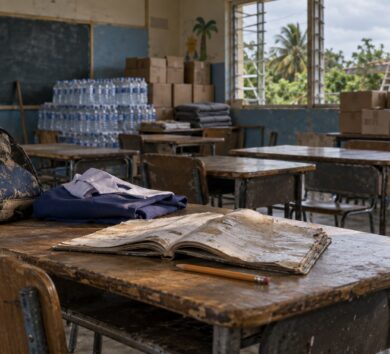
More importantly than the contrasting rhetoric is that, despite these “contingencies”, several schools that had been most severely affected by Hurricane Melissa are still faced with the challenge of having to usher in the new school year with fewer classrooms and learning spaces, incomplete reconstructions, disruption of classes due to unfavourable conditions and an overall lack of resources. At Holland Primary School, for example, teachers and students were forced to abandon a tent classroom because of the unbearable heat and poor ventilation, with some classes eventually being held beneath trees and in an outdoor bamboo structure. At the same time, Burnt Savannah Primary was only able to accommodate grade six students on the first day of school, with the broader cohort forced into online learning. Similarly, the first two days of classes at WestWood High School will be held virtually as the school awaits the completion of repairs that began last year in November.
Whilst these reports from principals and school administrations recounting their resourcefulness despite the restoration delays and finding the silver lining behind all the uncertainty may seem hopeful at first glance, it highlights a much more concerning issue as to whether we are romanticising and misunderstanding resilience. Resilience shouldn’t be conflated with the endurance of unfavourable conditions. It also does not look like employing short-term, unsustainable contingencies due to lack of support and resources. No child should have to sit outside, completely exposed to the elements with little to no protection save for the shade of a few trees, simply because of a lack of foresight and our inability to adequately mobilise the resources needed to rebuild our schools promptly. Most importantly, we should not have to rely on teachers finding creative ways to compensate for inadequate facilities while ignoring the failures that made those “solutions” necessary in the first place.

True resilience involves building back stronger, robust institutions that offer greater protections against climate threats and the many challenges that our schools face. If we are serious about building back better, then we cannot accept prolonged temporary solutions as substitutes for proper classrooms.
This situation also raises questions as to where the responsibility and onus for overseeing the reconstruction process, ensuring that these educational institutions would be ready for the new school year, lies. If schools were expected to be ready and reopened for the new school year, as was assured by the Minister of Education, who was responsible for ensuring that this happened? What criteria did we use to determine whether an institution was adequately prepared to welcome students for a new academic year? Where is the accountability? Was this simply an oversight on the part of the ministry, or does it reflect greater concerns around the apparent lack of due diligence, the absence of robust monitoring and accountability frameworks, as well as an inefficient level of investment into this reconstruction venture?
These questions are particularly important given the significant public resources being invested in post-hurricane recovery and the known implications of classroom disruption and displacement. The bottom line is that, for many students in the west, this back-to-school period is anything but a fresh start or a return to normalcy. It is a painful reminder of the disastrous impact of the hurricane and how much work remains to be done to restore the spaces in which our children learn.
The Jamaica Youth Advocacy Network (JYAN) therefore calls for greater oversight and accountability in the reconstruction of affected schools. We also call for increased urgency in completing outstanding construction projects, as schools should not be rendered incapacitated due to the lethargy and slow pace of contractors. In this way, we can ensure that schools are adequately prepared to facilitate the full return of students to in-person classes before the end of this semester. This is particularly important given the volatile weather we’re now experiencing, which will undoubtedly be exacerbated by the incoming El Niño and our ongoing hurricane season. If we don’t find a sustainable and comprehensive solution now, we fear that another storm may expose the same weakness. Beyond reconstruction, we would also like to see more feasible and sustainable solutions for schools whose educational spaces are still under construction, along with investment of hurricane recovery funds in the reconstruction of educational institutions in an effort to expedite the rebuilding process.
Ultimately, we want more than promises, radical optimism or unsustainable short-term solutions masked as “contingency plans”. Our children and schools deserve concrete, actionable and feasible remedies that truly embody the principles of recovery and sustainable resilience.
Dashawn Carter is a youth advocate and a project officer at the Jamaica Youth Advocacy Network (JYAN)




Comments