
Taneisha Ingleton | The Apprenticeship Imperative: Why the Caribbean can no longer afford to learn without doing

/ Our Today
administrator
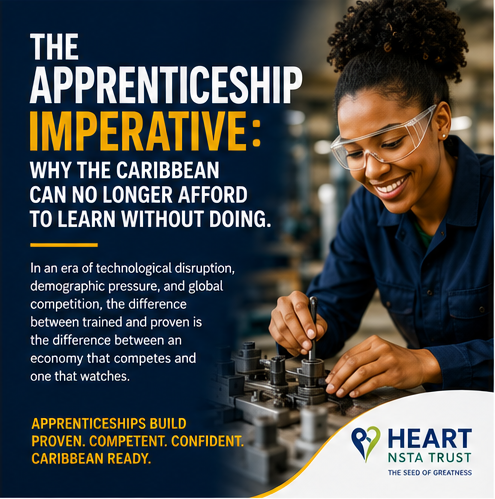
When a young person completes a quality apprenticeship, something happens that no examination result can replicate. They do not merely know how to do the work. They have done it, under real conditions, with real consequences, alongside practitioners who have spent careers mastering their craft. That experience produces a category of competence that is qualitatively different from anything a classroom can confer. It produces workers who are not just trained but proven. And in an era defined by technological disruption, demographic pressure, and intensifying global competition, the difference between trained and proven is the difference between an economy that competes and one that watches.
Across the Caribbean, that recognition is deepening, and the momentum to act on it is building.
The science of learning by doing
The foundational case for apprenticeship is not ideological. It is empirical.
Research reviewed by the Inter-American Development Bank suggests that differences in productive capability are shaped not only by formal educational attainment but also by the know-how and tacit skills acquired through workplace experience and learning by doing. This insight is reflected in Apprenticeships for the XXI Century: A Model for Latin America and the Caribbean (Fazio, Fernández-Coto & Ripani, Inter-American Development Bank, Labour Markets Division, 2016), a landmark study that examined apprenticeship systems across the region and assessed international best practices from Germany, Austria, Australia, and the United Kingdom. It is not a peripheral observation. It is a structural insight with profound implications for how governments, institutions, and enterprises invest in human capital.
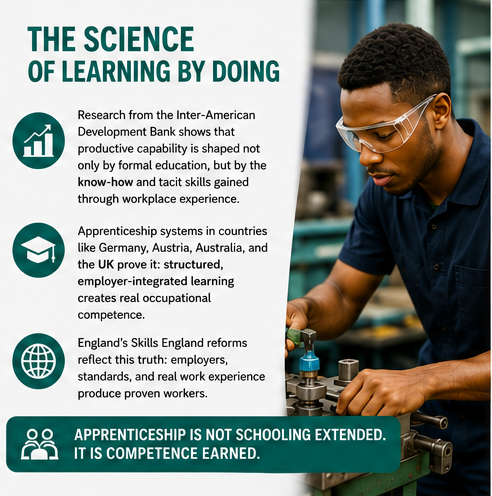
England’s recent apprenticeship reforms under Skills England, establishing employer-led occupational standards, streamlining assessment, and expanding into priority sectors including advanced manufacturing, construction, and digital technologies, reflect precisely this recognition: that sophisticated economies understand workforce development not as schooling extended into adulthood, but as structured, employer-integrated experience that produces genuine occupational competence.
What employers actually gain
Employers who invest in apprenticeship programmes are not making a philanthropic contribution to workforce development. They are making a calculated investment in the productive capacity of their own enterprises.
Evidence reviewed by the Inter-American Development Bank points to consistently strong employer outcomes among firms participating in structured apprenticeship programmes: over 80 per cent of participating employers reported satisfaction with their investment, and over 60 per cent noted measurable improvements in enterprise productivity as a direct result. These findings reinforce the proposition that apprenticeship is not merely a social intervention; it is a strategic investment in human capital.
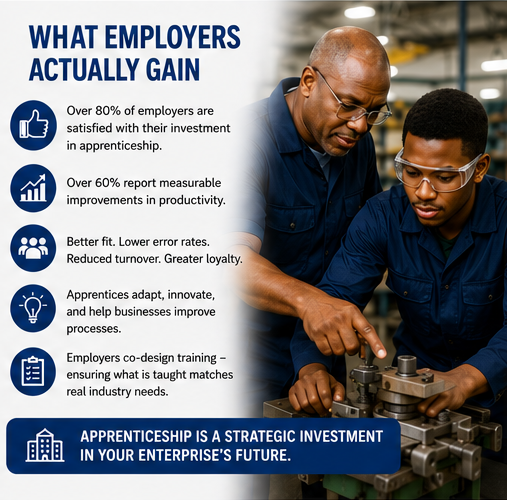
The mechanisms are well documented. Apprentices are trained within the enterprise, to its standards, culture, and operational requirements, producing a worker whose competence is contextually precise and attuned to the specific systems and expectations of the business that trained them. This precision of fit reduces onboarding time, lowers error rates, and builds loyalty that reduces costly staff turnover.
ILO analyses have consistently highlighted that apprenticeship systems support enterprise innovation by cultivating workers who adapt more readily to technological change and contribute to process improvement. The apprentice of today is the enterprise innovator of the next decade. Beyond this, quality apprenticeship frameworks give employers a structural voice in shaping what is taught and how, ensuring that training investment is aligned with real industry requirements. When employers co-design the curriculum, alignment deepens. When alignment deepens, training investment produces returns.
What trainees actually gain
An apprenticeship offers something that classroom-based training alone structurally cannot: the experience of consequential work. Not simulated work. Not assessed tasks designed to approximate workplace conditions. Real work, with real stakes, within real organizations, under the guidance of practitioners whose professional reputations depend on the quality of what they produce.
This matters not only for skill formation but for the development of non-cognitive competencies, professional conduct under pressure, problem-solving in ambiguous conditions, collaborative discipline, and the quiet but durable confidence that comes from having been trusted with meaningful responsibility and having risen to meet it.
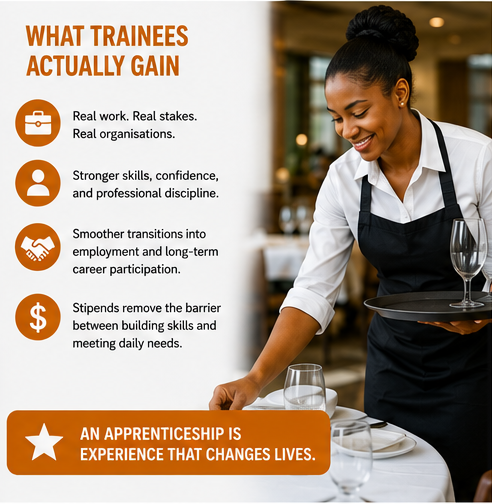
International evidence consistently demonstrates strong employment outcomes associated with quality apprenticeship systems. The ILO’s Guide for Policymakers on Quality Apprenticeships (2024) highlights the capacity of apprenticeships to support smoother transitions into employment and sustained labour market participation. The World Bank, in its June 2025 commentary Closing the Skills Gap to Create More Jobs in the Caribbean, similarly affirms that the disconnect between qualifications and workplace-ready competence remains a central economic challenge, one that structured work-based learning is uniquely positioned to address.
For young people from communities with constrained economic access, stipend-supported apprenticeship models remove a critical barrier: the need to choose between building skills and meeting immediate economic needs. When that barrier is removed, participation expands, talent pipelines deepen, and economies grow from a broader, stronger base.
The global standard and Jamaica’s response
In June 2023, the 111th Session of the International Labour Conference adopted the Quality Apprenticeships Recommendation (No. 208), the most significant international labour standard on apprenticeships in a generation. The ILO’s subsequent Guide for Policymakers on Quality Apprenticeships (December 2024) provides practical implementation guidance for member states. The Recommendation’s core principle is unambiguous: quality apprenticeships are a shared responsibility, requiring genuine collaboration between governments, training institutions, and employers.
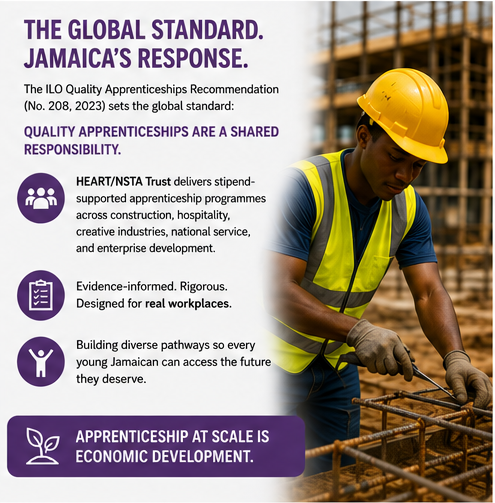
Jamaica’s response through HEART/NSTA Trust reflects both the letter and the spirit of that principle.
HEART currently delivers a range of apprenticeship and stipend-supported programmes spanning construction, hospitality, the creative industries, national service, and enterprise development. Together, these initiatives provide structured, work-based learning opportunities for young Jamaicans, supported by stipends that help ensure economic circumstances are not a barrier to participation.
This breadth of provision is deliberate. Jamaica’s labour market is not monolithic; it spans trades, services, the arts, agriculture, and emerging industries. An apprenticeship system worthy of that market must be equally diverse. By building programmes that reach across sectors, HEART is ensuring that the benefits of work-based learning are available to young Jamaicans wherever their talent and ambition lead them.
These are not programmes launched in hope. They are evidence-informed expansions of a proven model, designed with rigour and delivered with the understanding that apprenticeship at scale is not merely a training strategy. It is an economic development strategy.
The expanding mandate
The weight of international evidence is clear. The policy frameworks are in place. The institutional architecture across the Caribbean is being strengthened with growing ambition and investment.

For too long, apprenticeship has carried an undeserved perception gap, seen by some as a secondary route rather than a pathway of rigour and reward. Advanced economies are decisively closing that gap. Degree apprenticeships in the United Kingdom now allow young people to earn bachelor’s and master’s qualifications entirely through employer-integrated learning, affirming what practitioners have always known: apprenticeship is not the alternative to excellence. For an increasing number of the world’s most competitive economies, it is the vehicle for it.
The Caribbean is well positioned to lead this same elevation in our regional context. The World Bank’s January 2024 approval of the OECS Skills and Innovation Project, a US$36 million investment targeting over 40,000 youth across Grenada, Saint Lucia, and the OECS Commission, reflects growing multilateral confidence in the region’s capacity to build skills systems that are responsive, equitable, and internationally competitive.
A closing reflection
The most transformative moment in workforce development does not happen at a policy conference. It does not appear in a strategic plan. It happens when a young person who entered an apprenticeship uncertain of their own capability completes their programme and realises, with quiet and irreversible certainty, that they can do the work. Because they have done it.
That moment is what quality apprenticeship systems exist to produce. The Caribbean has the institutions. It has the frameworks. It has the young people. And it has, in the ILO’s Quality Apprenticeships Recommendation No. 208 (2023) and the accompanying Guide for Policymakers (2024), some of the most robust international guidance available to any policymaker or practitioner working in this space.
What is required now is the collective ambition to match the scale of that opportunity, and the discipline to build systems that keep the promise apprenticeship makes to every young person who enters one.
Dr. Taneisha Ingleton, PhD, LLB (Hons.), MPhil, is Managing Director of HEART/NSTA Trust and CEO of WorldSkills Jamaica. Her work has focused on educational policy, workforce systems transformation, and public sector competency development across the Caribbean. She designed Jamaica’s Whole of Government Competency Framework and Professional Pathways for the Public Service, has lectured at doctoral level in Jamaica and Canada, and is a published author on transformational leadership and organizational development. As CEO of WorldSkills Jamaica, she connects Jamaica’s workforce development agenda to a global community of practice spanning more than 85 countries.
Connect with Dr. Ingleton on LinkedIn or follow HEART/NSTA Trust for updates on Jamaica’s workforce development agenda.






Comments